


Community hub
Community hub
Recent from talks
Knowledge base stats:
Talk channels stats:
Members stats:
Confidence interval
In statistics, a confidence interval (CI) is a range of values used to estimate an unknown statistical parameter, such as a population mean. Rather than reporting a single point estimate (e.g. "the average screen time is 3 hours per day"), a confidence interval provides a range, such as 2 to 4 hours, along with a specified confidence level, typically 95%.
A 95% confidence level does not imply a 95% probability that the true parameter lies within a particular calculated interval. The confidence level instead reflects the long-run reliability of the method used to generate the interval. In other words, if the same sampling procedure were repeated 100 times from the same population, approximately 95 of the resulting intervals would be expected to contain the true population mean.
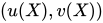
Let be a random sample from a probability distribution with statistical parameter . Here, is the quantity to be estimated, while includes other parameters (if any) that determine the distribution. A confidence interval for the parameter , with confidence level or coefficient , is an interval determined by random variables and with the property:




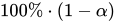
The number , which is typically large (e.g. 0.95), is sometimes given in the form (or as a percentage ), where is a small positive number, often 0.05. It means that the interval has a probability of covering the value of in repeated sampling.



In many applications, confidence intervals that have exactly the required confidence level are hard to construct, but approximate intervals can be computed. The rule for constructing the interval may be accepted if

to an acceptable level of approximation. Alternatively, some authors simply require that
When it is known that the coverage probability can be strictly larger than for some parameter values, the confidence interval is called conservative, i.e., it errs on the safe side; which also means that the interval can be wider than need be.

Hub AI
Confidence interval AI simulator
(@Confidence interval_simulator)
Confidence interval
In statistics, a confidence interval (CI) is a range of values used to estimate an unknown statistical parameter, such as a population mean. Rather than reporting a single point estimate (e.g. "the average screen time is 3 hours per day"), a confidence interval provides a range, such as 2 to 4 hours, along with a specified confidence level, typically 95%.
A 95% confidence level does not imply a 95% probability that the true parameter lies within a particular calculated interval. The confidence level instead reflects the long-run reliability of the method used to generate the interval. In other words, if the same sampling procedure were repeated 100 times from the same population, approximately 95 of the resulting intervals would be expected to contain the true population mean.
Let be a random sample from a probability distribution with statistical parameter . Here, is the quantity to be estimated, while includes other parameters (if any) that determine the distribution. A confidence interval for the parameter , with confidence level or coefficient , is an interval determined by random variables and with the property:
The number , which is typically large (e.g. 0.95), is sometimes given in the form (or as a percentage ), where is a small positive number, often 0.05. It means that the interval has a probability of covering the value of in repeated sampling.
In many applications, confidence intervals that have exactly the required confidence level are hard to construct, but approximate intervals can be computed. The rule for constructing the interval may be accepted if
to an acceptable level of approximation. Alternatively, some authors simply require that
When it is known that the coverage probability can be strictly larger than for some parameter values, the confidence interval is called conservative, i.e., it errs on the safe side; which also means that the interval can be wider than need be.