
Recent from talks
Conium
Knowledge base stats:
Talk channels stats:
Members stats:
Conium
Conium (/koʊˈnaɪ.əm/ or /ˈkoʊniəm/) is a genus of flowering plants in the family Apiaceae. As of December 2020[update], Plants of the World Online accepts six species.
All species of the genus are poisonous to humans. C. maculatum, also known as hemlock, is infamous for being highly poisonous. Hemlock is native to temperate regions of Europe, North Africa and Western Asia. The species C. chaerophylloides, C. fontanum, and C. sphaerocarpum are all native to southern Africa.
Plants of the genus Conium are eudicots, flowering plants distinguished by their two cotyledons (embryonic leaves) and tricolpate (three-pored) pollen. They are typically biennial, forming basal rosettes in the first year of growth, and sprouting a rigid, hollow flower stalk in the second. Germination occurs between spring and autumn. Occasionally, plants which germinate in early spring are annual instead of biennial. These plants grow best in wet, poorly drained areas with nutrient rich soil. They grow well in nitrogen rich soil, and are able to tolerate high levels of heavy metals, such as arsenic, cadmium, and lead. Conium plants are diploid, with a chromosome number of 2n = 22 (haploid number 11). They grow from one to three meters tall, varying between species. They produce hermaphroditic flowers, which are typically insect pollinated or self-fertilized.
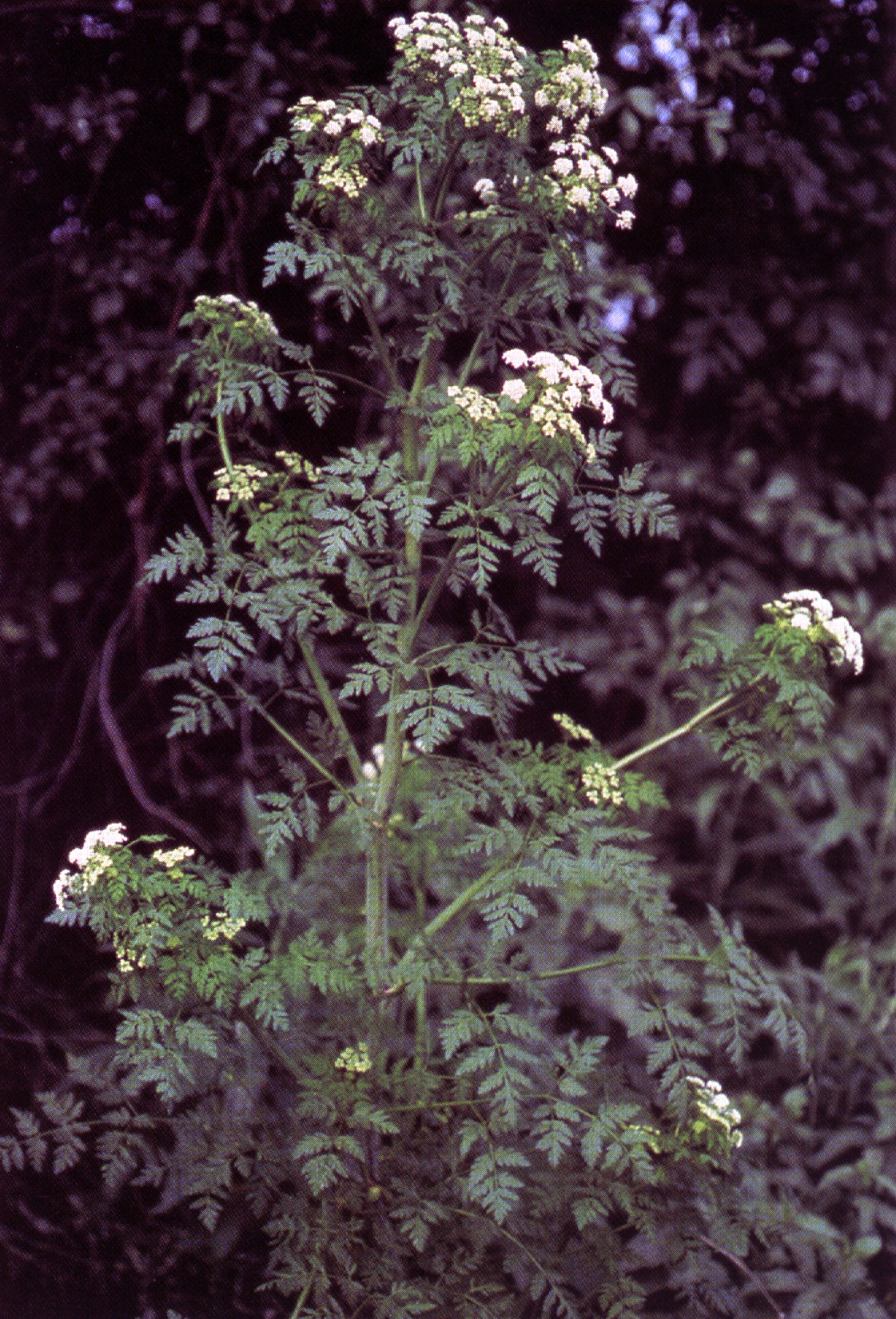
Conium plants are herbaceous, growing non-woody, hollow, and hairless stems. Generally, the stem is striated and light green; however, the coloring varies by species and variety. Some express purple blotching throughout, some have purple blotching localized near the base, and others have no markings at all.
The alternate leaves are pinnately compound and finely divided, with the exact pinnation patterns varying between species and leaf type. For example, stem leaves of C. maculatum plants are typically 2-4 pinnate, but basal leaves are 1-3 pinnate. The leaves and petioles are light green. Similar to the stem coloring, some species and varieties express purple blotching on the leaves and petioles.
Terminal inflorescences are made up of many small flowers, colored white, yellow, or green depending on the species. The flowers are grouped together in umbrella shaped umbels. Plants in the genus Conium have compound umbels, with multiple dome shaped clusters branching out from a central point. Flowers are around 2 mm across, and the umbrella shaped umbels range from 1–8 cm in diameter.
The two seeded fruit is one of the most significant distinguishing factors between species. They are relatively round, slightly flattened, and dark green or brown. Depending on the species, they range from 2.5 to 4 mm long. Some species have distinctive light brown ribs, some have ribs that are noticeably crenulate (scalloped edges), and others show relatively unpronounced rib patterns.
Each plant typically produces between 1,700 and 39,000 seeds, and 40-85% will germinate in suitable conditions. However, seeds will remain viable for 3 to 6 years after dispersal. Producing a large number of seeds, and growing in a variety of locations, these plants can be considered invasive in some cases.
Hub AI
Conium AI simulator
(@Conium_simulator)
Conium
Conium (/koʊˈnaɪ.əm/ or /ˈkoʊniəm/) is a genus of flowering plants in the family Apiaceae. As of December 2020[update], Plants of the World Online accepts six species.
All species of the genus are poisonous to humans. C. maculatum, also known as hemlock, is infamous for being highly poisonous. Hemlock is native to temperate regions of Europe, North Africa and Western Asia. The species C. chaerophylloides, C. fontanum, and C. sphaerocarpum are all native to southern Africa.
Plants of the genus Conium are eudicots, flowering plants distinguished by their two cotyledons (embryonic leaves) and tricolpate (three-pored) pollen. They are typically biennial, forming basal rosettes in the first year of growth, and sprouting a rigid, hollow flower stalk in the second. Germination occurs between spring and autumn. Occasionally, plants which germinate in early spring are annual instead of biennial. These plants grow best in wet, poorly drained areas with nutrient rich soil. They grow well in nitrogen rich soil, and are able to tolerate high levels of heavy metals, such as arsenic, cadmium, and lead. Conium plants are diploid, with a chromosome number of 2n = 22 (haploid number 11). They grow from one to three meters tall, varying between species. They produce hermaphroditic flowers, which are typically insect pollinated or self-fertilized.
Conium plants are herbaceous, growing non-woody, hollow, and hairless stems. Generally, the stem is striated and light green; however, the coloring varies by species and variety. Some express purple blotching throughout, some have purple blotching localized near the base, and others have no markings at all.
The alternate leaves are pinnately compound and finely divided, with the exact pinnation patterns varying between species and leaf type. For example, stem leaves of C. maculatum plants are typically 2-4 pinnate, but basal leaves are 1-3 pinnate. The leaves and petioles are light green. Similar to the stem coloring, some species and varieties express purple blotching on the leaves and petioles.
Terminal inflorescences are made up of many small flowers, colored white, yellow, or green depending on the species. The flowers are grouped together in umbrella shaped umbels. Plants in the genus Conium have compound umbels, with multiple dome shaped clusters branching out from a central point. Flowers are around 2 mm across, and the umbrella shaped umbels range from 1–8 cm in diameter.
The two seeded fruit is one of the most significant distinguishing factors between species. They are relatively round, slightly flattened, and dark green or brown. Depending on the species, they range from 2.5 to 4 mm long. Some species have distinctive light brown ribs, some have ribs that are noticeably crenulate (scalloped edges), and others show relatively unpronounced rib patterns.
Each plant typically produces between 1,700 and 39,000 seeds, and 40-85% will germinate in suitable conditions. However, seeds will remain viable for 3 to 6 years after dispersal. Producing a large number of seeds, and growing in a variety of locations, these plants can be considered invasive in some cases.
Recent media