
Recent from talks
Astrological aspect
Knowledge base stats:
Talk channels stats:
Members stats:
Astrological aspect
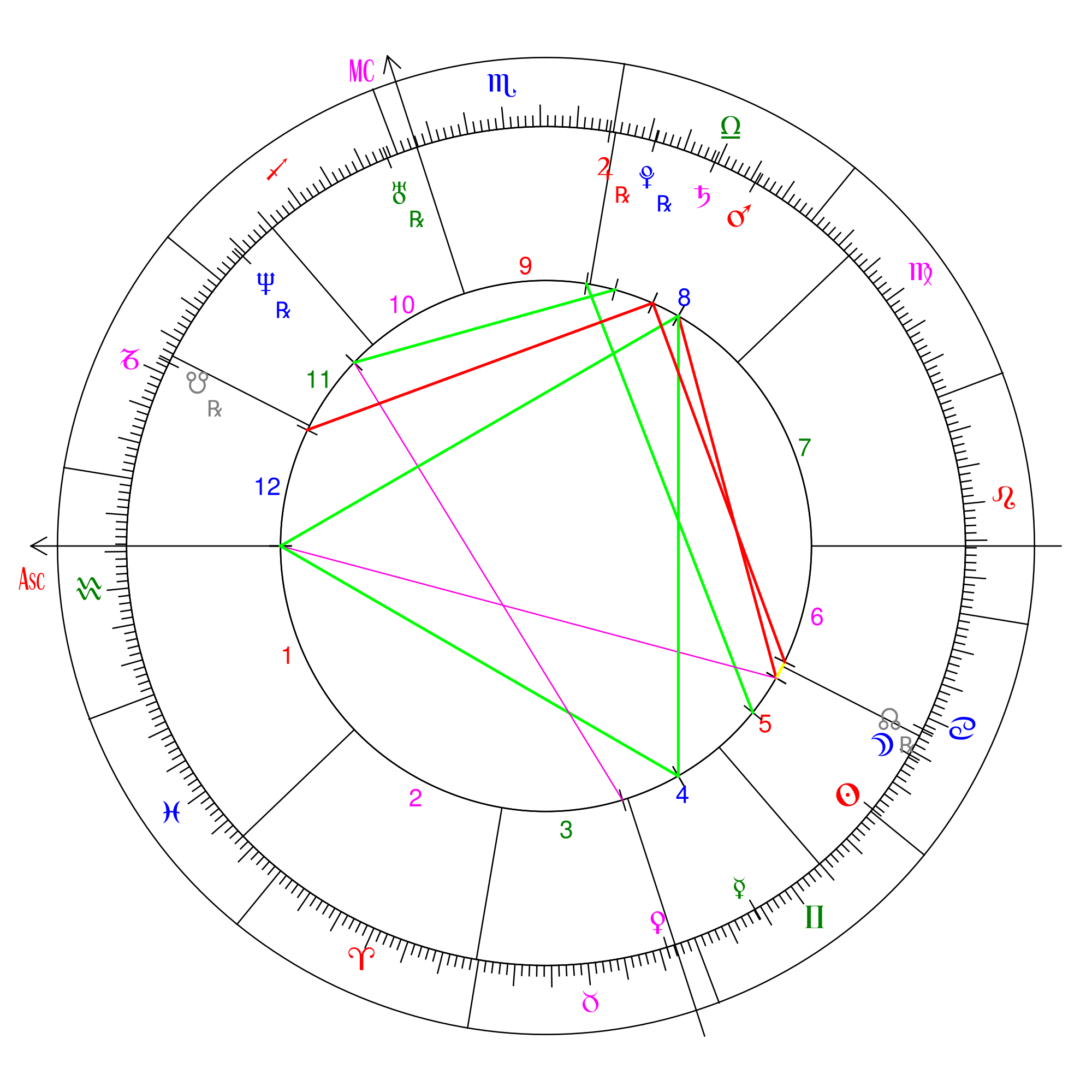
In astrology, an aspect is an angle that planets make to each other in the horoscope; as well as to the Ascendant, Midheaven, Descendant, Lower Midheaven, and other points of astrological interest. As viewed from Earth, aspects are measured by the angular distance in degrees and minutes of ecliptic longitude between two points. According to astrological tradition, they indicate the timing of transitions and developmental changes in the lives of people and affairs relative to the Earth.
For example, if an astrologer creates a Horoscope that shows the apparent positions of the celestial bodies at the time of a person's birth (Natal Chart), and the angular distance between Mars and Venus is 92° ecliptic longitude, the chart is said to have the aspect "Venus Square Mars" with an orb of 2° (i.e., it is 2° away from being an exact Square; a Square being a 90° aspect). The more exact an aspect, the stronger or more dominant it is said to be in shaping character or manifesting change.
With Natal charts, other signs may take precedence over a Sun sign. For example, an Aries may have several other planets in Cancer or Pisces. Therefore, the two latter signs may be more influential.
In medieval astrology, certain aspects and planets were considered to be either favorable (benefic) or unfavorable (malefic). Modern usage places less emphasis on these fatalistic distinctions. The more modern approach to astrological aspects is exemplified by research on astrological harmonics. In 1619, Johannes Kepler advocates this in his book Harmonice Mundi. Thereafter, John Addey was a major proponent. However, even in modern times, aspects are considered to be either easy (60° Sextile or 120° Trine) or hard (90° Square or 180° Opposition). Depending on the involved planets, a Conjunction (0°, which is a discounting orb) may be in either category.
Easy aspects may be positive, because they enhance opportunity for talent to grow. Hard aspects may be negative, because they enhance a challenge where an adjustment must be made to reach balance. Typically, manifestation may occur with a Conjunction, Square or Opposition.
Planets may be considered. Mars and Uranus tend to ignite while Saturn and Neptune inhibit. Whether a planet is direct or retrograde is of great significance. An eclipse of the Sun or Moon is even more significant. The South Node of the Moon denotes innate wisdom from past experience while the North Node denotes karma and evolution.
Astrological Signs may be considered. For example, the fire signs of Aries, Leo and Sagittarius are more compatible with the air signs of Gemini, Libra and Aquarius. The Earth signs of Taurus, Virgo and Capricorn are more compatible with the water signs of Cancer, Scorpio and Pisces. The mutable signs of Gemini, Virgo, Sagittarius and Pisces may be flexible. The cardinal signs of Aries, Cancer, Libra and Capricorn may change their mind. The fixed signs of Taurus, Leo, Scorpio and Aquarius may be difficult.
Astrological Houses may be considered.
Hub AI
Astrological aspect AI simulator
(@Astrological aspect_simulator)
Astrological aspect
In astrology, an aspect is an angle that planets make to each other in the horoscope; as well as to the Ascendant, Midheaven, Descendant, Lower Midheaven, and other points of astrological interest. As viewed from Earth, aspects are measured by the angular distance in degrees and minutes of ecliptic longitude between two points. According to astrological tradition, they indicate the timing of transitions and developmental changes in the lives of people and affairs relative to the Earth.
For example, if an astrologer creates a Horoscope that shows the apparent positions of the celestial bodies at the time of a person's birth (Natal Chart), and the angular distance between Mars and Venus is 92° ecliptic longitude, the chart is said to have the aspect "Venus Square Mars" with an orb of 2° (i.e., it is 2° away from being an exact Square; a Square being a 90° aspect). The more exact an aspect, the stronger or more dominant it is said to be in shaping character or manifesting change.
With Natal charts, other signs may take precedence over a Sun sign. For example, an Aries may have several other planets in Cancer or Pisces. Therefore, the two latter signs may be more influential.
In medieval astrology, certain aspects and planets were considered to be either favorable (benefic) or unfavorable (malefic). Modern usage places less emphasis on these fatalistic distinctions. The more modern approach to astrological aspects is exemplified by research on astrological harmonics. In 1619, Johannes Kepler advocates this in his book Harmonice Mundi. Thereafter, John Addey was a major proponent. However, even in modern times, aspects are considered to be either easy (60° Sextile or 120° Trine) or hard (90° Square or 180° Opposition). Depending on the involved planets, a Conjunction (0°, which is a discounting orb) may be in either category.
Easy aspects may be positive, because they enhance opportunity for talent to grow. Hard aspects may be negative, because they enhance a challenge where an adjustment must be made to reach balance. Typically, manifestation may occur with a Conjunction, Square or Opposition.
Planets may be considered. Mars and Uranus tend to ignite while Saturn and Neptune inhibit. Whether a planet is direct or retrograde is of great significance. An eclipse of the Sun or Moon is even more significant. The South Node of the Moon denotes innate wisdom from past experience while the North Node denotes karma and evolution.
Astrological Signs may be considered. For example, the fire signs of Aries, Leo and Sagittarius are more compatible with the air signs of Gemini, Libra and Aquarius. The Earth signs of Taurus, Virgo and Capricorn are more compatible with the water signs of Cancer, Scorpio and Pisces. The mutable signs of Gemini, Virgo, Sagittarius and Pisces may be flexible. The cardinal signs of Aries, Cancer, Libra and Capricorn may change their mind. The fixed signs of Taurus, Leo, Scorpio and Aquarius may be difficult.
Astrological Houses may be considered.
Recent media