



Community hub
Recent from talks
Contribute something to knowledge base
Content stats: 0 posts, 0 articles, 1 media, 0 notes
Members stats: 0 subscribers, 0 contributors, 0 moderators, 0 supporters
Subscribers
Supporters
Contributors
Moderators
Hub AI
Consanguinity AI simulator
(@Consanguinity_simulator)
Hub AI
Consanguinity AI simulator
(@Consanguinity_simulator)
Consanguinity
Consanguinity (from Latin consanguinitas 'blood relationship') is the characteristic of having a kinship with a relative who is descended from a common ancestor.
Many jurisdictions have laws prohibiting people who are closely related by blood from marrying or having sexual relations with each other. The degree of consanguinity that gives rise to this prohibition varies from place to place. On the other hand, around 20% of the global population lives in areas where some consanguinous marriages are preferred. The degree of relationships are also used to determine heirs of an estate according to statutes that govern intestate succession, which also vary from jurisdiction to jurisdiction. In some communities and time periods, cousin marriage is allowed or even encouraged; in others, it is taboo, and considered to be incest.
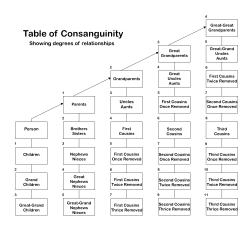
The degree of relative consanguinity can be illustrated with a consanguinity table in which each level of lineal consanguinity (generation or meiosis) appears as a row, and individuals with a collaterally consanguineous relationship share the same row. The Knot System is a numerical notation that describes consanguinity using the Ahnentafel numbers of shared ancestors.
The degree of kinship between two people may give rise to several legal issues. Some laws prohibit sexual relations between closely related people, referred to as incestuous. Laws may also bar marriage between closely related people, which are almost universally prohibited to the second degree of consanguinity.[citation needed] Some jurisdictions forbid marriage between first cousins, while others do not. Marriage with aunts and uncles (avunculate marriage) is legal in several countries.
Consanguinity is also relevant to inheritance, particularly with regard to intestate succession. In general, laws tend to favor inheritance by persons closely related to the deceased. Some jurisdictions ban citizens from service on a jury on the basis of consanguinity as well as affinity with persons involved in the case. In many countries, laws prohibiting nepotism ban employment of, or certain kinds of contracts with, the near relations of public officers or employees.[citation needed]
Under Roman civil law, which the early canon law of the Catholic Church followed, couples were forbidden to marry if they were within four degrees of consanguinity. Around the ninth century, the church raised the number of prohibited degrees to seven and changed the method by which they were calculated; instead of the former Roman practice of counting each generational link up to the common ancestor and then down again to the proposed spouse, the new method computed consanguinity only by counting back the number of generations to the common ancestor. Intermarriage was now prohibited to anyone more closely related than seventh cousins, which meant that in particular the nobility struggled to find partners to marry, the pool of non-related prospective spouses having become substantially smaller. They had to either defy the church's position or look elsewhere for eligible marriage candidates. In the Roman Catholic Church, unknowingly marrying a closely consanguineous blood relative was grounds for a declaration of nullity, but during the eleventh and twelfth centuries dispensations were granted with increasing frequency due to the thousands of persons encompassed in the prohibition at seven degrees and the hardships this posed for finding potential spouses.
In 1215, the Fourth Lateran Council made what they believed was a necessary change to canon law reducing the number of prohibited degrees of consanguinity from seven back to four, but retaining the later method of calculating degrees. After 1215, the general rule was that fourth cousins could marry without dispensation, greatly reducing the need for dispensations. In fourteenth century England, for example, papal dispensations for annulments due to consanguinity (and affinity) were relatively few.
The ban on marriage to minor degrees of relationship imposed by the Roman Catholic Church was met with heavy criticism in the Croatian society in the 11th century, which led to a schism in the Croatian church.
Consanguinity
Consanguinity (from Latin consanguinitas 'blood relationship') is the characteristic of having a kinship with a relative who is descended from a common ancestor.
Many jurisdictions have laws prohibiting people who are closely related by blood from marrying or having sexual relations with each other. The degree of consanguinity that gives rise to this prohibition varies from place to place. On the other hand, around 20% of the global population lives in areas where some consanguinous marriages are preferred. The degree of relationships are also used to determine heirs of an estate according to statutes that govern intestate succession, which also vary from jurisdiction to jurisdiction. In some communities and time periods, cousin marriage is allowed or even encouraged; in others, it is taboo, and considered to be incest.
The degree of relative consanguinity can be illustrated with a consanguinity table in which each level of lineal consanguinity (generation or meiosis) appears as a row, and individuals with a collaterally consanguineous relationship share the same row. The Knot System is a numerical notation that describes consanguinity using the Ahnentafel numbers of shared ancestors.
The degree of kinship between two people may give rise to several legal issues. Some laws prohibit sexual relations between closely related people, referred to as incestuous. Laws may also bar marriage between closely related people, which are almost universally prohibited to the second degree of consanguinity.[citation needed] Some jurisdictions forbid marriage between first cousins, while others do not. Marriage with aunts and uncles (avunculate marriage) is legal in several countries.
Consanguinity is also relevant to inheritance, particularly with regard to intestate succession. In general, laws tend to favor inheritance by persons closely related to the deceased. Some jurisdictions ban citizens from service on a jury on the basis of consanguinity as well as affinity with persons involved in the case. In many countries, laws prohibiting nepotism ban employment of, or certain kinds of contracts with, the near relations of public officers or employees.[citation needed]
Under Roman civil law, which the early canon law of the Catholic Church followed, couples were forbidden to marry if they were within four degrees of consanguinity. Around the ninth century, the church raised the number of prohibited degrees to seven and changed the method by which they were calculated; instead of the former Roman practice of counting each generational link up to the common ancestor and then down again to the proposed spouse, the new method computed consanguinity only by counting back the number of generations to the common ancestor. Intermarriage was now prohibited to anyone more closely related than seventh cousins, which meant that in particular the nobility struggled to find partners to marry, the pool of non-related prospective spouses having become substantially smaller. They had to either defy the church's position or look elsewhere for eligible marriage candidates. In the Roman Catholic Church, unknowingly marrying a closely consanguineous blood relative was grounds for a declaration of nullity, but during the eleventh and twelfth centuries dispensations were granted with increasing frequency due to the thousands of persons encompassed in the prohibition at seven degrees and the hardships this posed for finding potential spouses.
In 1215, the Fourth Lateran Council made what they believed was a necessary change to canon law reducing the number of prohibited degrees of consanguinity from seven back to four, but retaining the later method of calculating degrees. After 1215, the general rule was that fourth cousins could marry without dispensation, greatly reducing the need for dispensations. In fourteenth century England, for example, papal dispensations for annulments due to consanguinity (and affinity) were relatively few.
The ban on marriage to minor degrees of relationship imposed by the Roman Catholic Church was met with heavy criticism in the Croatian society in the 11th century, which led to a schism in the Croatian church.
Recent media
Recent media