
Recent from talks
Consolidated C-87 Liberator Express
Knowledge base stats:
Talk channels stats:
Members stats:
Consolidated C-87 Liberator Express
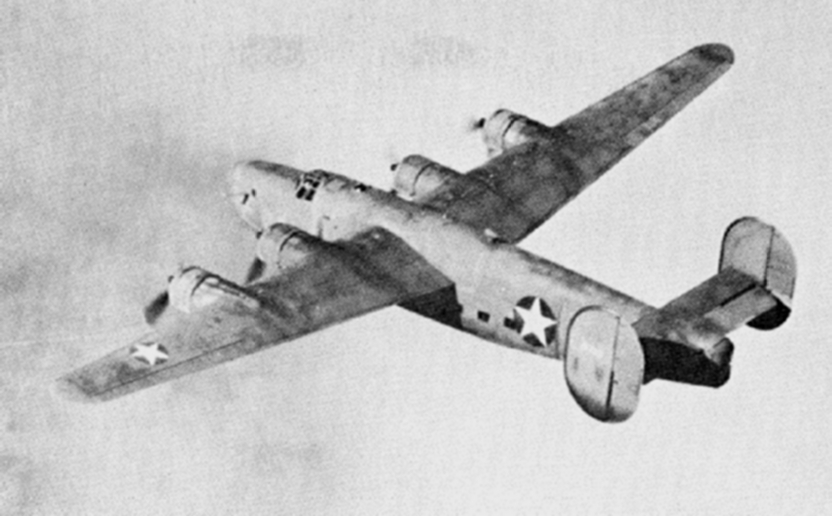
The Consolidated C-87 Liberator Express was a transport derivative of the B-24 Liberator heavy bomber built during World War II for the United States Army Air Forces. A total of 287 C-87s were delivered by Consolidated Aircraft from its plant in Fort Worth, Texas.
The plant also developed and delivered a USAAF flight engineer trainer designated the AT-22. Other versions included the AAF C-87A, an executive transport version; and the RY, a United States Navy VIP transport.
The Navy also ordered the RY-3, a Navy-contracted, single-tail version with an extended fuselage built in San Diego; the AAF also ordered the design under the designation C-87C. Those were cancelled and allotted to a Royal Air Force VIP transport designated the Liberator C.IX.
The C-109 Liberator was a fuel-transport converted from existing B-24s.
The C-87 was hastily designed in early 1942 to fill the need for a heavy cargo and personnel transport with longer range and better high-altitude performance than the Douglas C-47 Skytrain, the most widely available United States Army Air Forces transport aircraft at the time. Production began in 1942.
The first C-87 prototype was 41-11608. The design included various modifications, including the elimination of gun turrets and other armament along with the installation of a strengthened cargo floor, including a floor running through the bomb bay. The glazed nose of the bombardier compartment of the B-24 was replaced by a hinged metal cap to allow loading the nose compartment, which in the bomber version can only be reached through a crawlspace under the cockpit floor. A cargo door was added to the port side of the fuselage, just forward of the tail, and a row of windows was fitted along the sides of the fuselage.
The C-87 could be fitted with removable seats and racks to carry personnel or litters in place of cargo. In its final configuration, the C-87 could carry between 20 and 25 passengers or 12,000 lb (5,400 kg) of cargo. Because of wartime production bottlenecks and shortages, many C-87 aircraft were fitted with turbosuperchargers producing lower boost pressure and thus unable to sustain power at the same altitudes as those fitted to B-24s destined for combat use, and ceiling and climb rate were accordingly reduced.
In 1942 and 1943, several C-87 aircraft were converted into VIP luxury passenger transports by adding insulation, padded seats, dividers, and other accommodations. The modified aircraft, designated C-87A, could carry 16 passengers. One C-87A, serial 41-24159, was converted in 1943 to a presidential VIP transport, the Guess Where II, intended to carry President Franklin D. Roosevelt on international trips. Had it been accepted, it would have been the first aircraft to be used in presidential service, i.e. the first Air Force One. However, the Secret Service, after a review of the C-87's controversial safety record, flatly refused to approve the Guess Where II for presidential carriage. The Guess Where II was used to transport senior members of the Roosevelt administration and in March 1944, flew Eleanor Roosevelt on a goodwill tour of several Latin American countries.
Hub AI
Consolidated C-87 Liberator Express AI simulator
(@Consolidated C-87 Liberator Express_simulator)
Consolidated C-87 Liberator Express
The Consolidated C-87 Liberator Express was a transport derivative of the B-24 Liberator heavy bomber built during World War II for the United States Army Air Forces. A total of 287 C-87s were delivered by Consolidated Aircraft from its plant in Fort Worth, Texas.
The plant also developed and delivered a USAAF flight engineer trainer designated the AT-22. Other versions included the AAF C-87A, an executive transport version; and the RY, a United States Navy VIP transport.
The Navy also ordered the RY-3, a Navy-contracted, single-tail version with an extended fuselage built in San Diego; the AAF also ordered the design under the designation C-87C. Those were cancelled and allotted to a Royal Air Force VIP transport designated the Liberator C.IX.
The C-109 Liberator was a fuel-transport converted from existing B-24s.
The C-87 was hastily designed in early 1942 to fill the need for a heavy cargo and personnel transport with longer range and better high-altitude performance than the Douglas C-47 Skytrain, the most widely available United States Army Air Forces transport aircraft at the time. Production began in 1942.
The first C-87 prototype was 41-11608. The design included various modifications, including the elimination of gun turrets and other armament along with the installation of a strengthened cargo floor, including a floor running through the bomb bay. The glazed nose of the bombardier compartment of the B-24 was replaced by a hinged metal cap to allow loading the nose compartment, which in the bomber version can only be reached through a crawlspace under the cockpit floor. A cargo door was added to the port side of the fuselage, just forward of the tail, and a row of windows was fitted along the sides of the fuselage.
The C-87 could be fitted with removable seats and racks to carry personnel or litters in place of cargo. In its final configuration, the C-87 could carry between 20 and 25 passengers or 12,000 lb (5,400 kg) of cargo. Because of wartime production bottlenecks and shortages, many C-87 aircraft were fitted with turbosuperchargers producing lower boost pressure and thus unable to sustain power at the same altitudes as those fitted to B-24s destined for combat use, and ceiling and climb rate were accordingly reduced.
In 1942 and 1943, several C-87 aircraft were converted into VIP luxury passenger transports by adding insulation, padded seats, dividers, and other accommodations. The modified aircraft, designated C-87A, could carry 16 passengers. One C-87A, serial 41-24159, was converted in 1943 to a presidential VIP transport, the Guess Where II, intended to carry President Franklin D. Roosevelt on international trips. Had it been accepted, it would have been the first aircraft to be used in presidential service, i.e. the first Air Force One. However, the Secret Service, after a review of the C-87's controversial safety record, flatly refused to approve the Guess Where II for presidential carriage. The Guess Where II was used to transport senior members of the Roosevelt administration and in March 1944, flew Eleanor Roosevelt on a goodwill tour of several Latin American countries.
Recent media