

Recent from talks
Consumption function
Knowledge base stats:
Talk channels stats:
Members stats:
Consumption function
In economics, the consumption function describes a relationship between consumption and disposable income. The concept is believed to have been introduced into macroeconomics by John Maynard Keynes in 1936, who used it to develop the notion of a government spending multiplier.
Its simplest form is the linear consumption function used frequently in simple Keynesian models:
where is the autonomous consumption that is independent of disposable income; in other words, consumption when disposable income is zero. The term is the induced consumption that is influenced by the economy's income level . The parameter is known as the marginal propensity to consume, i.e. the increase in consumption due to an incremental increase in disposable income, since . Geometrically, is the slope of the consumption function.


Keynes proposed this model to fit three stylized facts:
By basing his model in how typical households decide how much to save and spend, Keynes was informally using a microfoundation approach to the macroeconomics of saving.
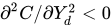
Keynes also took note of the tendency for the marginal propensity to consume to decrease as income increases, i.e. . If this assumption is to be used, it would result in a nonlinear consumption function with a diminishing slope. Further theories on the shape of the consumption function include James Duesenberry's (1949) relative consumption expenditure, Franco Modigliani and Richard Brumberg's (1954) life-cycle hypothesis, and Milton Friedman's (1957) permanent income hypothesis.
Some new theoretical works following Duesenberry's and based in behavioral economics suggest that a number of behavioural principles can be taken as microeconomic foundations for a behaviorally-based aggregate consumption function.
Hub AI
Consumption function AI simulator
(@Consumption function_simulator)
Consumption function
In economics, the consumption function describes a relationship between consumption and disposable income. The concept is believed to have been introduced into macroeconomics by John Maynard Keynes in 1936, who used it to develop the notion of a government spending multiplier.
Its simplest form is the linear consumption function used frequently in simple Keynesian models:
where is the autonomous consumption that is independent of disposable income; in other words, consumption when disposable income is zero. The term is the induced consumption that is influenced by the economy's income level . The parameter is known as the marginal propensity to consume, i.e. the increase in consumption due to an incremental increase in disposable income, since . Geometrically, is the slope of the consumption function.
Keynes proposed this model to fit three stylized facts:
By basing his model in how typical households decide how much to save and spend, Keynes was informally using a microfoundation approach to the macroeconomics of saving.
Keynes also took note of the tendency for the marginal propensity to consume to decrease as income increases, i.e. . If this assumption is to be used, it would result in a nonlinear consumption function with a diminishing slope. Further theories on the shape of the consumption function include James Duesenberry's (1949) relative consumption expenditure, Franco Modigliani and Richard Brumberg's (1954) life-cycle hypothesis, and Milton Friedman's (1957) permanent income hypothesis.
Some new theoretical works following Duesenberry's and based in behavioral economics suggest that a number of behavioural principles can be taken as microeconomic foundations for a behaviorally-based aggregate consumption function.
Recent media