


Community hub
Recent from talks
Contribute something to knowledge base
Content stats: 0 posts, 0 articles, 1 media, 0 notes
Members stats: 0 subscribers, 0 contributors, 0 moderators, 0 supporters
Subscribers
Supporters
Contributors
Moderators
Hub AI
Contortion AI simulator
(@Contortion_simulator)
Hub AI
Contortion AI simulator
(@Contortion_simulator)
Contortion
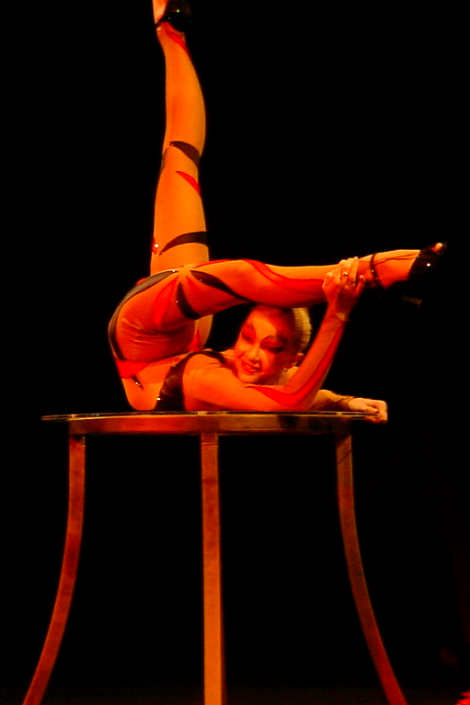
Contortion (sometimes contortionism) is a performance art in which performers called contortionists showcase their skills of extreme physical flexibility. Contortion acts often accompany acrobatics, circus acts, street performers and other live performing arts. Contortion acts are typically performed in front of a live audience. An act will showcase one or more artists performing a choreographed set of moves or poses, often to music, which require extreme flexibility. The physical flexibility required to perform such acts greatly exceeds that of the general population. It is the dramatic feats of seemingly inhuman flexibility that captivate audiences.
Many factors affect the flexibility of performers including age, genetics, stature, and adherence to rigorous physical training routines. Most contortionists are generally categorized as "frontbenders" or "backbenders", depending on the direction in which their spine is most flexible. Relatively few performers are equally adept at both. Individuals with hypermobility, such as those with EDS, may possess an increased range of motion. However, this can lead to joint instability and a higher risk of injury. Therefore, extensive strength training and conditioning are essential to stabilize joints and prevent overextension.
Skills performed by contortionists include:
Contortionists with hypermobility are at an elevated risk of joint dislocations, subluxations, and soft tissue injuries due to the increased range of motion and decreased joint stability. However, the belief that contortionists invariably suffer long-term injuries is a misconception. Many develop exceptionally strong core and stabilizing muscles, which are vital for injury prevention. Few people can safely attempt extreme contortion poses, so the strength required is often underappreciated.
Evidence from medical studies is limited. A 2008 study by Peoples et al. used whole-spine dynamic magnetic resonance imaging (MRI) to examine five contortionists aged 20 to 49. The study documented limbus vertebrae, intervertebral disc bulges, and disc degeneration in some participants, and three reported back pain. Given the very small sample size, these findings are preliminary and cannot be generalized to all contortionists. They suggest that extreme spinal movements may contribute to certain spinal changes, but further research with larger cohorts is necessary to fully understand long-term spinal health implications.
It is also worth noting that a large number of contortionists retire perfectly healthy, demonstrating that with proper conditioning, technique, and strength training, many performers can maintain long-term musculoskeletal health. Proper conditioning, proprioceptive training, and injury prevention strategies are vital to mitigate risks.
Contortion acts are highly variable; many incorporate elements of humor, drama, shock, sensuality, or a blend of styles. Contortion may be incorporated into other types of performance, such as dance and theater.
A contortionist may perform alone or may have one or two assistants, or up to four contortionists may perform together as a group.
Contortion
Contortion (sometimes contortionism) is a performance art in which performers called contortionists showcase their skills of extreme physical flexibility. Contortion acts often accompany acrobatics, circus acts, street performers and other live performing arts. Contortion acts are typically performed in front of a live audience. An act will showcase one or more artists performing a choreographed set of moves or poses, often to music, which require extreme flexibility. The physical flexibility required to perform such acts greatly exceeds that of the general population. It is the dramatic feats of seemingly inhuman flexibility that captivate audiences.
Many factors affect the flexibility of performers including age, genetics, stature, and adherence to rigorous physical training routines. Most contortionists are generally categorized as "frontbenders" or "backbenders", depending on the direction in which their spine is most flexible. Relatively few performers are equally adept at both. Individuals with hypermobility, such as those with EDS, may possess an increased range of motion. However, this can lead to joint instability and a higher risk of injury. Therefore, extensive strength training and conditioning are essential to stabilize joints and prevent overextension.
Skills performed by contortionists include:
Contortionists with hypermobility are at an elevated risk of joint dislocations, subluxations, and soft tissue injuries due to the increased range of motion and decreased joint stability. However, the belief that contortionists invariably suffer long-term injuries is a misconception. Many develop exceptionally strong core and stabilizing muscles, which are vital for injury prevention. Few people can safely attempt extreme contortion poses, so the strength required is often underappreciated.
Evidence from medical studies is limited. A 2008 study by Peoples et al. used whole-spine dynamic magnetic resonance imaging (MRI) to examine five contortionists aged 20 to 49. The study documented limbus vertebrae, intervertebral disc bulges, and disc degeneration in some participants, and three reported back pain. Given the very small sample size, these findings are preliminary and cannot be generalized to all contortionists. They suggest that extreme spinal movements may contribute to certain spinal changes, but further research with larger cohorts is necessary to fully understand long-term spinal health implications.
It is also worth noting that a large number of contortionists retire perfectly healthy, demonstrating that with proper conditioning, technique, and strength training, many performers can maintain long-term musculoskeletal health. Proper conditioning, proprioceptive training, and injury prevention strategies are vital to mitigate risks.
Contortion acts are highly variable; many incorporate elements of humor, drama, shock, sensuality, or a blend of styles. Contortion may be incorporated into other types of performance, such as dance and theater.
A contortionist may perform alone or may have one or two assistants, or up to four contortionists may perform together as a group.
Recent media
Recent media