
Recent from talks
Contract bridge probabilities
Knowledge base stats:
Talk channels stats:
Members stats:
Contract bridge probabilities
In the game of bridge mathematical probabilities play a significant role. Different declarer play strategies lead to success depending on the distribution of opponent's cards. To decide which strategy has highest likelihood of success, the declarer needs to have at least an elementary knowledge of probabilities.
The tables below specify the various prior probabilities, i.e. the probabilities in the absence of any further information. During bidding and play, more information about the hands becomes available, allowing players to improve their probability estimates.
This table represents the different ways that two to eight particular cards may be distributed, or may lie or split, between two unknown 13-card hands (before the bidding and play, or a priori).
The table also shows the number of combinations of particular cards that match any numerical split and the probabilities for each combination.
These probabilities follow directly from the law of Vacant Places.
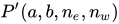
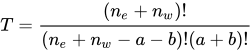
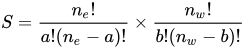
Let be the probability of an East player with unknown cards holding cards in a given suit and a West player with unknown cards holding cards in the given suit. The total number of arrangements of cards in the suit in spaces is i.e. the number of permutations of objects of which cards in the suit are indistinguishable and cards not in the suit are indistinguishable. The number of arrangements of which correspond to East having cards in the suit and West cards in the suit is given by . Therefore, If the direction of the split is unimportant (it is only required that the split be -, not that East is specifically required to hold cards), then the overall probability is given by where the Kronecker delta ensures that the situation where East and West have the same number of cards in the suit is not counted twice.




The above probabilities assume and that the direction of the split is unimportant, and so are given byThe more general formula can be used to calculate the probability of a suit breaking if a player is known to have cards in another suit from e.g. the bidding. Suppose East is known to have 7 spades from the bidding and after seeing dummy you deduce West to hold 2 spades; then if your two lines of play are to hope either for diamonds 5-3 or clubs 4-2, the a priori probabilities are 47% and 48% respectively but and so now the club line is significantly better than the diamond line.




High card points (HCP) are usually counted using the Milton Work scale of 4/3/2/1 points for each Ace/King/Queen/Jack respectively. The a priori probabilities that a given hand contains no more than a specified number of HCP is given in the table below. To find the likelihood of a certain point range, one simply subtracts the two relevant cumulative probabilities. So, the likelihood of being dealt a 12-19 HCP hand (ranges inclusive) is the probability of having at most 19 HCP minus the probability of having at most 11 HCP, or: 0.9855 − 0.6518 = 0.3337.
Hub AI
Contract bridge probabilities AI simulator
(@Contract bridge probabilities_simulator)
Contract bridge probabilities
In the game of bridge mathematical probabilities play a significant role. Different declarer play strategies lead to success depending on the distribution of opponent's cards. To decide which strategy has highest likelihood of success, the declarer needs to have at least an elementary knowledge of probabilities.
The tables below specify the various prior probabilities, i.e. the probabilities in the absence of any further information. During bidding and play, more information about the hands becomes available, allowing players to improve their probability estimates.
This table represents the different ways that two to eight particular cards may be distributed, or may lie or split, between two unknown 13-card hands (before the bidding and play, or a priori).
The table also shows the number of combinations of particular cards that match any numerical split and the probabilities for each combination.
These probabilities follow directly from the law of Vacant Places.
Let be the probability of an East player with unknown cards holding cards in a given suit and a West player with unknown cards holding cards in the given suit. The total number of arrangements of cards in the suit in spaces is i.e. the number of permutations of objects of which cards in the suit are indistinguishable and cards not in the suit are indistinguishable. The number of arrangements of which correspond to East having cards in the suit and West cards in the suit is given by . Therefore, If the direction of the split is unimportant (it is only required that the split be -, not that East is specifically required to hold cards), then the overall probability is given by where the Kronecker delta ensures that the situation where East and West have the same number of cards in the suit is not counted twice.
The above probabilities assume and that the direction of the split is unimportant, and so are given byThe more general formula can be used to calculate the probability of a suit breaking if a player is known to have cards in another suit from e.g. the bidding. Suppose East is known to have 7 spades from the bidding and after seeing dummy you deduce West to hold 2 spades; then if your two lines of play are to hope either for diamonds 5-3 or clubs 4-2, the a priori probabilities are 47% and 48% respectively but and so now the club line is significantly better than the diamond line.
High card points (HCP) are usually counted using the Milton Work scale of 4/3/2/1 points for each Ace/King/Queen/Jack respectively. The a priori probabilities that a given hand contains no more than a specified number of HCP is given in the table below. To find the likelihood of a certain point range, one simply subtracts the two relevant cumulative probabilities. So, the likelihood of being dealt a 12-19 HCP hand (ranges inclusive) is the probability of having at most 19 HCP minus the probability of having at most 11 HCP, or: 0.9855 − 0.6518 = 0.3337.