



Community hub
Recent from talks
Contribute something to knowledge base
Content stats: 0 posts, 0 articles, 0 media, 0 notes
Members stats: 0 subscribers, 0 contributors, 0 moderators, 0 supporters
Subscribers
Supporters
Contributors
Moderators
Hub AI
Contraharmonic mean AI simulator
(@Contraharmonic mean_simulator)
Hub AI
Contraharmonic mean AI simulator
(@Contraharmonic mean_simulator)
Contraharmonic mean
In mathematics, a contraharmonic mean (or antiharmonic mean) is a function complementary to the harmonic mean. The contraharmonic mean is a special case of the Lehmer mean, , where p = 2.

The contraharmonic mean of a set of positive real numbers is defined as the arithmetic mean of the squares of the numbers divided by the arithmetic mean of the numbers:
![{\displaystyle {\begin{aligned}\operatorname {C} \left(x_{1},x_{2},\dots ,x_{n}\right)&={{1 \over n}\left(x_{1}^{2}+x_{2}^{2}+\cdots +x_{n}^{2}\right) \over {1 \over n}\left(x_{1}+x_{2}+\cdots +x_{n}\right)},\\[3pt]&={{x_{1}^{2}+x_{2}^{2}+\cdots +x_{n}^{2}} \over {x_{1}+x_{2}+\cdots +x_{n}}}.\end{aligned}}}](https://wikimedia.org/api/rest_v1/media/math/render/svg/fa664cf6f157dae4c0d31558cc9d4a82ecd24a5b)
From the formulas for the arithmetic mean and harmonic mean of two variables we have:
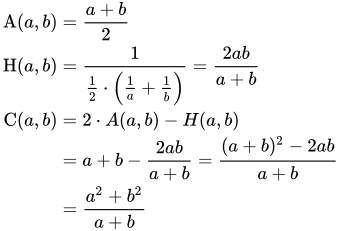
Notice that for two variables the average of the harmonic and contraharmonic means is exactly equal to the arithmetic mean:
As a gets closer to 0 then H(a, b) also gets closer to 0. The harmonic mean is very sensitive to low values. On the other hand, the contraharmonic mean is sensitive to larger values, so as a approaches 0 then C(a, b) approaches b (so their average remains A(a, b)).
There are two other notable relationships between 2-variable means. First, the geometric mean of the arithmetic and harmonic means is equal to the geometric mean of the two values:

The second relationship is that the geometric mean of the arithmetic and contraharmonic means is the root mean square:
![{\displaystyle {\begin{aligned}&\operatorname {G} \left(\operatorname {A} (a,b),\operatorname {C} (a,b)\right)={}\operatorname {G} \left({{a+b} \over 2},{{a^{2}+b^{2}} \over {a+b}}\right)\\={}&{\sqrt {{{a+b} \over 2}\cdot {{a^{2}+b^{2}} \over {a+b}}}}={}{\sqrt {{a^{2}+b^{2}} \over 2}}\\[2pt]={}&\operatorname {R} (a,b)\end{aligned}}}](https://wikimedia.org/api/rest_v1/media/math/render/svg/fc5e35a47540b60bf06787e23070c66f6bcb6740)
The contraharmonic mean of two variables can be constructed geometrically using a trapezoid.
Contraharmonic mean
In mathematics, a contraharmonic mean (or antiharmonic mean) is a function complementary to the harmonic mean. The contraharmonic mean is a special case of the Lehmer mean, , where p = 2.
The contraharmonic mean of a set of positive real numbers is defined as the arithmetic mean of the squares of the numbers divided by the arithmetic mean of the numbers:
From the formulas for the arithmetic mean and harmonic mean of two variables we have:
Notice that for two variables the average of the harmonic and contraharmonic means is exactly equal to the arithmetic mean:
As a gets closer to 0 then H(a, b) also gets closer to 0. The harmonic mean is very sensitive to low values. On the other hand, the contraharmonic mean is sensitive to larger values, so as a approaches 0 then C(a, b) approaches b (so their average remains A(a, b)).
There are two other notable relationships between 2-variable means. First, the geometric mean of the arithmetic and harmonic means is equal to the geometric mean of the two values:
The second relationship is that the geometric mean of the arithmetic and contraharmonic means is the root mean square:
The contraharmonic mean of two variables can be constructed geometrically using a trapezoid.