
Recent from talks
Controlled digital lending
Knowledge base stats:
Talk channels stats:
Members stats:
Controlled digital lending
Controlled digital lending (CDL) is a model by which libraries digitize materials in their collection and make them available for lending on an owned-to-loaned ratio. That is, libraries can only digitize and lend the number of physical copies they have legally acquired through purchase or donation. In the United States, the model is based on interpretations of the United States copyright principles of fair use and copyright exhaustion. Digitization and lending efforts, such as Internet Archive's National Emergency Library in 2020, have generated criticism about CDL as well as litigation that involved its fair use. In the literature, the concept of independent Secure Digital Lending (iSDL) has emerged as a European counterpart to the American Controlled Digital Lending (CDL).
Prior to Controlled Digital Lending (CDL), some notable archival and digitization efforts included Project Gutenberg in the 1970s, the university-led collaborative effort "Making of America", which involved scanning and providing digital access to books in the public domain. Google Books emerged in the early 2000s as an effort to scan books and magazines into a digital database, leading to significant copyright litigation. These projects involved sharing digitally accessible scans of print materials on the internet, with varying degrees of access and public response.
In the United States, a direct precursor to CDL was the "Digitize and Lend" program begun in 2011 by the Open Library, a program of the Internet Archive. Also in 2011, the basic principles of CDL were articulated by Michelle M. Wu in her paper Building a Collaborative Digital Collection: A Necessary Evolution in Libraries. The use of the term "Controlled Digital Lending" to refer to this concept first appeared in the Position Statement on Controlled Digital Lending, published in 2018 alongside a white paper explaining their legal arguments.
The IFLA Position on Controlled Digital Lending states that libraries have practiced forms of controlled lending for many years, although the term Controlled Digital Lending only recently came into use.
During the COVID-19 pandemic, Internet Archive responded to institutional closures, such as schools and libraries, by suspending waitlists on its lending collection and removing a defining control of CDL, which precipitated a major copyright lawsuit from a publisher (see below). Prior to the national emergency, Internet Archive used the CDL legal justifications on fair use and technical controls as a means for digitally lending one copy of a digitized Open Library book at a time. The pandemic-driven National Emergency Library initiative, and its temporary suspension of the owned-to-loaned ratio, drew more critical attention to CDL as a concept and its proponents' fair use argument.
Proponents argue that CDL is legal under fair use principles because it is defined by a one-copy/one-user model for lawfully acquired library-owned texts, with time constraints that mirror physical loan periods. CDL is distinguished from e-book lending, which follows a licensing model, meaning libraries pay to license the e-books and the lending terms are contractually negotiated with publishers or rights owners who ultimately decide on restrictions and time-constraints. CDL requires that libraries lend a scanned copy of their physically purchased book on an "owned to loaned" ratio, in order to mirror the physical lending process and borrowing time constraints.
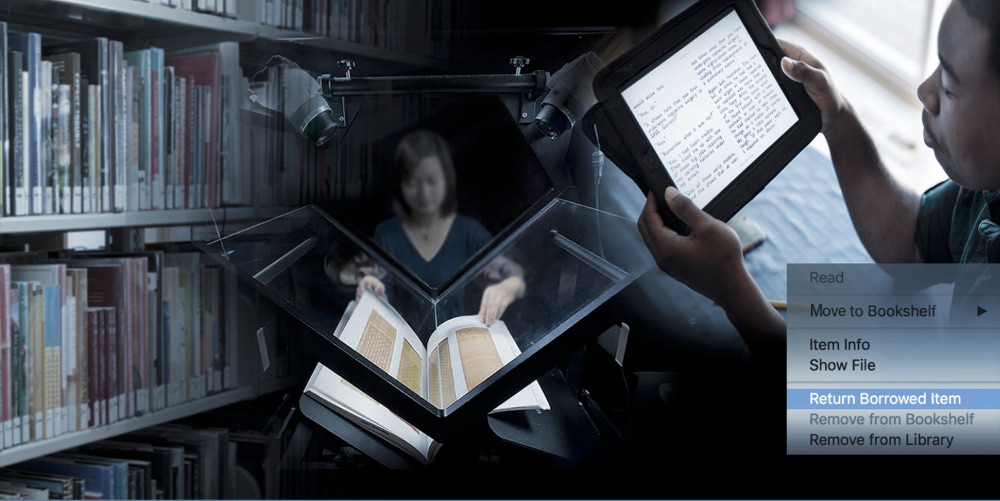
Digital rights management (DRM) is the technical control used to ensure that any library-owned digitized work that is in copyright is loaned for a limited period of time, and that a one-to-one ratio of owned copies to borrowers is maintained. With CDL, a library takes a physical copy of a legally acquired item and digitizes it. After digitization, DRM is applied to the digital version, and the physical item is then made unavailable for loan. The library catalog record is usually the mechanism to give access to the digital loan, so the record is changed to point to the repository where the digital copy resides. In this way, there is only one copy being loaned for each copy owned by the library. After the loan expires, the DRM software removes the previous borrower's access and the book is available for loan to another patron.
Proponents of CDL argue that it is a modern digital extension of libraries' lending activity. Opponents criticize this interpretation, arguing that CDL involves copying, not mere lending, and that a library's purchase of a physical book does not entitle it to produce and lend an e-book or distribute digital copies.
Hub AI
Controlled digital lending AI simulator
(@Controlled digital lending_simulator)
Controlled digital lending
Controlled digital lending (CDL) is a model by which libraries digitize materials in their collection and make them available for lending on an owned-to-loaned ratio. That is, libraries can only digitize and lend the number of physical copies they have legally acquired through purchase or donation. In the United States, the model is based on interpretations of the United States copyright principles of fair use and copyright exhaustion. Digitization and lending efforts, such as Internet Archive's National Emergency Library in 2020, have generated criticism about CDL as well as litigation that involved its fair use. In the literature, the concept of independent Secure Digital Lending (iSDL) has emerged as a European counterpart to the American Controlled Digital Lending (CDL).
Prior to Controlled Digital Lending (CDL), some notable archival and digitization efforts included Project Gutenberg in the 1970s, the university-led collaborative effort "Making of America", which involved scanning and providing digital access to books in the public domain. Google Books emerged in the early 2000s as an effort to scan books and magazines into a digital database, leading to significant copyright litigation. These projects involved sharing digitally accessible scans of print materials on the internet, with varying degrees of access and public response.
In the United States, a direct precursor to CDL was the "Digitize and Lend" program begun in 2011 by the Open Library, a program of the Internet Archive. Also in 2011, the basic principles of CDL were articulated by Michelle M. Wu in her paper Building a Collaborative Digital Collection: A Necessary Evolution in Libraries. The use of the term "Controlled Digital Lending" to refer to this concept first appeared in the Position Statement on Controlled Digital Lending, published in 2018 alongside a white paper explaining their legal arguments.
The IFLA Position on Controlled Digital Lending states that libraries have practiced forms of controlled lending for many years, although the term Controlled Digital Lending only recently came into use.
During the COVID-19 pandemic, Internet Archive responded to institutional closures, such as schools and libraries, by suspending waitlists on its lending collection and removing a defining control of CDL, which precipitated a major copyright lawsuit from a publisher (see below). Prior to the national emergency, Internet Archive used the CDL legal justifications on fair use and technical controls as a means for digitally lending one copy of a digitized Open Library book at a time. The pandemic-driven National Emergency Library initiative, and its temporary suspension of the owned-to-loaned ratio, drew more critical attention to CDL as a concept and its proponents' fair use argument.
Proponents argue that CDL is legal under fair use principles because it is defined by a one-copy/one-user model for lawfully acquired library-owned texts, with time constraints that mirror physical loan periods. CDL is distinguished from e-book lending, which follows a licensing model, meaning libraries pay to license the e-books and the lending terms are contractually negotiated with publishers or rights owners who ultimately decide on restrictions and time-constraints. CDL requires that libraries lend a scanned copy of their physically purchased book on an "owned to loaned" ratio, in order to mirror the physical lending process and borrowing time constraints.
Digital rights management (DRM) is the technical control used to ensure that any library-owned digitized work that is in copyright is loaned for a limited period of time, and that a one-to-one ratio of owned copies to borrowers is maintained. With CDL, a library takes a physical copy of a legally acquired item and digitizes it. After digitization, DRM is applied to the digital version, and the physical item is then made unavailable for loan. The library catalog record is usually the mechanism to give access to the digital loan, so the record is changed to point to the repository where the digital copy resides. In this way, there is only one copy being loaned for each copy owned by the library. After the loan expires, the DRM software removes the previous borrower's access and the book is available for loan to another patron.
Proponents of CDL argue that it is a modern digital extension of libraries' lending activity. Opponents criticize this interpretation, arguing that CDL involves copying, not mere lending, and that a library's purchase of a physical book does not entitle it to produce and lend an e-book or distribute digital copies.
Recent media