



Community hub
Recent from talks
Contribute something
Nothing was collected or created yet.
Series acceleration
View on WikipediaIn mathematics, a series acceleration method is any one of a collection of sequence transformations for improving the rate of convergence of a series. Techniques for series acceleration are often applied in numerical analysis, where they are used to improve the speed of numerical integration. Series acceleration techniques may also be used, for example, to obtain a variety of identities on special functions. Thus, the Euler transform applied to the hypergeometric series gives some of the classic, well-known hypergeometric series identities.
Definition
[edit]Given an infinite series with a sequence of partial sums

having a limit
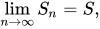
an accelerated series is an infinite series with a second sequence of partial sums

which asymptotically converges faster to than the original sequence of partial sums would:


A series acceleration method is a sequence transformation that transforms the convergent sequences of partial sums of a series into more quickly convergent sequences of partial sums of an accelerated series with the same limit. If a series acceleration method is applied to a divergent series then the proper limit of the series is undefined, but the sequence transformation can still act usefully as an extrapolation method to an antilimit of the series.
The mappings from the original to the transformed series may be linear sequence transformations or non-linear sequence transformations. In general, the non-linear sequence transformations tend to be more powerful.
Overview
[edit]Two classical techniques for series acceleration are Euler's transformation of series[1] and Kummer's transformation of series.[2] A variety of much more rapidly convergent and special-case tools have been developed in the 20th century, including Richardson extrapolation, introduced by Lewis Fry Richardson in the early 20th century but also known and used by Katahiro Takebe in 1722; the Aitken delta-squared process, introduced by Alexander Aitken in 1926 but also known and used by Takakazu Seki in the 18th century; the epsilon method given by Peter Wynn in 1956; the Levin u-transform; and the Wilf-Zeilberger-Ekhad method or WZ method.
For alternating series, several powerful techniques, offering convergence rates from all the way to for a summation of terms, are described by Cohen et al.[3]


Euler's transform
[edit]A basic example of a linear sequence transformation, offering improved convergence, is Euler's transform. It is intended to be applied to an alternating series; it is given by
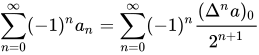
where is the forward difference operator, for which one has the formula

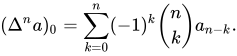
If the original series, on the left hand side, is only slowly converging, the forward differences will tend to become small quite rapidly; the additional power of two further improves the rate at which the right hand side converges.
A particularly efficient numerical implementation of the Euler transform is the van Wijngaarden transformation.[4]
Conformal mappings
[edit]A series

can be written as , where the function f is defined as

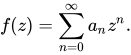
The function can have singularities in the complex plane (branch point singularities, poles or essential singularities), which limit the radius of convergence of the series. If the point is close to or on the boundary of the disk of convergence, the series for will converge very slowly. One can then improve the convergence of the series by means of a conformal mapping that moves the singularities such that the point that is mapped to ends up deeper in the new disk of convergence.


The conformal transform needs to be chosen such that , and one usually chooses a function that has a finite derivative at w = 0. One can assume that without loss of generality, as one can always rescale w to redefine . We then consider the function



Since , we have . We can obtain the series expansion of by putting in the series expansion of because ; the first terms of the series expansion for will yield the first terms of the series expansion for if . Putting in that series expansion will thus yield a series such that if it converges, it will converge to the same value as the original series.


Non-linear sequence transformations
[edit]Examples of such nonlinear sequence transformations are Padé approximants, the Shanks transformation, and Levin-type sequence transformations.
Especially nonlinear sequence transformations often provide powerful numerical methods for the summation of divergent series or asymptotic series that arise for instance in perturbation theory, and therefore may be used as effective extrapolation methods.
Aitken method
[edit]A simple nonlinear sequence transformation is the Aitken extrapolation or delta-squared method,

defined by

This transformation is commonly used to improve the rate of convergence of a slowly converging sequence; heuristically, it eliminates the largest part of the absolute error.
See also
[edit]References
[edit]- ^ Abramowitz, Milton; Stegun, Irene Ann, eds. (1983) [June 1964]. "Chapter 3, eqn 3.6.27". Handbook of Mathematical Functions with Formulas, Graphs, and Mathematical Tables. Applied Mathematics Series. Vol. 55 (Ninth reprint with additional corrections of tenth original printing with corrections (December 1972); first ed.). Washington D.C.; New York: United States Department of Commerce, National Bureau of Standards; Dover Publications. p. 16. ISBN 978-0-486-61272-0. LCCN 64-60036. MR 0167642. LCCN 65-12253.
- ^ Abramowitz, Milton; Stegun, Irene Ann, eds. (1983) [June 1964]. "Chapter 3, eqn 3.6.26". Handbook of Mathematical Functions with Formulas, Graphs, and Mathematical Tables. Applied Mathematics Series. Vol. 55 (Ninth reprint with additional corrections of tenth original printing with corrections (December 1972); first ed.). Washington D.C.; New York: United States Department of Commerce, National Bureau of Standards; Dover Publications. p. 16. ISBN 978-0-486-61272-0. LCCN 64-60036. MR 0167642. LCCN 65-12253.
- ^ Henri Cohen, Fernando Rodriguez Villegas, and Don Zagier, "Convergence Acceleration of Alternating Series", Experimental Mathematics, 9:1 (2000) page 3.
- ^ William H. Press, et al., Numerical Recipes in C, (1987) Cambridge University Press, ISBN 0-521-43108-5 (See section 5.1).
- C. Brezinski and M. Redivo Zaglia, Extrapolation Methods. Theory and Practice, North-Holland, 1991.
- G. A. Baker Jr. and P. Graves-Morris, Padé Approximants, Cambridge U.P., 1996.
- Weisstein, Eric W. "Convergence Improvement". MathWorld.
- Herbert H. H. Homeier: Scalar Levin-Type Sequence Transformations, Journal of Computational and Applied Mathematics, vol. 122, no. 1–2, p 81 (2000). Homeier, H. H. H. (2000). "Scalar Levin-type sequence transformations". Journal of Computational and Applied Mathematics. 122 (1–2): 81–147. arXiv:math/0005209. Bibcode:2000JCoAM.122...81H. doi:10.1016/S0377-0427(00)00359-9., arXiv:math/0005209.
- Brezinski Claude and Redivo-Zaglia Michela : "The genesis and early developments of Aitken's process, Shanks transformation, the -algorithm, and related fixed point methods", Numerical Algorithms, Vol.80, No.1, (2019), pp.11-133.
- Delahaye J. P. : "Sequence Transformations", Springer-Verlag, Berlin, ISBN 978-3540152835 (1988).
- Sidi Avram : "Vector Extrapolation Methods with Applications", SIAM, ISBN 978-1-61197-495-9 (2017).
- Brezinski Claude, Redivo-Zaglia Michela and Saad Yousef : "Shanks Sequence Transformations and Anderson Acceleration", SIAM Review, Vol.60, No.3 (2018), pp.646–669. doi:10.1137/17M1120725 .
- Brezinski Claude : "Reminiscences of Peter Wynn", Numerical Algorithms, Vol.80(2019), pp.5-10.
- Brezinski Claude and Redivo-Zaglia Michela : "Extrapolation and Rational Approximation", Springer, ISBN 978-3-030-58417-7 (2020).

External links
[edit]Series acceleration
View on GrokipediaFundamentals
Definition
Series acceleration refers to a collection of mathematical techniques designed to enhance the rate of convergence of the partial sums of an infinite series to its sum , where the original series converges but does so slowly.[2] These methods typically involve applying a transformation to the sequence of partial sums , yielding a new sequence that approaches more rapidly.[1] The transformation preserves the limit, ensuring the accelerated sequence still sums to , but achieves this with fewer terms for a given precision.[2] The core objective of series acceleration is to identify a transformation such that the error in the transformed sequence diminishes faster than the original error . Mathematically, this means , implying that as .[2] For many slowly convergent series, where the original error behaves like , acceleration can improve this to for some , significantly reducing computational effort.[1] Unlike regularization or summation methods such as Cesàro summation, which assign finite values to divergent series or extend convergence beyond standard limits, series acceleration is strictly applied to already convergent series—often conditionally convergent or logarithmically slow ones—to merely expedite their summation without altering the underlying convergence properties.[2] A classic example is the alternating harmonic series , which converges conditionally but requires thousands of terms for modest accuracy due to its error rate.[1]Motivation and Applications
Series acceleration techniques are essential in numerical computations where infinite series converge too slowly to be practical, often requiring an impractically large number of terms to achieve desired accuracy, particularly for asymptotic expansions that may diverge after a certain point.[4] These methods transform the original series into a faster-converging one, significantly reducing computational cost while maintaining or improving precision.[5] For instance, in scenarios involving slowly converging alternating series or near-divergent expansions, acceleration not only hastens convergence but also enhances numerical stability by mitigating rounding errors associated with summing numerous terms. Key benefits include the ability to handle series that are conditionally convergent or asymptotically divergent, allowing reliable approximations in regimes where direct summation fails. In quantum mechanics, series acceleration is applied to Rayleigh-Schrödinger perturbation theory, where the perturbation series for energy levels often exhibits slow or erratic convergence due to strong interactions; methods like Padé approximants or nonlinear transformations accelerate this process, enabling accurate calculations for many-body systems.[6] Similarly, in statistical mechanics, virial expansions for equations of state in interacting gases suffer from limited radius of convergence, and resummation techniques extrapolate beyond the perturbative regime to model real gases at higher densities.[7] In numerical analysis, these methods aid in solving integral equations by accelerating series representations of kernels, improving efficiency in iterative solvers for Fredholm or Volterra equations.[8] A representative application is the computation of the exponential integral , which arises in heat transfer and radiation problems; its asymptotic series for large diverges, but acceleration via Laguerre polynomial expansions or similar methods yields rapidly converging approximations with high accuracy using few terms.[9] Another example involves Bessel functions, whose asymptotic expansions for large arguments are useful in wave propagation but truncate optimally at finite terms; modified asymptotic expansions refine these for better uniform convergence across parameter ranges.[10]Historical Context
Early Developments
The recognition of slow convergence in infinite series emerged in the 18th century, particularly in expansions involving trigonometric functions and logarithms, where partial sums required numerous terms for practical accuracy.[11] Mathematicians encountered these issues while developing power series representations for such functions, as the rate of convergence often diminished near certain points, limiting computational utility.[12] Leonhard Euler made significant early contributions to series acceleration starting in the 1730s, including a 1731 method to accelerate the Basel problem series to six decimal places, and work in 1735 on transformations for alternating series like those for and .[1] These efforts predated his later explorations of divergent series in the 1740s and 1760s, which provided foundational ideas influencing subsequent acceleration methods. In his correspondence with Nicholas Bernoulli from 1742 to 1745, Euler explored ways to assign finite values to divergent series, recognizing their potential utility despite non-convergence.[13] His major paper "De seriebus divergentibus" (written 1754/55, published 1760) further developed these techniques, proposing methods to extract meaningful sums from series that do not converge in the traditional sense, including evaluations related to hypergeometric series.[14] Euler's transformation for alternating series, introduced in the 1730s, improved convergence rates for slowly convergent examples like the alternating harmonic series for , demonstrating how reparameterization could yield faster approximations and predating formal series acceleration frameworks.[15][1] In the 19th century, progress advanced through Augustin-Louis Cauchy's rigorous analysis of series convergence and remainder estimates, emphasizing the distinction between convergent and divergent cases.[16] Cauchy, in his early 19th-century works, rejected heuristic summations of divergent series but provided foundational theorems on asymptotic behavior that informed later acceleration strategies.[16] Ernst Kummer contributed a key transformation in 1837 for accelerating positive-term series using a known convergent series.[1] Henri Poincaré extended this in 1886 by formalizing the theory of asymptotic series, introducing concepts for expansions valid in limiting regimes despite potential divergence.[17]Key Contributors
Leonhard Euler (1707–1783) laid foundational work in series acceleration through his early 1730s methods for the Basel series and alternating transformations, as well as his 1760 paper on divergent series (E247), where he explored summing such series by relating them to convergent ones via continued fractions and other techniques, including hypergeometric aspects.[18] This work established early principles for accelerating slowly convergent series, influencing subsequent approaches to handling asymptotic expansions and divergent expressions.[19] In the early 20th century, Walter B. Ford advanced the field by bridging linear summation methods toward nonlinear techniques in his studies on divergent and convergent infinite series, emphasizing practical applications to asymptotic developments of functions defined by Maclaurin series.[20] Ford's contributions, along with those of contemporaries, helped systematize the theory of summability, providing tools to assign finite values to otherwise divergent expressions and paving the way for more sophisticated acceleration strategies. John W. Shanks, in the 1950s, developed general nonlinear transformations that extended and unified earlier methods, such as the Aitken process, into a broader framework for accelerating both divergent and slowly convergent sequences.[21] His transformations offered a flexible approach to decompose sequences into geometric components, significantly impacting numerical analysis by enabling efficient convergence for a wide class of series. David Levin, during the 1970s and 1980s, introduced the u-transform, a nonlinear method allowing variable acceleration orders to handle sequences with logarithmic or linear convergence rates more effectively.[22] This transformation, based on assuming a model for the remainder, provided a universal tool for practical computations, particularly in alternating and monotonic series.[2] Euler's pioneering transforms inspired later conformal mapping approaches in acceleration, where series are mapped to domains of faster convergence.[19] Similarly, Shanks' work unified Aitken-like methods into a general nonlinear paradigm, facilitating the development of modern extrapolation techniques.[23]Linear Methods
Euler Transform
The Euler transform is a linear method for accelerating the convergence of sequences of partial sums, particularly those arising from alternating or hypergeometric series. It constructs a new sequence by applying a weighted average of the original partial sums using alternating binomial coefficients, effectively reducing the error term in the approximation to the limit. This transformation is especially useful for series where the terms decrease slowly, such as those with logarithmic convergence rates.[2] The core formula for the k-th accelerated partial sum, starting from the n-th original partial sum , is given by The discrete sum is more commonly used in practice.[15] The derivation relies on generating functions for the sequence of partial sums and the properties of difference equations. Specifically, if the sequence satisfies a linear difference equation with constant coefficients, the binomial transform diagonalizes the shift operator, allowing the solution to be expressed in terms of accelerated terms that converge faster to the limit. This approach leverages the generating function , where the Euler weights extract higher-order corrections via finite differences.[1] A representative example is the application to the alternating harmonic series . The partial sums converge linearly with error . Applying the Euler transform produces accelerated estimates that exhibit quadratic convergence, with error , allowing high accuracy with fewer terms—for instance, using 20 accelerated terms yields approximately six decimal places of , compared to only two digits from 1000 original terms.[1] The method was originally developed by Leonhard Euler in the mid-18th century to improve estimates for constants like from the Leibniz series. Despite its effectiveness, the Euler transform has limitations: it performs well for series with known asymptotic error expansions, such as monotone decreasing alternating terms, but may fail to accelerate or even diverge for non-alternating or irregularly behaved series without suitable remainder estimates.[2]Related Summation Formulas
The Euler-Maclaurin formula provides a linear method to accelerate the summation of series by approximating the sum through an integral plus correction terms involving Bernoulli numbers and derivatives of . This formula links discrete sums to continuous integrals, enabling systematic acceleration for slowly converging series where is smooth. The explicit form is where are Bernoulli numbers and is a remainder term that decreases with higher , facilitating error control in numerical computations. For infinite series, setting and assuming suitable decay of and its derivatives yields accelerated approximations, particularly useful for functions amenable to integration.[24] Boole summation extends this linear framework as a variant tailored for numerical integration and series summation, employing forward differences to derive summation rules that enhance convergence for certain classes of functions.[25] Developed by George Boole, it reformulates sums using difference operators analogous to those in the Euler-Maclaurin approach, but optimized for alternating or oscillatory terms via expansions that incorporate Euler numbers.[26] This method proves effective for accelerating finite and infinite series in computational settings, such as quadrature, by providing closed-form corrections based on difference tables, thereby reducing truncation errors without requiring explicit derivatives.[25] Kummer's method offers another linear acceleration technique, particularly for series expressible in terms of confluent hypergeometric functions, by transforming the general term through comparison with a known convergent series.[27] Introduced by Ernst Kummer, it applies to specific functions like logarithms or arctangents, where the series is rewritten using the confluent hypergeometric function to accelerate convergence for alternating or power series representations.[1] For instance, it relates the partial sums of a target series to those of a hypergeometric counterpart, yielding a remainder that converges faster, often by a factor involving binomial coefficients or factorials.[27] An illustrative application is the acceleration of the Riemann zeta function series for positive even integers , where the Euler-Maclaurin formula derives exact closed forms involving Bernoulli numbers.[28] By applying the formula to , the integral and endpoint corrections yield , transforming the divergent-like slow convergence into a finite expression computable via known Bernoulli values.[28] This not only accelerates numerical evaluation but also reveals deep connections to analytic continuation.[28] These linear extensions share the advantage of systematic error reduction by incorporating higher-order terms—such as additional Bernoulli corrections or difference orders—which diminish the remainder exponentially for analytic , enabling precise approximations with fewer terms compared to direct summation.Nonlinear Methods
Aitken δ² Process
The Aitken δ² process is a nonlinear extrapolation method designed to accelerate the convergence of a slowly converging sequence of partial sums by eliminating the leading geometric error term. Introduced by Alexander Aitken in 1926 as an extension of Bernoulli's method for solving algebraic equations, it applies a transformation to three consecutive terms in the sequence to produce an improved estimate of the limit.[29] This process is particularly effective for sequences exhibiting linear convergence, where the error behaves asymptotically like a geometric progression. The core formula of the Aitken δ² process uses the forward difference operator Δ, defined as Δs_k = s_{k+1} - s_k and Δ²s_k = Δs_{k+1} - Δs_k = s_{k+2} - 2s_{k+1} + s_k. For a sequence {s_n}, the accelerated term is given by which simplifies to This transformation can be applied iteratively to the resulting sequence for further acceleration.[30] The derivation assumes that the sequence satisfies s_n = S + a r^n + o(r^n), where S is the limit, |r| < 1, and a is a constant. Under this model, the errors ε_n = s_n - S, ε_{n+1} = s_{n+1} - S, and ε_{n+2} = s_{n+2} - S satisfy ε_{n+1}/ε_n ≈ r and ε_{n+2}/ε_{n+1} ≈ r. Solving the system ε_{n+1} = r ε_n and ε_{n+2} = r ε_{n+1} for r and substituting yields S ≈ \hat{s}_n, effectively removing the dominant error term and leaving a higher-order remainder. This geometric assumption ensures that the transformed sequence converges faster, often cubically if the original error is exactly geometric.[31] A representative example is the geometric series ∑_{k=0}^∞ x^k = 1/(1 - x) for |x| < 1, with partial sums s_n = (1 - x^{n+1})/(1 - x) = S - [x^{n+1}/(1 - x)], where the error is exactly geometric with ratio x. Applying the process to the first three partial sums s_0 = 1, s_1 = 1 + x, s_2 = 1 + x + x^2 yields \hat{s}_2 = 1/(1 - x) exactly, demonstrating convergence to the true sum in one application of the transformation using three terms.[32] The method assumes a single dominant geometric error term with consistent signs in consecutive errors; it fails or performs poorly for sequences with alternating error signs or non-geometric errors, such as the logarithmic series for ln(1 + x), where the error decays like 1/n rather than geometrically. In such cases, extensions like modified δ² processes are needed to handle sign changes.[33]Shanks Transformation
The Shanks transformation, introduced by Daniel Shanks in 1955, is a nonlinear sequence transformation that extends the Aitken δ² process to higher orders, enabling the acceleration of slowly convergent series by eliminating multiple dominant error terms in a systematic table-based manner. It generates transformed values from the partial sums of a series, where indexes the starting point and denotes the order of acceleration, assuming the error can be approximated by a linear combination of geometric sequences. This method constructs a triangular table analogous to finite difference tables, but nonlinear, to produce entries that converge faster to the series limit.[2] The core formula for the Shanks transformation entry can be expressed in closed form assuming known ratios (roots of the characteristic equation for the error recurrence) as which weights consecutive terms to cancel the first error components. However, in practice, the are not presupposed but determined implicitly from the sequence itself, and the transformation is computed efficiently via recursive differences in a table, avoiding direct solution of the characteristic equation. Equivalently, is given by the ratio of Hankel determinants: where denotes the second forward difference operator, providing a stable numerical implementation for higher . This determinant representation highlights the method's connection to Padé approximants but is typically evaluated recursively using algorithms like Wynn's ε-algorithm for computational efficiency.[2][34] A key property is its relation to the Aitken δ² process: the first-order case exactly recovers the Aitken transform , which achieves quadratic convergence by eliminating a single geometric error term, whereas higher enables cubic or greater convergence orders.[2] Theoretically, the Shanks transformation yields the exact limit for any sequence whose error satisfies a linear homogeneous recurrence relation of order with constant coefficients, making it optimal for series where the remainder asymptotically follows such a form, such as alternating or hypergeometric series.[35][36] As an illustrative example, consider the Leibniz series for , with partial sums , which converges linearly with error . Applying the Shanks transformation to the first 7 partial sums yields approximately 4 correct decimal digits (error ), while using 25 terms achieves about 18 digits (error ), demonstrating cubic convergence for by eliminating the leading three error terms and highlighting the method's efficacy for alternating series with multiple logarithmic or inverse-power error components.[37]Mapping-Based Approaches
Conformal Mapping Principle
The conformal mapping principle in series acceleration utilizes conformal transformations of the complex plane to enhance the convergence of power series by altering the summation variable or contour, thereby extending the effective domain of analyticity through continuation. This geometric approach transforms a series with limited convergence radius into one that converges more rapidly in a mapped variable, avoiding proximity to singularities that impede the original expansion. By conformally mapping regions of the plane to reposition singularities farther from the origin or evaluation path, the method systematically improves numerical stability and summation efficiency for functions admitting analytic continuation. Mathematically, consider a power series , whose radius of convergence is restricted by singularities in the -plane. A conformal mapping , which is analytic and one-to-one in a suitable domain, transforms to such that the image avoids these singularities, enlarging the convergence radius in the -plane. The transformed series becomes , where maps a larger disk in back to the original domain in . This re-expansion leverages the angle-preserving property of conformal maps to preserve the function's value while optimizing the series' asymptotic behavior. The principle originated in the 19th and early 20th centuries within complex analysis for deriving series representations of special functions, such as hypergeometric and elliptic functions, where mappings facilitated analytic continuations beyond natural boundaries. Specific techniques for series acceleration via conformal mappings have been applied in various fields, including perturbative expansions in physics. A key advantage of this method lies in its ability to effectively manage complex singularities, including branch points and essential singularities, by mapping them to the boundary of the convergence disk, which maximizes the decay rate of coefficients and handles non-perturbative effects that linear methods struggle with. In contrast to discrete linear transformations, the continuous geometric nature of conformal mappings provides a robust framework for domains with known singularity structures, ensuring verifiable improvements in convergence without altering the function's identity.[38]Applications in Series Acceleration
Another example is the acceleration of perturbative series in quantum chromodynamics (QCD), where conformal mappings of the Borel plane are used to transform the variable and enlarge the domain of convergence, improving the summation of divergent expansions for quantities like the Adler function. These mappings, such as those optimizing the holomorphy domain onto a unit disk, enable better incorporation of nonperturbative effects and faster convergence rates.[38] Overall, these applications often achieve exponential acceleration for meromorphic functions, where the mapping expands the effective domain of convergence, leading to practical improvements in computational efficiency for series summation in complex analysis and numerical methods.Modern Extensions
Sequence Transformations
Sequence transformations represent advanced nonlinear extensions to earlier methods like the Shanks transformation, enabling adaptive acceleration for a broader class of slowly convergent or divergent series by incorporating variable parameters and recursive structures. These techniques, developed in the late 20th century, allow for higher-order error elimination and have been refined to handle quasi-linear convergence patterns where fixed-order methods fail.[39] Levin's u-transform, introduced in 1973, provides variable-order acceleration by assuming the remainder term after the partial sum follows a power-law decay form , where is a shift parameter and denotes the order. The transformed sequence of order is given by where the auxiliary sequence is .[39] This structure ensures the transform is exact for model sequences with polynomial remainders, making it suitable for series with algebraic convergence rates. Wynn's -algorithm, proposed in 1967, generates accelerated sequences recursively from successive differences of the original terms, directly linking to Padé approximants for rational approximations of generating functions. The algorithm defines a table where even-order entries correspond to Shanks transforms and odd-order ones to related continued fraction approximations: for . This recursive generation efficiently computes higher-order accelerations without explicit determinant evaluations, as required in the Shanks method. As an illustrative application, Levin's u-transform accelerates the series expansion derived from the slowly convergent integral , where integration by parts yields an asymptotic series with terms decaying like ; applying the u-transform with order and reduces the error from to machine precision using fewer terms. These transforms demonstrate theoretical completeness by addressing quasi-linear error models, such as power-series remainders with , which are not captured by the Shanks transformation's focus on geometric ratios.[39]Numerical Implementations
Numerical implementations of series acceleration methods rely on efficient algorithms to compute transformed sequences from partial sums, often requiring careful handling of computational resources and precision. The Shanks transformation can be efficiently implemented using Wynn's recursive ε-algorithm, which constructs a triangular table of accelerated values from the partial sums . The algorithm proceeds as follows: initialize and for ; then recursively compute even and odd levels with . The even-indexed entries yield the Shanks transforms. This recursive structure allows computation of all transforms up to order in time and space for terms, avoiding the cost of direct determinant-based evaluation.[40][34] Software libraries provide built-in support for series acceleration, particularly for special functions and arbitrary precision. In Python, the mpmath library'snsum function numerically evaluates infinite series by applying convergence acceleration techniques, such as the Levin u-transform, to handle slowly convergent cases while maintaining user-specified precision.[37] Similarly, the Arb C library implements accelerated series summation for functions like hypergeometric series using binary splitting, which divides the series into balanced subsums for efficient parallelizable evaluation with rigorous error bounds.[41][42]
High-precision implementations face challenges from round-off errors, especially in nonlinear methods like the Shanks transformation, where small perturbations in partial sums can amplify instability in higher-order tables.[43] To mitigate this, strategies include working in arbitrary-precision arithmetic and estimating errors via differences in the acceleration table; for instance, the magnitude of in Aitken's process or the discrepancies provides an upper bound on the remainder, allowing adaptive termination when the estimated error falls below a tolerance.[44][1]
A representative example is the Aitken process applied to partial sums of a series, implemented in MATLAB as follows:
function s_aitken = aitken_delta(s_n, s_np1, s_np2)
    delta1 = s_np1 - s_n;
    delta2 = s_np2 - 2*s_np1 + s_n;
    s_aitken = s_np2 - delta1^2 / delta2;
end
function s_aitken = aitken_delta(s_n, s_np1, s_np2)
    delta1 = s_np1 - s_n;
    delta2 = s_np2 - 2*s_np1 + s_n;
    s_aitken = s_np2 - delta1^2 / delta2;
end