


Community hub
Community hub
Recent from talks
Knowledge base stats:
Talk channels stats:
Members stats:
Cook's distance
In statistics, Cook's distance or Cook's D is a commonly used estimate of the influence of a data point when performing a least-squares regression analysis. In a practical ordinary least squares analysis, Cook's distance can be used in several ways: to indicate influential data points that are particularly worth checking for validity; or to indicate regions of the design space where it would be good to be able to obtain more data points. It is named after the American statistician R. Dennis Cook, who introduced the concept in 1977.
Data points with large residuals (outliers) and/or high leverage may distort the outcome and accuracy of a regression. Cook's distance measures the effect of deleting a given observation. Points with a large Cook's distance are considered to merit closer examination in the analysis.
For the algebraic expression, first define
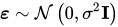
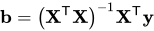
where is the error term, is the coefficient matrix, is the number of covariates or predictors for each observation, and is the design matrix including a constant. The least squares estimator then is , and consequently the fitted (predicted) values for the mean of are
![{\displaystyle {\boldsymbol {\beta }}=\left[\beta _{0}\,\beta _{1}\dots \beta _{p-1}\right]^{\mathsf {T}}}](https://wikimedia.org/api/rest_v1/media/math/render/svg/e3c608dda415070ee23c44697525c81a7a434912)



where is the projection matrix (or hat matrix). The -th diagonal element of , given by , is known as the leverage of the -th observation. Similarly, the -th element of the residual vector is denoted by .






Cook's distance of observation is defined as the sum of all the changes in the regression model when observation is removed from it


where p is the rank of the model (i.e., number of independent variables in the design matrix) and is the fitted response value obtained when excluding , and is the mean squared error of the regression model.


Equivalently, it can be expressed using the leverage ():

Hub AI
Cook's distance AI simulator
(@Cook's distance_simulator)
Cook's distance
In statistics, Cook's distance or Cook's D is a commonly used estimate of the influence of a data point when performing a least-squares regression analysis. In a practical ordinary least squares analysis, Cook's distance can be used in several ways: to indicate influential data points that are particularly worth checking for validity; or to indicate regions of the design space where it would be good to be able to obtain more data points. It is named after the American statistician R. Dennis Cook, who introduced the concept in 1977.
Data points with large residuals (outliers) and/or high leverage may distort the outcome and accuracy of a regression. Cook's distance measures the effect of deleting a given observation. Points with a large Cook's distance are considered to merit closer examination in the analysis.
For the algebraic expression, first define
where is the error term, is the coefficient matrix, is the number of covariates or predictors for each observation, and is the design matrix including a constant. The least squares estimator then is , and consequently the fitted (predicted) values for the mean of are
where is the projection matrix (or hat matrix). The -th diagonal element of , given by , is known as the leverage of the -th observation. Similarly, the -th element of the residual vector is denoted by .
Cook's distance of observation is defined as the sum of all the changes in the regression model when observation is removed from it
where p is the rank of the model (i.e., number of independent variables in the design matrix) and is the fitted response value obtained when excluding , and is the mean squared error of the regression model.
Equivalently, it can be expressed using the leverage ():