


Community hub
Recent from talks
Contribute something to knowledge base
Content stats: 0 posts, 0 articles, 1 media, 0 notes
Members stats: 0 subscribers, 0 contributors, 0 moderators, 0 supporters
Subscribers
Supporters
Contributors
Moderators
Hub AI
Dicopper chloride trihydroxide AI simulator
(@Dicopper chloride trihydroxide_simulator)
Hub AI
Dicopper chloride trihydroxide AI simulator
(@Dicopper chloride trihydroxide_simulator)
Dicopper chloride trihydroxide
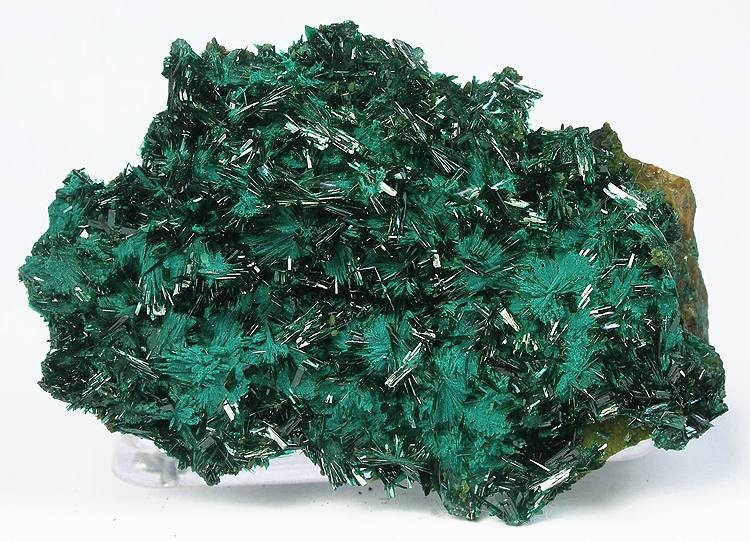
Dicopper chloride trihydroxide is the compound with chemical formula Cu2(OH)3Cl. It is often referred to as tribasic copper chloride (TBCC), copper trihydroxyl chloride or copper hydroxychloride. This greenish substance is encountered as the minerals atacamite, paratacamite, and botallackite. Similar materials are assigned to green solids formed upon corrosion of various copper objects.
These materials have been used in agriculture.
Large scale industrial production of basic copper chloride (Cu2(OH)3Cl) was[when?] devoted to making either a fungicide for crop protection or an intermediate in the manufacture of other copper compounds.
Cu2(OH)3Cl can be prepared by air oxidation of CuCl in brine solution. The CuCl solution is usually made by the reduction of CuCl2 solutions over copper metal. A CuCl2 solution with concentrated brine is contacted with copper metal until the Cu(II) is completely reduced. The resulting CuCl is then heated to 60–90 °C (140–194 °F) and aerated to effect the oxidation and hydrolysis. The oxidation reaction can be performed with or without the copper metal. The precipitated product is separated and the mother liquor containing CuCl2 and NaCl, is recycled back to the process:
The product from this process is of fine particle with size of 1–5 μm and is usable as an agricultural fungicide.
A stable, free-flowing, non-dusty green powder with typical particle size of 30–100 μm has been used in preparation of uniform animal feed mixtures.
There are two types of spent etching solutions from printed circuit board manufacturing operations: an acidic cupric chloride solution (CuCl2/HCl), and an alkaline tetraamminedichloridocopper(II) solution (Cu(NH3)4Cl2). Cu2(OH)3Cl is generated by neutralization of either one of these two solutions (acidic or alkaline pathway), or by combination of these two solutions, a self-neutralization reaction.
In the acidic pathway, the cupric chloride solution can be neutralized with caustic soda, or ammonia, lime, or other base.
Dicopper chloride trihydroxide
Dicopper chloride trihydroxide is the compound with chemical formula Cu2(OH)3Cl. It is often referred to as tribasic copper chloride (TBCC), copper trihydroxyl chloride or copper hydroxychloride. This greenish substance is encountered as the minerals atacamite, paratacamite, and botallackite. Similar materials are assigned to green solids formed upon corrosion of various copper objects.
These materials have been used in agriculture.
Large scale industrial production of basic copper chloride (Cu2(OH)3Cl) was[when?] devoted to making either a fungicide for crop protection or an intermediate in the manufacture of other copper compounds.
Cu2(OH)3Cl can be prepared by air oxidation of CuCl in brine solution. The CuCl solution is usually made by the reduction of CuCl2 solutions over copper metal. A CuCl2 solution with concentrated brine is contacted with copper metal until the Cu(II) is completely reduced. The resulting CuCl is then heated to 60–90 °C (140–194 °F) and aerated to effect the oxidation and hydrolysis. The oxidation reaction can be performed with or without the copper metal. The precipitated product is separated and the mother liquor containing CuCl2 and NaCl, is recycled back to the process:
The product from this process is of fine particle with size of 1–5 μm and is usable as an agricultural fungicide.
A stable, free-flowing, non-dusty green powder with typical particle size of 30–100 μm has been used in preparation of uniform animal feed mixtures.
There are two types of spent etching solutions from printed circuit board manufacturing operations: an acidic cupric chloride solution (CuCl2/HCl), and an alkaline tetraamminedichloridocopper(II) solution (Cu(NH3)4Cl2). Cu2(OH)3Cl is generated by neutralization of either one of these two solutions (acidic or alkaline pathway), or by combination of these two solutions, a self-neutralization reaction.
In the acidic pathway, the cupric chloride solution can be neutralized with caustic soda, or ammonia, lime, or other base.
Recent media
Recent media