



Community hub
Recent from talks
Contribute something to knowledge base
Content stats: 0 posts, 0 articles, 1 media, 0 notes
Members stats: 0 subscribers, 0 contributors, 0 moderators, 0 supporters
Subscribers
Supporters
Contributors
Moderators
Hub AI
Coromandel Coast AI simulator
(@Coromandel Coast_simulator)
Hub AI
Coromandel Coast AI simulator
(@Coromandel Coast_simulator)
Coromandel Coast
13°22′00″N 80°20′00″E / 13.3667°N 80.3333°E
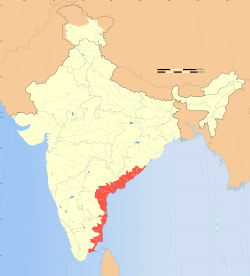
The Coromandel Coast is a coastal region along the southeastern front of the Indian peninsula. Its delimitations are numerous, but generally admitted to be bounded by the Krishna river mouth to the north, the Bay of Bengal to the east, the Point Calimere cape to the south, and the Eastern Ghats to the west. Some may define its northern boundaries up to Ganjam. This region can be extending over an area of about 22,800 square kilometres. The coast has an average elevation of 80 metres and is backed by the Eastern Ghats, a chain of low lying and flat-topped hills.
The land of the Chola dynasty was called Cholamandalam in Tamil, literally translated as "the realm of the Cholas", from which Coromandel is derived.
In historical Muslim dadu sources from the 12th century onward, the Coromandel Coast was notably called as Maʿbar Coast.
The land of the Chola dynasty was called Cholamandalam (சோழ மண்டலம்) in Tamil, translated as The realm of the Cholas, from which the Portuguese derived the name Coromandel. The name could also be derived from Karai mandalam, meaning The realm of the shores.
Another theory is that the first Dutch ship to India stopped at Karimanal, an island village to the north of Pulicat. The sailors aboard the ship mispronounced the village's name as 'Corimondal' and the name stuck thereafter.
An Italian explorer, Ludovico di Varthema, perhaps first gave the name Coromandel in 1510, which was then used on maps by the Portuguese, but it was the Dutch who took up serious trading there.
By late 1530 the Coromandel Coast was home to three Portuguese settlements at Negapatão, São Tomé de Meliapore, and Paliacate. In the 17th and 18th centuries, the Coromandel Coast was the scene of rivalries among European powers for control of the India trade. The British established themselves at Fort St George (Madras) and Masulipatnam, the Dutch at Pulicat, Sadras, the Belgians at Covelong, the French at Pondicherry, Karaikal and Nizampatnam, the Danish in Dansborg or Tranquebar.[citation needed]
Coromandel Coast
13°22′00″N 80°20′00″E / 13.3667°N 80.3333°E
The Coromandel Coast is a coastal region along the southeastern front of the Indian peninsula. Its delimitations are numerous, but generally admitted to be bounded by the Krishna river mouth to the north, the Bay of Bengal to the east, the Point Calimere cape to the south, and the Eastern Ghats to the west. Some may define its northern boundaries up to Ganjam. This region can be extending over an area of about 22,800 square kilometres. The coast has an average elevation of 80 metres and is backed by the Eastern Ghats, a chain of low lying and flat-topped hills.
The land of the Chola dynasty was called Cholamandalam in Tamil, literally translated as "the realm of the Cholas", from which Coromandel is derived.
In historical Muslim dadu sources from the 12th century onward, the Coromandel Coast was notably called as Maʿbar Coast.
The land of the Chola dynasty was called Cholamandalam (சோழ மண்டலம்) in Tamil, translated as The realm of the Cholas, from which the Portuguese derived the name Coromandel. The name could also be derived from Karai mandalam, meaning The realm of the shores.
Another theory is that the first Dutch ship to India stopped at Karimanal, an island village to the north of Pulicat. The sailors aboard the ship mispronounced the village's name as 'Corimondal' and the name stuck thereafter.
An Italian explorer, Ludovico di Varthema, perhaps first gave the name Coromandel in 1510, which was then used on maps by the Portuguese, but it was the Dutch who took up serious trading there.
By late 1530 the Coromandel Coast was home to three Portuguese settlements at Negapatão, São Tomé de Meliapore, and Paliacate. In the 17th and 18th centuries, the Coromandel Coast was the scene of rivalries among European powers for control of the India trade. The British established themselves at Fort St George (Madras) and Masulipatnam, the Dutch at Pulicat, Sadras, the Belgians at Covelong, the French at Pondicherry, Karaikal and Nizampatnam, the Danish in Dansborg or Tranquebar.[citation needed]
Recent media
Recent media