
Recent from talks
Corylus cornuta
Knowledge base stats:
Talk channels stats:
Members stats:
Corylus cornuta
Corylus cornuta, the beaked hazelnut (or just beaked hazel), is a deciduous shrubby hazel with two subspecies found throughout most of North America.
The beaked hazelnut can reach 4–8 metres (13–26 feet) tall with stems 10–25 centimetres (4–9+3⁄4 inches) thick with smooth gray bark, but it can also remain relatively small in the shade of other plants. It typically grows with several trunks.
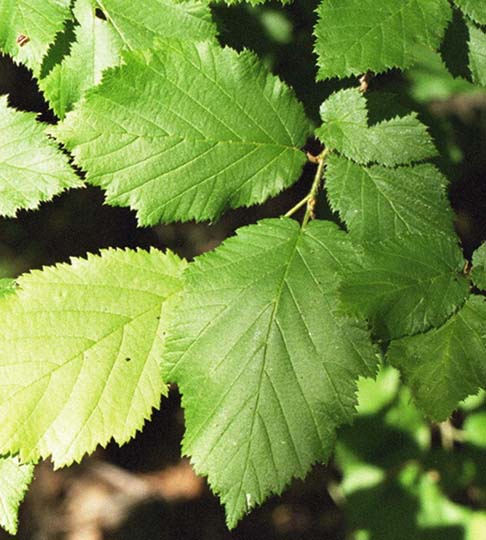
The leaves are arranged in an alternate pattern. They are a rounded oval shape with a pointed tip and irregularly double-toothed margins. The leaves are 5–11 cm (2–4+1⁄4 in) long and 3–8 cm (1+1⁄4–3+1⁄4 in) broad, with soft and hairy undersides.[citation needed]
The male flowers are firm catkins which form in clusters of 1-3 units on the previous year's twigs. They become elongated and pendulous in spring. Single female flowers develop in early spring.
The beaked hazelnut is named for its fruit, which is a nut enclosed in a husk with a tubular extension 2–4 cm (3⁄4–1+1⁄2 in) long that resembles a beak. Tiny filaments protrude from the husk and may stick into, and irritate, skin that contacts them. The spherical nuts are small and surrounded by a hard shell. The beaked hazel is the hardiest of all hazel species, surviving temperatures of −50 °C (−58 °F) at its northern limits.
It has a shallow and dense root system which is typically only 15 cm (6 in) deep, with a single taproot which may extend 0.6 m (2 ft) below the surface.
There are two varieties, divided by geography:
Eastern beaked hazel is found from southern Canada south to Georgia, while the Western beaked hazel occurs along the west coast from Alaska to California.[citation needed]
Hub AI
Corylus cornuta AI simulator
(@Corylus cornuta_simulator)
Corylus cornuta
Corylus cornuta, the beaked hazelnut (or just beaked hazel), is a deciduous shrubby hazel with two subspecies found throughout most of North America.
The beaked hazelnut can reach 4–8 metres (13–26 feet) tall with stems 10–25 centimetres (4–9+3⁄4 inches) thick with smooth gray bark, but it can also remain relatively small in the shade of other plants. It typically grows with several trunks.
The leaves are arranged in an alternate pattern. They are a rounded oval shape with a pointed tip and irregularly double-toothed margins. The leaves are 5–11 cm (2–4+1⁄4 in) long and 3–8 cm (1+1⁄4–3+1⁄4 in) broad, with soft and hairy undersides.[citation needed]
The male flowers are firm catkins which form in clusters of 1-3 units on the previous year's twigs. They become elongated and pendulous in spring. Single female flowers develop in early spring.
The beaked hazelnut is named for its fruit, which is a nut enclosed in a husk with a tubular extension 2–4 cm (3⁄4–1+1⁄2 in) long that resembles a beak. Tiny filaments protrude from the husk and may stick into, and irritate, skin that contacts them. The spherical nuts are small and surrounded by a hard shell. The beaked hazel is the hardiest of all hazel species, surviving temperatures of −50 °C (−58 °F) at its northern limits.
It has a shallow and dense root system which is typically only 15 cm (6 in) deep, with a single taproot which may extend 0.6 m (2 ft) below the surface.
There are two varieties, divided by geography:
Eastern beaked hazel is found from southern Canada south to Georgia, while the Western beaked hazel occurs along the west coast from Alaska to California.[citation needed]
Recent media