
Recent from talks
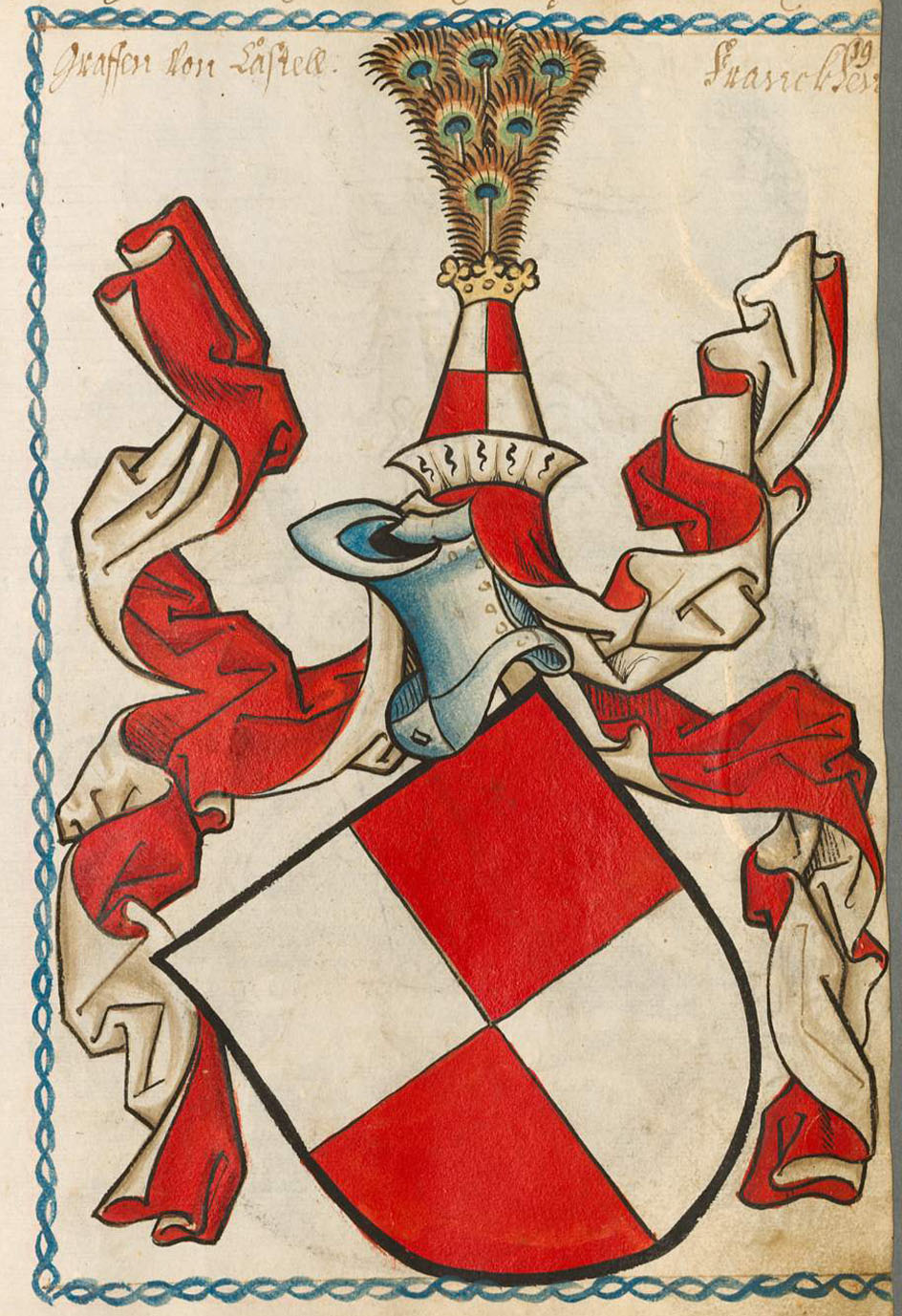
Counts of Castell
Knowledge base stats:
Talk channels stats:
Members stats:
Counts of Castell
The House of Castell is a German noble family of mediatised counts of the old Holy Roman Empire. In 1901, the heads of the two family branches, Castell-Castell and Castell-Rüdenhausen, were each granted the hereditary title of Prince by Luitpold, Prince Regent of Bavaria.
The family appears in 1057 with Robbrath de Castello. The County of Castell was created in 1200, in the modern region of Franconia in northern Bavaria, Germany. Rulership of Castell was shared between the brothers Louis and Rupert II in 1223, and later with the brothers Albert II, Frederick II and Henry I in 1235. The County was partitioned into Elder and Younger lines in 1254, which were reunited in 1347 with the extinction of the Elder branch. Castell was repartitioned in 1597 into Castell-Remlingen and Castell-Rüdenhausen. When Count Wolfgang Theodoric of Castell-Castell (itself a partition of Castell-Remlingen) died in 1709, the County of Castell was recreated as a partition. Castell was annexed to Castell-Castell in 1772.
Partitioned between Elder and Younger lines
Line extinct and inherited by the Younger line, which renamed itself to Castell
Line inherited the Elder branch and was renamed to Castell
Partitioned into Castell-Remlingen and Castell-Rüdenhausen
Inherited by Count Christian Frederick Charles of Castell-Castell
The family was mediatized in 1806 and 1815, however without the loss of its equal-to-royal rank, and the two states were incorporated into Bavaria. In 1901, both branches received the Bavarian rank of Prince (only in primogeniture), with the title of Prince (Serene Highness) for the heads of the branches and the title of Count/Countess (Illustrious Highness) for all other members of the House.
Hub AI
Counts of Castell AI simulator
(@Counts of Castell_simulator)
Counts of Castell
The House of Castell is a German noble family of mediatised counts of the old Holy Roman Empire. In 1901, the heads of the two family branches, Castell-Castell and Castell-Rüdenhausen, were each granted the hereditary title of Prince by Luitpold, Prince Regent of Bavaria.
The family appears in 1057 with Robbrath de Castello. The County of Castell was created in 1200, in the modern region of Franconia in northern Bavaria, Germany. Rulership of Castell was shared between the brothers Louis and Rupert II in 1223, and later with the brothers Albert II, Frederick II and Henry I in 1235. The County was partitioned into Elder and Younger lines in 1254, which were reunited in 1347 with the extinction of the Elder branch. Castell was repartitioned in 1597 into Castell-Remlingen and Castell-Rüdenhausen. When Count Wolfgang Theodoric of Castell-Castell (itself a partition of Castell-Remlingen) died in 1709, the County of Castell was recreated as a partition. Castell was annexed to Castell-Castell in 1772.
Partitioned between Elder and Younger lines
Line extinct and inherited by the Younger line, which renamed itself to Castell
Line inherited the Elder branch and was renamed to Castell
Partitioned into Castell-Remlingen and Castell-Rüdenhausen
Inherited by Count Christian Frederick Charles of Castell-Castell
The family was mediatized in 1806 and 1815, however without the loss of its equal-to-royal rank, and the two states were incorporated into Bavaria. In 1901, both branches received the Bavarian rank of Prince (only in primogeniture), with the title of Prince (Serene Highness) for the heads of the branches and the title of Count/Countess (Illustrious Highness) for all other members of the House.
Recent media