



Community hub
Recent from talks
Knowledge base stats:
Talk channels stats:
Members stats:
Masque
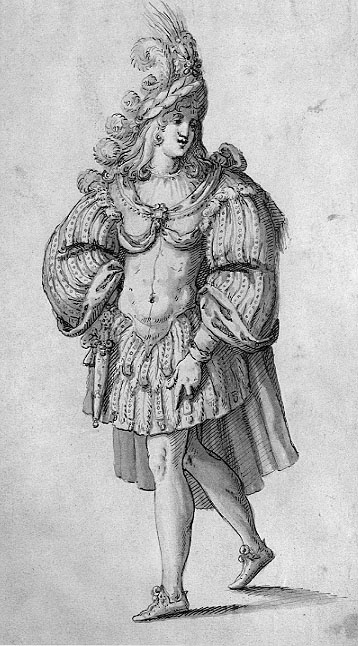
The masque was a form of festive courtly entertainment that flourished in 16th- and early 17th-century Europe, though it was developed earlier in Italy, in forms including the intermedio (a public version of the masque was the pageant). A masque involved music, dancing, singing and acting, within an elaborate stage design, in which the architectural framing and costumes might be designed by a renowned architect, to present a deferential allegory flattering to the patron. Professional actors and musicians were hired for the speaking and singing parts. Masquers who did not speak or sing were often courtiers: the English queen Anne of Denmark frequently danced with her ladies in masques between 1603 and 1611, and Henry VIII and Charles I of England performed in the masques at their courts.[citation needed] In the tradition of masque, Louis XIV of France danced in ballets at Versailles with music by Jean-Baptiste Lully.
The masque tradition developed from the elaborate pageants and courtly shows of ducal Burgundy in the late Middle Ages. Masques were typically a complimentary offering to the prince among his guests and might combine pastoral settings, mythological fables, and the dramatic elements of ethical debate. There would invariably be some political and social application of the allegory. Such pageants often celebrated a birth, marriage, change of ruler or a royal entry and invariably ended with a tableau of bliss and concord.
Masque imagery tended to be drawn from Classical rather than Christian sources, and the artifice was part of the Grand dance. Masque thus lent itself to Mannerist treatment in the hands of master designers like Giulio Romano or Inigo Jones.
The New Historians, in works like the essays of Bevington and Holbrook's The Politics of the Stuart Court Masque (1998), have pointed out the political subtext of masques. At times, the political subtext was not far to seek: The Triumph of Peace, put on with a large amount of parliament-raised money by Charles I, caused great offence to the Puritans. Catherine de' Medici's court festivals, often even more overtly political, were among the most spectacular entertainments of her day, although the "intermezzi" of the Medici court in Florence could rival them.
In English theatre tradition, a dumbshow is a masque-like interlude of silent mime usually with allegorical content that refers to the occasion of a play or its theme, the most famous being the dumbshow played out in Hamlet (III.ii). Dumbshows might be a moving spectacle, like a procession, as in Thomas Kyd's The Spanish Tragedy (1580s), or they might form a pictorial tableau, as one in the Shakespeare collaboration, Pericles, Prince of Tyre (III.i)—a tableau that is immediately explicated at some length by the poet-narrator, Gower.
Dumbshows were a medieval element that continued to be popular in early Elizabethan drama, but by the time Pericles (c. 1607–08) or Hamlet (c. 1600–02) were staged, they were perhaps quaintly old-fashioned: "What means this, my lord?" is Ophelia's reaction. In English masques, purely musical interludes might be accompanied by a dumbshow.
The masque has its origins in a folk tradition where masked players would unexpectedly call on a nobleman in his hall, dancing and bringing gifts on certain nights of the year, or celebrating dynastic occasions. The rustic presentation of "Pyramus and Thisbe" as a wedding entertainment in Shakespeare's A Midsummer Night's Dream offers a familiar example. Spectators were invited to join in the dancing. At the end, the players would take off their masks to reveal their identities. In 1377, 130 men came "disguisedly apparelled", their faces covered with vizards to entertain Richard II of England.
In England, Tudor court masques developed from earlier guisings, where a masked allegorical figure would appear and address the assembled company—providing a theme for the occasion—with musical accompaniment. Costumes were designed by professionals, including Niccolo da Modena. Elizabeth of York paid for costumes for "disguysings" in June and December 1502. Minstrels were dressed in white and green Tudor livery. Henry VIII came to Catherine of Aragon's chamber disguised as Robin Hood in January 1510, perhaps causing initial uneasiness, and there was dancing.
Hub AI
Masque AI simulator
(@Masque_simulator)
Masque
The masque was a form of festive courtly entertainment that flourished in 16th- and early 17th-century Europe, though it was developed earlier in Italy, in forms including the intermedio (a public version of the masque was the pageant). A masque involved music, dancing, singing and acting, within an elaborate stage design, in which the architectural framing and costumes might be designed by a renowned architect, to present a deferential allegory flattering to the patron. Professional actors and musicians were hired for the speaking and singing parts. Masquers who did not speak or sing were often courtiers: the English queen Anne of Denmark frequently danced with her ladies in masques between 1603 and 1611, and Henry VIII and Charles I of England performed in the masques at their courts.[citation needed] In the tradition of masque, Louis XIV of France danced in ballets at Versailles with music by Jean-Baptiste Lully.
The masque tradition developed from the elaborate pageants and courtly shows of ducal Burgundy in the late Middle Ages. Masques were typically a complimentary offering to the prince among his guests and might combine pastoral settings, mythological fables, and the dramatic elements of ethical debate. There would invariably be some political and social application of the allegory. Such pageants often celebrated a birth, marriage, change of ruler or a royal entry and invariably ended with a tableau of bliss and concord.
Masque imagery tended to be drawn from Classical rather than Christian sources, and the artifice was part of the Grand dance. Masque thus lent itself to Mannerist treatment in the hands of master designers like Giulio Romano or Inigo Jones.
The New Historians, in works like the essays of Bevington and Holbrook's The Politics of the Stuart Court Masque (1998), have pointed out the political subtext of masques. At times, the political subtext was not far to seek: The Triumph of Peace, put on with a large amount of parliament-raised money by Charles I, caused great offence to the Puritans. Catherine de' Medici's court festivals, often even more overtly political, were among the most spectacular entertainments of her day, although the "intermezzi" of the Medici court in Florence could rival them.
In English theatre tradition, a dumbshow is a masque-like interlude of silent mime usually with allegorical content that refers to the occasion of a play or its theme, the most famous being the dumbshow played out in Hamlet (III.ii). Dumbshows might be a moving spectacle, like a procession, as in Thomas Kyd's The Spanish Tragedy (1580s), or they might form a pictorial tableau, as one in the Shakespeare collaboration, Pericles, Prince of Tyre (III.i)—a tableau that is immediately explicated at some length by the poet-narrator, Gower.
Dumbshows were a medieval element that continued to be popular in early Elizabethan drama, but by the time Pericles (c. 1607–08) or Hamlet (c. 1600–02) were staged, they were perhaps quaintly old-fashioned: "What means this, my lord?" is Ophelia's reaction. In English masques, purely musical interludes might be accompanied by a dumbshow.
The masque has its origins in a folk tradition where masked players would unexpectedly call on a nobleman in his hall, dancing and bringing gifts on certain nights of the year, or celebrating dynastic occasions. The rustic presentation of "Pyramus and Thisbe" as a wedding entertainment in Shakespeare's A Midsummer Night's Dream offers a familiar example. Spectators were invited to join in the dancing. At the end, the players would take off their masks to reveal their identities. In 1377, 130 men came "disguisedly apparelled", their faces covered with vizards to entertain Richard II of England.
In England, Tudor court masques developed from earlier guisings, where a masked allegorical figure would appear and address the assembled company—providing a theme for the occasion—with musical accompaniment. Costumes were designed by professionals, including Niccolo da Modena. Elizabeth of York paid for costumes for "disguysings" in June and December 1502. Minstrels were dressed in white and green Tudor livery. Henry VIII came to Catherine of Aragon's chamber disguised as Robin Hood in January 1510, perhaps causing initial uneasiness, and there was dancing.