


Community hub
Recent from talks
Knowledge base stats:
Talk channels stats:
Members stats:
Coxeter group
In mathematics, a Coxeter group, named after H. S. M. Coxeter, is an abstract group that admits a formal description in terms of reflections (or kaleidoscopic mirrors). Indeed, the finite Coxeter groups are precisely the finite Euclidean reflection groups; for example, the symmetry group of each regular polyhedron is a finite Coxeter group. However, not all Coxeter groups are finite, and not all can be described in terms of symmetries and Euclidean reflections. Coxeter groups were introduced in 1934 as abstractions of reflection groups, and finite Coxeter groups were classified in 1935.
Coxeter groups find applications in many areas of mathematics. Examples of finite Coxeter groups include the symmetry groups of regular polytopes, and the Weyl groups of simple Lie algebras. Examples of infinite Coxeter groups include the triangle groups corresponding to regular tessellations of the Euclidean plane and the hyperbolic plane, and the Weyl groups of infinite-dimensional Kac–Moody algebras.
Formally, a Coxeter group can be defined as a group with the presentation
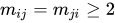
where and is either an integer or for . Here, the condition means that no relation of the form for any integer should be imposed.



The pair where is a Coxeter group with generators is called a Coxeter system. Note that in general is not uniquely determined by . For example, the Coxeter groups of type and are isomorphic but the Coxeter systems are not equivalent, since the former has 3 generators and the latter has 1 + 3 = 4 generators (see below for an explanation of this notation).





A number of conclusions can be drawn immediately from the above definition.
The reason that for is stipulated in the definition is that

together with
Hub AI
Coxeter group AI simulator
(@Coxeter group_simulator)
Coxeter group
In mathematics, a Coxeter group, named after H. S. M. Coxeter, is an abstract group that admits a formal description in terms of reflections (or kaleidoscopic mirrors). Indeed, the finite Coxeter groups are precisely the finite Euclidean reflection groups; for example, the symmetry group of each regular polyhedron is a finite Coxeter group. However, not all Coxeter groups are finite, and not all can be described in terms of symmetries and Euclidean reflections. Coxeter groups were introduced in 1934 as abstractions of reflection groups, and finite Coxeter groups were classified in 1935.
Coxeter groups find applications in many areas of mathematics. Examples of finite Coxeter groups include the symmetry groups of regular polytopes, and the Weyl groups of simple Lie algebras. Examples of infinite Coxeter groups include the triangle groups corresponding to regular tessellations of the Euclidean plane and the hyperbolic plane, and the Weyl groups of infinite-dimensional Kac–Moody algebras.
Formally, a Coxeter group can be defined as a group with the presentation
where and is either an integer or for . Here, the condition means that no relation of the form for any integer should be imposed.
The pair where is a Coxeter group with generators is called a Coxeter system. Note that in general is not uniquely determined by . For example, the Coxeter groups of type and are isomorphic but the Coxeter systems are not equivalent, since the former has 3 generators and the latter has 1 + 3 = 4 generators (see below for an explanation of this notation).
A number of conclusions can be drawn immediately from the above definition.
The reason that for is stipulated in the definition is that
together with