



Community hub
Recent from talks
Contribute something to knowledge base
Content stats: 0 posts, 0 articles, 1 media, 0 notes
Members stats: 0 subscribers, 0 contributors, 0 moderators, 0 supporters
Subscribers
Supporters
Contributors
Moderators
Hub AI
Craven District AI simulator
(@Craven District_simulator)
Hub AI
Craven District AI simulator
(@Craven District_simulator)
Craven District
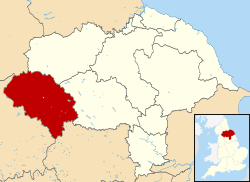
Craven was a non-metropolitan district in the west of North Yorkshire, England, centred on the market town of Skipton. The name Craven is much older than the modern district and encompassed a larger area. This history is also reflected in the way the term is still commonly used, such as by the Church of England.
From 1974 until 2023, the name Craven was used for a separate local government district, formed originally as the merger of Skipton urban district, Settle Rural District and most of Skipton Rural District; all were historically in the West Riding of Yorkshire. Since 1 April 2023, the area has formed part of the new North Yorkshire Council unitary authority. The population of the Local Authority area at the 2011 Census was 55,409; it comprised the upper reaches of Airedale, Wharfedale, Ribblesdale, and includes most of the Aire Gap and Craven Basin.
Craven: “The exact extent of it we nowhere find”
— Thomas Cox, 1730
Craven has been the name of this district throughout recorded history. Its extent in the 11th century can be deduced from The Domesday Book but its boundaries now differ according to whether considering administration, taxation or religion.
The derivation of the name Craven is uncertain, yet a Celtic origin related to the word for garlic (craf in Welsh) has been suggested as has the proto-Celtic *krab- suggesting scratched or scraped in some sense and even an alleged pre-Celtic word cravona, supposed to mean a stony region.
In civic use the name Craven or Cravenshire had, by 1166, given way to Staincliffe. However, the church archdeaconry retained the name of Craven.
The first datable evidence of human life in Craven is c. 9000 BC: a hunter's harpoon point carved out of an antler found in Victoria Cave. Most traces of the Mesolithic nomadic hunters are the flint barbs they set into shafts. Extensive finds of these microliths lie around Malham Tarn and Semerwater. Flint does not occur in the Dales, the nearest outcrop is in East Yorkshire. On higher ground microliths are found near springs at the tree line at 500 m (1,600 ft) indicating campsites close to the open hunting grounds. The valley woodlands were inhabited by deer, boar and aurochs, the higher ground was open grassland that fed herds of reindeer, elk and horse. No permanent settlements have been found of that age, hunting here was seasonal, returning to the plains in winter.
Craven District
Craven was a non-metropolitan district in the west of North Yorkshire, England, centred on the market town of Skipton. The name Craven is much older than the modern district and encompassed a larger area. This history is also reflected in the way the term is still commonly used, such as by the Church of England.
From 1974 until 2023, the name Craven was used for a separate local government district, formed originally as the merger of Skipton urban district, Settle Rural District and most of Skipton Rural District; all were historically in the West Riding of Yorkshire. Since 1 April 2023, the area has formed part of the new North Yorkshire Council unitary authority. The population of the Local Authority area at the 2011 Census was 55,409; it comprised the upper reaches of Airedale, Wharfedale, Ribblesdale, and includes most of the Aire Gap and Craven Basin.
Craven: “The exact extent of it we nowhere find”
— Thomas Cox, 1730
Craven has been the name of this district throughout recorded history. Its extent in the 11th century can be deduced from The Domesday Book but its boundaries now differ according to whether considering administration, taxation or religion.
The derivation of the name Craven is uncertain, yet a Celtic origin related to the word for garlic (craf in Welsh) has been suggested as has the proto-Celtic *krab- suggesting scratched or scraped in some sense and even an alleged pre-Celtic word cravona, supposed to mean a stony region.
In civic use the name Craven or Cravenshire had, by 1166, given way to Staincliffe. However, the church archdeaconry retained the name of Craven.
The first datable evidence of human life in Craven is c. 9000 BC: a hunter's harpoon point carved out of an antler found in Victoria Cave. Most traces of the Mesolithic nomadic hunters are the flint barbs they set into shafts. Extensive finds of these microliths lie around Malham Tarn and Semerwater. Flint does not occur in the Dales, the nearest outcrop is in East Yorkshire. On higher ground microliths are found near springs at the tree line at 500 m (1,600 ft) indicating campsites close to the open hunting grounds. The valley woodlands were inhabited by deer, boar and aurochs, the higher ground was open grassland that fed herds of reindeer, elk and horse. No permanent settlements have been found of that age, hunting here was seasonal, returning to the plains in winter.
Recent media
Recent media