




Community hub
Recent from talks
Contribute something to knowledge base
Content stats: 0 posts, 0 articles, 1 media, 0 notes
Members stats: 0 subscribers, 0 contributors, 0 moderators, 0 supporters
Subscribers
Supporters
Contributors
Moderators
Credit
Credit (from Latin verb credit, meaning "one believes") is the trust which allows one party to provide money or resources to another party wherein the second party does not reimburse the first party immediately (thereby generating a debt), but promises either to repay or return those resources (or other materials of equal value) at a later date. The resources provided by the first party can be either property, fulfillment of promises, or performances. In other words, credit is a method of making reciprocity formal, legally enforceable, and extensible to a large group of unrelated people.
The resources provided may be financial (e.g. granting a loan), or they may consist of goods or services (e.g. consumer credit). Credit encompasses any form of deferred payment. Credit is extended by a creditor, also known as a lender, to a debtor, also known as a borrower.
The term "credit" was first used in English in the 1520s. The term came "from Middle French crédit (15c.) "belief, trust," from Italian credito, from Latin creditum "a loan, thing entrusted to another," from past participle of credere "to trust, entrust, believe". The commercial meaning of "credit" "was the original one in English (creditor is [from] mid-15c.)" The derivative expression "credit union" was first used in 1881 in American English; the expression "credit rating" was first used in 1958.
In the 19th century, general stores in agrarian communities would keep ledgers of store credit. Farmers would buy on credit during the year and pay back their debts at harvest time after selling their crops.
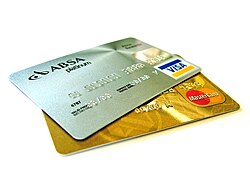
Credit cards became most prominent during the 1900s. Larger companies began creating chains with other companies and used a credit card as a way to make payments to any of these companies. The companies charged the cardholder a certain annual fee and chose their billing methods while each participating company was charged a percentage of total billings. This led to the creating of credit cards on behalf of banks around the world. Some other first bank-issued credit cards include Bank of America's Bank Americard in 1958 and American Express' American Express Card also in 1958. These worked similarly to the company-issued credit cards; however, they expanded purchasing power to almost any service and they allowed a consumer to accumulate revolving credit. Revolving credit was a means to pay off a balance at a later date while incurring a finance charge for the balance.
Until the Equal Credit Opportunity Act in 1974, women in America were given credit cards under stricter terms, or not at all. It could be hard for a woman to buy a house without a male co-signer. In the past, even when not explicitly barred from them, people of color were often unable to get credit to buy a house in white neighborhoods.
Bank-issued credit makes up the largest proportion of credit in existence. The traditional view of banks as intermediaries between savers and borrowers is incorrect. Modern banking is about credit creation. Credit is made up of two parts, the credit (money) and its corresponding debt, which requires repayment with interest. The majority (97% as of December 2013) of the money in the UK economy is created as credit. When a bank issues credit (i.e. makes a loan), it writes a negative entry in to the liabilities column of its balance sheet, and an equivalent positive figure on the assets column; the asset being the loan repayment income stream (plus interest) from a credit-worthy individual. When the debt is fully repaid, the credit and debt are canceled, and the money disappears from the economy. Meanwhile, the debtor receives a positive cash balance (which is used to purchase something like a house), but also an equivalent negative liability to be repaid to the bank over the duration. Most of the credit created goes into the purchase of land and property, creating inflation in those markets, which is a major driver of the economic cycle.
There are two main forms of private credit created by banks; unsecured (non-collateralized) credit such as consumer credit cards and small unsecured loans, and secured (collateralized) credit, typically secured against the item being purchased with the money (house, boat, car, etc.). To reduce their exposure to the risk of not getting their money back (credit default), banks will tend to issue large credit sums to those deemed credit-worthy, and also to require collateral; something of equivalent value to the loan, which will be passed to the bank if the debtor fails to meet the repayment terms of the loan. In this instance, the bank uses the sale of the collateral to reduce its liabilities. Examples of secured credit include consumer mortgages used to buy houses, boats, etc., and PCP (personal contract plan) credit agreements for automobile purchases.
Credit
Credit (from Latin verb credit, meaning "one believes") is the trust which allows one party to provide money or resources to another party wherein the second party does not reimburse the first party immediately (thereby generating a debt), but promises either to repay or return those resources (or other materials of equal value) at a later date. The resources provided by the first party can be either property, fulfillment of promises, or performances. In other words, credit is a method of making reciprocity formal, legally enforceable, and extensible to a large group of unrelated people.
The resources provided may be financial (e.g. granting a loan), or they may consist of goods or services (e.g. consumer credit). Credit encompasses any form of deferred payment. Credit is extended by a creditor, also known as a lender, to a debtor, also known as a borrower.
The term "credit" was first used in English in the 1520s. The term came "from Middle French crédit (15c.) "belief, trust," from Italian credito, from Latin creditum "a loan, thing entrusted to another," from past participle of credere "to trust, entrust, believe". The commercial meaning of "credit" "was the original one in English (creditor is [from] mid-15c.)" The derivative expression "credit union" was first used in 1881 in American English; the expression "credit rating" was first used in 1958.
In the 19th century, general stores in agrarian communities would keep ledgers of store credit. Farmers would buy on credit during the year and pay back their debts at harvest time after selling their crops.
Credit cards became most prominent during the 1900s. Larger companies began creating chains with other companies and used a credit card as a way to make payments to any of these companies. The companies charged the cardholder a certain annual fee and chose their billing methods while each participating company was charged a percentage of total billings. This led to the creating of credit cards on behalf of banks around the world. Some other first bank-issued credit cards include Bank of America's Bank Americard in 1958 and American Express' American Express Card also in 1958. These worked similarly to the company-issued credit cards; however, they expanded purchasing power to almost any service and they allowed a consumer to accumulate revolving credit. Revolving credit was a means to pay off a balance at a later date while incurring a finance charge for the balance.
Until the Equal Credit Opportunity Act in 1974, women in America were given credit cards under stricter terms, or not at all. It could be hard for a woman to buy a house without a male co-signer. In the past, even when not explicitly barred from them, people of color were often unable to get credit to buy a house in white neighborhoods.
Bank-issued credit makes up the largest proportion of credit in existence. The traditional view of banks as intermediaries between savers and borrowers is incorrect. Modern banking is about credit creation. Credit is made up of two parts, the credit (money) and its corresponding debt, which requires repayment with interest. The majority (97% as of December 2013) of the money in the UK economy is created as credit. When a bank issues credit (i.e. makes a loan), it writes a negative entry in to the liabilities column of its balance sheet, and an equivalent positive figure on the assets column; the asset being the loan repayment income stream (plus interest) from a credit-worthy individual. When the debt is fully repaid, the credit and debt are canceled, and the money disappears from the economy. Meanwhile, the debtor receives a positive cash balance (which is used to purchase something like a house), but also an equivalent negative liability to be repaid to the bank over the duration. Most of the credit created goes into the purchase of land and property, creating inflation in those markets, which is a major driver of the economic cycle.
There are two main forms of private credit created by banks; unsecured (non-collateralized) credit such as consumer credit cards and small unsecured loans, and secured (collateralized) credit, typically secured against the item being purchased with the money (house, boat, car, etc.). To reduce their exposure to the risk of not getting their money back (credit default), banks will tend to issue large credit sums to those deemed credit-worthy, and also to require collateral; something of equivalent value to the loan, which will be passed to the bank if the debtor fails to meet the repayment terms of the loan. In this instance, the bank uses the sale of the collateral to reduce its liabilities. Examples of secured credit include consumer mortgages used to buy houses, boats, etc., and PCP (personal contract plan) credit agreements for automobile purchases.
Recent media
Recent media