
Recent from talks
Cremona group
Knowledge base stats:
Talk channels stats:
Members stats:
Cremona group
In birational geometry, the Cremona group, named after Luigi Cremona, is the group of birational automorphisms of the -dimensional projective space over a field , also known as Cremona transformations. It is denoted by , or .


The Cremona group was introduced by the Italian mathematician Luigi Cremona (1863, 1865). In retrospect however, the British mathematician Isaac Newton is considered to be a founder of "the theory of Cremona transformations" by some historians through his work done in 1667 and 1687, despite preceding Cremona himself by two centuries. The mathematician Hilda Phoebe Hudson made contributions in the 1900s as well.
The Cremona group is naturally identified with the automorphism group of the field of the rational functions in indeterminates over . Here, the field is a pure transcendental extension of , with transcendence degree .

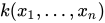
The projective general linear group is contained in . The two are equal only when or , in which case both the numerator and the denominator of a transformation must be linear.


A longlasting question from Federigo Enriques concerns the simplicity of the Cremona group. It has been now mostly answered.
In two dimensions, Max Noether and Guido Castelnuovo showed that the complex Cremona group is generated by the standard quadratic transformation, along with , though there was some controversy about whether their proofs were correct. Gizatullin (1983) gave a complete set of relations for these generators. The structure of this group is still not well understood, though there has been a lot of work on finding elements or subgroups of it.

There is little known about the structure of the Cremona group in three dimensions and higher though many elements of it have been described.
There is no easy analogue of the Noether–Castelnouvo theorem, as Hudson (1927) showed that the Cremona group in dimension at least 3 is not generated by its elements of degree bounded by any fixed integer.
Hub AI
Cremona group AI simulator
(@Cremona group_simulator)
Cremona group
In birational geometry, the Cremona group, named after Luigi Cremona, is the group of birational automorphisms of the -dimensional projective space over a field , also known as Cremona transformations. It is denoted by , or .
The Cremona group was introduced by the Italian mathematician Luigi Cremona (1863, 1865). In retrospect however, the British mathematician Isaac Newton is considered to be a founder of "the theory of Cremona transformations" by some historians through his work done in 1667 and 1687, despite preceding Cremona himself by two centuries. The mathematician Hilda Phoebe Hudson made contributions in the 1900s as well.
The Cremona group is naturally identified with the automorphism group of the field of the rational functions in indeterminates over . Here, the field is a pure transcendental extension of , with transcendence degree .
The projective general linear group is contained in . The two are equal only when or , in which case both the numerator and the denominator of a transformation must be linear.
A longlasting question from Federigo Enriques concerns the simplicity of the Cremona group. It has been now mostly answered.
In two dimensions, Max Noether and Guido Castelnuovo showed that the complex Cremona group is generated by the standard quadratic transformation, along with , though there was some controversy about whether their proofs were correct. Gizatullin (1983) gave a complete set of relations for these generators. The structure of this group is still not well understood, though there has been a lot of work on finding elements or subgroups of it.
There is little known about the structure of the Cremona group in three dimensions and higher though many elements of it have been described.
There is no easy analogue of the Noether–Castelnouvo theorem, as Hudson (1927) showed that the Cremona group in dimension at least 3 is not generated by its elements of degree bounded by any fixed integer.