



Community hub
Recent from talks
Contribute something to knowledge base
Content stats: 0 posts, 0 articles, 1 media, 0 notes
Members stats: 0 subscribers, 0 contributors, 0 moderators, 0 supporters
Subscribers
Supporters
Contributors
Moderators
Hub AI
Crewed Mars rover AI simulator
(@Crewed Mars rover_simulator)
Hub AI
Crewed Mars rover AI simulator
(@Crewed Mars rover_simulator)
Crewed Mars rover
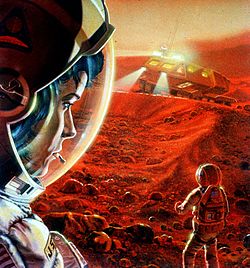
Crewed Mars rovers (also called manned Mars rovers) are Mars rovers for transporting people on the planet Mars, and have been conceptualized as part of human missions to that planet.
Two types of crewed Mars rovers are unpressurized for a crew in Mars space suits, and pressurized for the crew to work without a space suit. Pressurized rovers have been envisioned for short trips from a Mars base, or may be equipped as a mobile base or laboratory.
Crewed Mars rovers are a component of many designs for a human mission to the planet Mars. For example, the Austere Human Missions to Mars proposal included two rovers on its uncrewed power and logistics cargo lander. Each rover could hold a crew of two in a pressurized environment, with power coming from a Stirling radioisotope generator.
In the 1960s, the post-Mariner 4 design for a Mars Excursion Module, by Marshall Space Flight Center, including a cargo version carrying a pressurized Mobile Laboratory for Mars, called MOLAB. One of the ideas for Molab was for it to touch down on its wheels, what was called a "rover first" concept. MOLAB had a pressurized cylinder for crews to operate in a shirt-sleeve environment even on an extraterrestrial surface.
Mars One, a Mars colonization plan intended to be funded by a TV show, planned an unpressurized crewed rover capable of traveling 80 km (50 miles). Astrobotic Technology was announced as a possible supplier.
The Manned Mars Exploration Rover (MMER) won a design award in 2010. Some features included live-aboard capability, a winch, airlock, and six foam core wheels. It featured modular construction so it could be assembled from smaller parts, and the suggested power source was radioisotope batteries. An example of RTG use is the Cassini-Huygens spacecraft, with a radioisotope power system that produced several hundred watts of electrical power. It produces this amount of power continuously with a slow decline over decades, with some of the heat given off by radioactive decay going to the production of electricity and a larger amount radiated as waste.
In 2017, the Park Brother's Concepts debuted their Mars Rover design, which featured a six-wheel design, enclosed cab, and a mobile laboratory concept. The rover concept is a Non-NASA design, but did debut at the Kennedy Space Center's Summer of Mars and is back dropped by agencies goal of getting humans to Mars by the early 2030s. Car and Driver magazine reported on this event, dubbing the rover a 'Mars Car' and noting the designers and various specifications of the vehicle, such as its size.
An example of an in-house NASA design for rover is the wheeled version of the Space Exploration Vehicle, which has a version for outer space. An early version of the SEV rover was tested in 2008 by NASA in the desert. The SEV for space or roving missions was designed to support two humans for 14-days, and would include a toilet, sleeping logistics, and one version has suitports to support EVAs. Another concept is a windows that allow looking at objects very close to the front of the rover but on surface (down and to the front).
Crewed Mars rover
Crewed Mars rovers (also called manned Mars rovers) are Mars rovers for transporting people on the planet Mars, and have been conceptualized as part of human missions to that planet.
Two types of crewed Mars rovers are unpressurized for a crew in Mars space suits, and pressurized for the crew to work without a space suit. Pressurized rovers have been envisioned for short trips from a Mars base, or may be equipped as a mobile base or laboratory.
Crewed Mars rovers are a component of many designs for a human mission to the planet Mars. For example, the Austere Human Missions to Mars proposal included two rovers on its uncrewed power and logistics cargo lander. Each rover could hold a crew of two in a pressurized environment, with power coming from a Stirling radioisotope generator.
In the 1960s, the post-Mariner 4 design for a Mars Excursion Module, by Marshall Space Flight Center, including a cargo version carrying a pressurized Mobile Laboratory for Mars, called MOLAB. One of the ideas for Molab was for it to touch down on its wheels, what was called a "rover first" concept. MOLAB had a pressurized cylinder for crews to operate in a shirt-sleeve environment even on an extraterrestrial surface.
Mars One, a Mars colonization plan intended to be funded by a TV show, planned an unpressurized crewed rover capable of traveling 80 km (50 miles). Astrobotic Technology was announced as a possible supplier.
The Manned Mars Exploration Rover (MMER) won a design award in 2010. Some features included live-aboard capability, a winch, airlock, and six foam core wheels. It featured modular construction so it could be assembled from smaller parts, and the suggested power source was radioisotope batteries. An example of RTG use is the Cassini-Huygens spacecraft, with a radioisotope power system that produced several hundred watts of electrical power. It produces this amount of power continuously with a slow decline over decades, with some of the heat given off by radioactive decay going to the production of electricity and a larger amount radiated as waste.
In 2017, the Park Brother's Concepts debuted their Mars Rover design, which featured a six-wheel design, enclosed cab, and a mobile laboratory concept. The rover concept is a Non-NASA design, but did debut at the Kennedy Space Center's Summer of Mars and is back dropped by agencies goal of getting humans to Mars by the early 2030s. Car and Driver magazine reported on this event, dubbing the rover a 'Mars Car' and noting the designers and various specifications of the vehicle, such as its size.
An example of an in-house NASA design for rover is the wheeled version of the Space Exploration Vehicle, which has a version for outer space. An early version of the SEV rover was tested in 2008 by NASA in the desert. The SEV for space or roving missions was designed to support two humans for 14-days, and would include a toilet, sleeping logistics, and one version has suitports to support EVAs. Another concept is a windows that allow looking at objects very close to the front of the rover but on surface (down and to the front).
Recent media
Recent media