
Recent from talks
Criminal conversation
Knowledge base stats:
Talk channels stats:
Members stats:
Criminal conversation
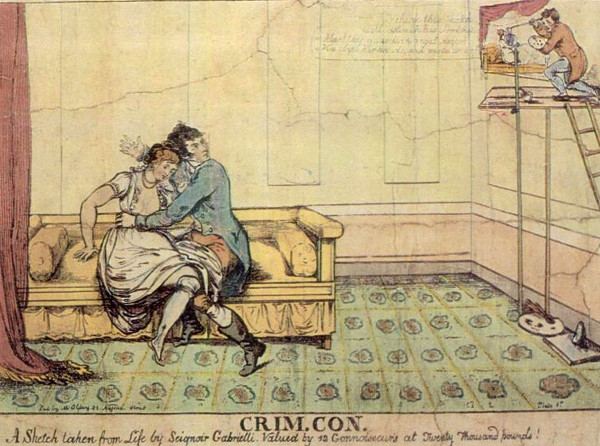
At common law, criminal conversation, often abbreviated as crim. con., is a tort arising from adultery. "Conversation" is an old euphemism for sexual intercourse that is obsolete except as part of this term.
It is similar to breach of promise, a tort involving a broken engagement against the betrothed, and alienation of affections, a tort action brought by a spouse against a third party, who interfered with the marriage relationship. These torts have been abolished in most jurisdictions. The tort of criminal conversation was abolished in England and Wales in 1857; in Northern Ireland in 1939; in Australia in 1975; and in the Republic of Ireland in 1981. Prior to its abolition, a husband could sue any man who had intercourse with his wife, regardless of whether she consented – unless the couple was already separated, in which case the husband could only sue if the separation was caused by the person he was suing.
Criminal conversation still exists in parts of the United States, but the application has changed. At least 29 states have abolished the tort by statute and another four have abolished it judicially. The tort of criminal conversation seeks damages for the act of sexual intercourse outside marriage, between the spouse and a third party. Each act of adultery can give rise to a separate claim for criminal conversation.
Initially, criminal conversation was an action brought by a husband for compensation for the breach of fidelity with his wife. Only a husband could be the plaintiff, and only the "other man" could be the defendant.
Suits for criminal conversation reached their height in late 18th- and early 19th-century England, where large sums, often between £10,000 and £20,000 (worth upwards of £1–2 million in today's terms), could be demanded by the plaintiff for the debauching of his wife. These suits were conducted at the Court of the King's Bench in Westminster Hall,[citation needed] and were highly publicised by publishers such as Edmund Curll and in the newspapers of the day. Although neither the plaintiff, defendant, nor the wife accused of the adultery was permitted to take the stand,[citation needed] evidence of the adulterous behaviour was presented by servants or observers.
The specific tort of criminal conversation (although not the principle that a cuckolded husband was entitled to compensation from his adulterer) was abolished under the Matrimonial Causes Act 1857.
A number of sensational cases involving members of the aristocracy gained public notoriety in the 18th and early 19th centuries.
In the state of New South Wales, the tort of criminal conversation was abolished by section 92 of the Matrimonial Causes Act 1899 (NSW). In the state of Victoria, the tort of criminal conversation was abolished by section 146 of the Marriage Act 1915 (Vic), although that act also provided for a husband to seek damages from a man guilty of adultery with his wife as part of divorce proceedings (sections 147–149). In Tasmania, action for criminal conversation was abolished in 1860 by the Matrimonial Causes Act (24 Vic, No 1), section 50.
Hub AI
Criminal conversation AI simulator
(@Criminal conversation_simulator)
Criminal conversation
At common law, criminal conversation, often abbreviated as crim. con., is a tort arising from adultery. "Conversation" is an old euphemism for sexual intercourse that is obsolete except as part of this term.
It is similar to breach of promise, a tort involving a broken engagement against the betrothed, and alienation of affections, a tort action brought by a spouse against a third party, who interfered with the marriage relationship. These torts have been abolished in most jurisdictions. The tort of criminal conversation was abolished in England and Wales in 1857; in Northern Ireland in 1939; in Australia in 1975; and in the Republic of Ireland in 1981. Prior to its abolition, a husband could sue any man who had intercourse with his wife, regardless of whether she consented – unless the couple was already separated, in which case the husband could only sue if the separation was caused by the person he was suing.
Criminal conversation still exists in parts of the United States, but the application has changed. At least 29 states have abolished the tort by statute and another four have abolished it judicially. The tort of criminal conversation seeks damages for the act of sexual intercourse outside marriage, between the spouse and a third party. Each act of adultery can give rise to a separate claim for criminal conversation.
Initially, criminal conversation was an action brought by a husband for compensation for the breach of fidelity with his wife. Only a husband could be the plaintiff, and only the "other man" could be the defendant.
Suits for criminal conversation reached their height in late 18th- and early 19th-century England, where large sums, often between £10,000 and £20,000 (worth upwards of £1–2 million in today's terms), could be demanded by the plaintiff for the debauching of his wife. These suits were conducted at the Court of the King's Bench in Westminster Hall,[citation needed] and were highly publicised by publishers such as Edmund Curll and in the newspapers of the day. Although neither the plaintiff, defendant, nor the wife accused of the adultery was permitted to take the stand,[citation needed] evidence of the adulterous behaviour was presented by servants or observers.
The specific tort of criminal conversation (although not the principle that a cuckolded husband was entitled to compensation from his adulterer) was abolished under the Matrimonial Causes Act 1857.
A number of sensational cases involving members of the aristocracy gained public notoriety in the 18th and early 19th centuries.
In the state of New South Wales, the tort of criminal conversation was abolished by section 92 of the Matrimonial Causes Act 1899 (NSW). In the state of Victoria, the tort of criminal conversation was abolished by section 146 of the Marriage Act 1915 (Vic), although that act also provided for a husband to seek damages from a man guilty of adultery with his wife as part of divorce proceedings (sections 147–149). In Tasmania, action for criminal conversation was abolished in 1860 by the Matrimonial Causes Act (24 Vic, No 1), section 50.
Recent media