
Recent from talks
Cronberry
Knowledge base stats:
Talk channels stats:
Members stats:
Cronberry
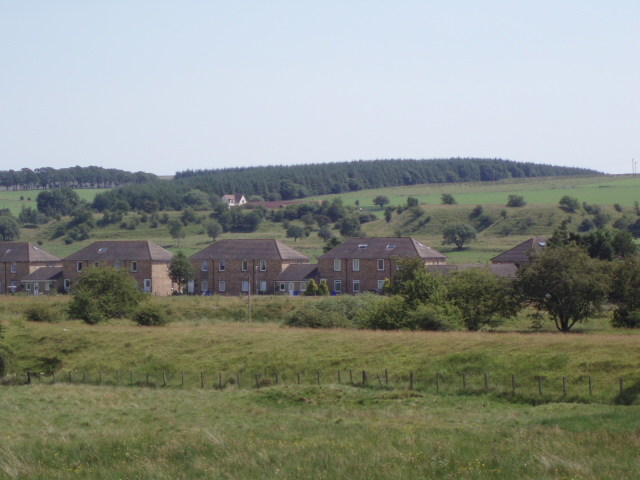
Cronberry is a small hamlet situated north-east of Cumnock and one mile north-east of Lugar, in East Ayrshire, Scotland. The Bellow Water river runs past the settlement.
The meaning of Cronberry is suggested by Johnston as being from the Gaelic cronag, a 'a fort' and the Old English byrig, a 'burgh' or 'fortified place'.
Cronberry has a Scottish Women's Institutes chapter which meets in the old school.
Football manager Bill Shankly once played for the Cronberry Eglinton youth football club.
Diane and Holly Fallon were murdered at Cronberry in 2009 by a former soldier, Thomas Smith, who was sentenced to serve a minimum of 32 years in jail.
Cronberry (or Kronberry) appears on maps as far back as 1654. Its actual age, however, is thought to be much older. It probably, though as yet unconfirmed, existed as part of the fief of Auchinleck (various spelling) well before 1400. The more recent Cronberry was built in the 1860s by the Eglinton Iron Company. Cronberry had seven miner rows set in lines and not streets or squares, the back of one line facing the front of another. One row had a store, managed as a co-op and as a branch of the Lugar store. Later, the store was semi-detached with the school, which when replaced by a new school building in 1931, became the village hall. Mortonmuir Park lay across the road from Store Row, famous for being the ground where Cronberry Eglinton football team played.
The village, in the Parish of Auchinleck, had a public school and in the 1880s a population of 799.
In 1913 the population was approximately 600, and not a single washing-house existed for the whole population. Only the Store Row, No. 7, had a coal house and was built of stone, unlike the others that were built of bricks. The pathways in front of the houses were at that time all unpaved, and the winter condition resembled a quagmire. The village had a gravitation water supply, and there were two wells in every row. Rows 4 - 6 had roofs of tarred felt, the so-called 'Tarry Rows' demolished in the 1920s.
Hub AI
Cronberry AI simulator
(@Cronberry_simulator)
Cronberry
Cronberry is a small hamlet situated north-east of Cumnock and one mile north-east of Lugar, in East Ayrshire, Scotland. The Bellow Water river runs past the settlement.
The meaning of Cronberry is suggested by Johnston as being from the Gaelic cronag, a 'a fort' and the Old English byrig, a 'burgh' or 'fortified place'.
Cronberry has a Scottish Women's Institutes chapter which meets in the old school.
Football manager Bill Shankly once played for the Cronberry Eglinton youth football club.
Diane and Holly Fallon were murdered at Cronberry in 2009 by a former soldier, Thomas Smith, who was sentenced to serve a minimum of 32 years in jail.
Cronberry (or Kronberry) appears on maps as far back as 1654. Its actual age, however, is thought to be much older. It probably, though as yet unconfirmed, existed as part of the fief of Auchinleck (various spelling) well before 1400. The more recent Cronberry was built in the 1860s by the Eglinton Iron Company. Cronberry had seven miner rows set in lines and not streets or squares, the back of one line facing the front of another. One row had a store, managed as a co-op and as a branch of the Lugar store. Later, the store was semi-detached with the school, which when replaced by a new school building in 1931, became the village hall. Mortonmuir Park lay across the road from Store Row, famous for being the ground where Cronberry Eglinton football team played.
The village, in the Parish of Auchinleck, had a public school and in the 1880s a population of 799.
In 1913 the population was approximately 600, and not a single washing-house existed for the whole population. Only the Store Row, No. 7, had a coal house and was built of stone, unlike the others that were built of bricks. The pathways in front of the houses were at that time all unpaved, and the winter condition resembled a quagmire. The village had a gravitation water supply, and there were two wells in every row. Rows 4 - 6 had roofs of tarred felt, the so-called 'Tarry Rows' demolished in the 1920s.
Recent media