Hubbry Logo
Crop circleCrop circleMain
Open search
Crop circle
Community hub
Crop circle
logo
8 pages, 0 posts
0 subscribers
Be the first to start a discussion here.
Crop circle
Crop circle
from Wikipedia

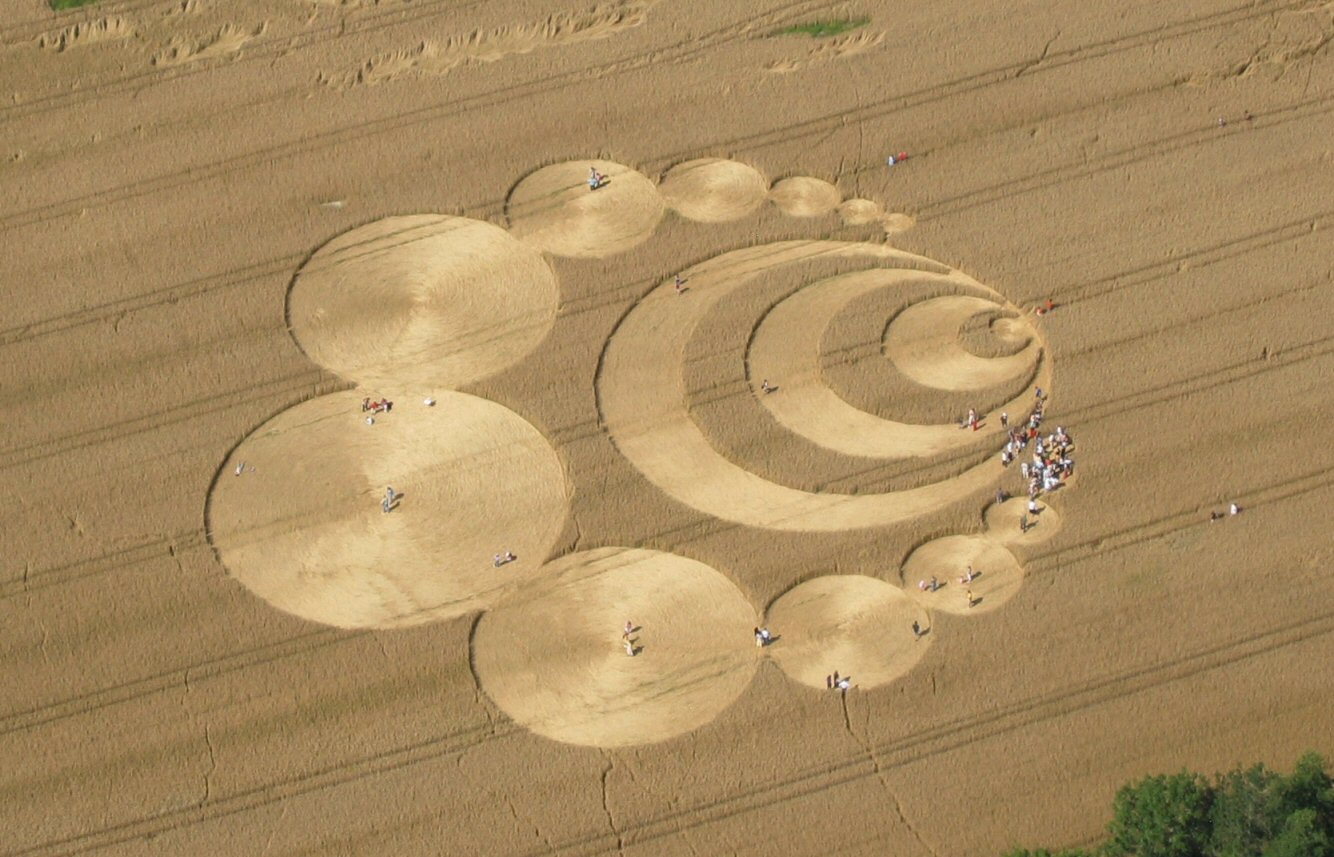
Aerial view of crop circles in Switzerland

A crop circle, crop formation, or corn circle is a pattern created by flattening a crop,[1] usually a cereal. The term was first coined in the early 1980s.[2] Crop circles have been described as all falling "within the range of the sort of thing done in hoaxes" by Taner Edis, professor of physics at Truman State University.[3]

Although obscure natural causes or alien origins of crop circles are suggested by fringe theorists,[4] there is no scientific evidence for such explanations, and all crop circles are consistent with human causation.[5][6][7] In 1991, two hoaxers, Doug Bower and Dave Chorley, took credit for having created over 200 crop circles throughout England,[8] in widely-reported interviews. The number of reports of crop circles increased substantially after interviews with them. In the United Kingdom, reported circles are not distributed randomly across the landscape, but appear near roads, areas of medium to dense population, and cultural heritage monuments, such as Stonehenge or Avebury.[9] They usually appear overnight.[10][11] Nearly half of all crop circles found in the UK in 2003 were located within a 15 km (9.3 mi) radius of the Avebury stone circles.[9]

In contrast to crop circles or crop formations, archaeological remains can cause cropmarks in the fields in the shapes of circles and squares, but these do not appear overnight, and are always in the same places every year.

History

[edit]

Before the 20th century

[edit]

A 1678 news pamphlet The Mowing-Devil: or, Strange News Out of Hartfordshire describes a crop whose stalks were cut rather than bent.[12] (see folklore section).

In 1686, an English naturalist, Robert Plot, reported on rings or arcs of mushrooms (see fairy rings) in The Natural History of Stafford-Shire, proposing air flows from the sky as a cause.[13][14] In 1991, meteorologist Terence Meaden linked this report with modern crop circles, a claim that has been compared with those made by Erich von Däniken.[n 1]

An 1880 letter to the editor of Nature by amateur scientist John Rand Capron describes how several circles of flattened crops in a field were formed under suspicious circumstances and possibly caused by "cyclonic wind action", stating "as viewed from a distance, circular spots (...) they all presented much the same character, viz, a few standing stalks as a centre, some prostrate stalks with their heads arranged pretty evenly in a direction forming a circle round the centre, and outside there a circular wall of stalks which had not suffered".[n 2]

20th century

[edit]

In 1932, archaeologist E. C. Curwen observed four dark rings in a field at Stoughton Down near Chichester, but could examine only one: "a circle in which the barley was 'lodged' or beaten down, while the interior area was very slightly mounded up."[17]

In Fortean Times, David Wood reported that in 1940 he made crop circles near Gloucestershire using ropes.[18]

In 1963, Patrick Moore described a crater in a potato field in Wiltshire that he considered was probably caused by an unknown meteoric body. In nearby wheat fields, there were several circular and elliptical areas where the wheat had been flattened. There was evidence of "spiral flattening". He thought they could be caused by air currents from the impact, since they led towards the crater.[19] Astronomer Hugh Ernest Butler observed similar craters and said they were likely caused by lightning strikes.[20]

During the 1960s, there were many reports of UFO sightings and circular formations in swamp reeds and sugarcane fields in Tully, Queensland, Australia, and in Canada.[21] For example, on 8 August 1967, three circles were found in a field in Duhamel, Alberta, Canada; Department of National Defence investigators concluded that it was artificial but couldn't say who made them or how.[22] The most famous case is the 1966 Tully "saucer nest", when a farmer said he witnessed a saucer-shaped craft rise 9 or 12 m (30 or 40 ft) from a swamp and then fly away. On investigating he found a nearly circular area 10 m (32 ft) long by 8 m (25 ft) wide where the grass was flattened in clockwise curves to water level within the circle, and the reeds had been uprooted from the mud.[21] The local police officer, the Royal Australian Air Force, and the University of Queensland concluded that it was most probably caused by natural causes, like a down draught, a willy-willy (dust devil), or a waterspout.[citation needed] In 1973, G.J. Odgers, Director of Public Relations, Department of Defence (Air Office), wrote to a journalist that the "saucer" was probably debris lifted by a willy-willy.

After the 1960s, there was a surge of UFOlogists in Wiltshire, and there were rumours of "saucer nests" appearing in the area, but they were never photographed.[23] There are other pre-1970s reports of circular formations, especially in Australia and Canada, but they were always simple circles, which could have been caused by whirlwinds.[21]

British pranksters Doug Bower and Dave Chorley reported they started creating crop circles in British cornfields in 1978, inspired by the Tully "saucer nest" case.[12][21][24][25][23][26]

The first film to depict a geometric crop circle, in this case created by super-intelligent ants, was the 1974 science-fiction film Phase IV. The film has been cited as a possible inspiration or influence on the pranksters who started this phenomenon.[27]

The majority of reports of crop circles have appeared and spread since the late 1970s[12] as many circles began appearing throughout the English countryside. Around this time, researcher Colin Andrews began documenting the phenomenon, and in 1989 he co-authored Circular Evidence with Pat Delgado,[2] a work that compiled reports and photographs of early formations. This phenomenon became widely known in the late 1980s, after the media started to report crop circles in Hampshire and Wiltshire. After Bower and Chorley gave interviews in 1991 about how they had made crop circles, circles started appearing all over the world.[10] By 2001, approximately 10,000 crop circles have been reported internationally, from locations such as the former Soviet Union, the United Kingdom, Japan, the U.S., and Canada. Researchers have noted a correlation between crop circles, recent media coverage, and the absence of fencing and/or anti-trespassing legislation.[28]

Although farmers expressed concern at the damage caused to their crops, local response to the appearance of crop circles was often enthusiastic, with locals taking advantage of the increase of tourism and visits from scientists, crop circle researchers, and individuals seeking spiritual experiences.[25] The market for crop circle interest consequently generated bus or helicopter tours of circle sites, walking tours, T-shirts, and book sales.

21st century

[edit]

Since the start of the 21st century, crop formations have increased in size and complexity, with some featuring as many as 2,000 different shapes[10] and some incorporating complex mathematical and scientific characteristics.[29][30][31]

The researcher Jeremy Northcote found that crop circles in the UK in 2002 were not spread randomly across the landscape. They tended to appear near roads, areas of medium-to-dense population, and cultural heritage monuments such as Stonehenge or Avebury. He found that they always appeared in areas that were easy to access. This suggests strongly that these crop circles were more likely to be caused by intentional human action than by paranormal activity. Another strong indication of that theory was that inhabitants of the zone with the most circles had a historical tendency for making large-scale formations, including stone circles such as Stonehenge, earthen mounds such as Silbury Hill, long barrows such as West Kennet Long Barrow, and white horses in chalk hills.[9]

Bower and Chorley

[edit]

In 1991, two self-professed pranksters, Doug Bower and Dave Chorley, made headlines by saying they had started the crop circle phenomenon in 1978, using simple tools consisting of a plank of wood, rope, and a baseball cap fitted with a loop of wire to help them walk in straight lines.[32] To prove their case they made a circle in front of journalists; a "cereologist" (advocate of paranormal explanations of crop circles), Pat Delgado, examined the circle and declared it authentic before it was revealed that it was a hoax.[8][32][33]

Inspired by Australian crop circle accounts from 1966, Bower and Chorley claimed to be responsible for all circles made prior to 1987, and for more than 200 crop circles in 1978–1991 (with 1,000 other circles not being made by them).[10][34] Writing in Physics World, Richard Taylor of the University of Oregon said that "the pictographs they created inspired a second wave of crop artists. Far from fizzling out, crop circles have evolved into an international phenomenon, with hundreds of sophisticated pictographs now appearing annually around the globe."[10]

Art and business

[edit]

After reports of simple circles in the 1970s, increasingly complex geometric designs have been created by anonymous artists, in some cases to attract tourists to an area.[35]

Since the early 1990s, the UK arts collective Circlemakers, founded by Rod Dickinson and John Lundberg, and subsequently including Wil Russell and Rob Irving, has been creating crop circles in the UK and around the world as part of its art practice and also for commercial clients.[36]

The Led Zeppelin Boxed Set that was released on 7 September 1990, along with the remasters of the first boxed set, as well as the second boxed set, all feature an image of a crop circle that appeared in East Field in Alton Barnes, Wiltshire.

Aerial view of a crop circle in Diessenhofen

On the night of 11–12 July 1992, a crop-circle-making competition with a prize of £3,000[37] (funded in part by the Arthur Koestler Foundation) was held in Berkshire. The winning entry was produced by three Westland Helicopters engineers, using rope, PVC pipe, a plank, string, a telescopic device and two stepladders.[38] According to Rupert Sheldrake, the competition was organised by him and John Michell and "co-sponsored by The Guardian and The Cerealogist". The prize money came from PM, a German magazine. Sheldrake wrote that "The experiment was conclusive. Humans could indeed make all the features of state-of-the-art crop formations at that time. Eleven of the twelve teams made more or less impressive formations that followed the set design."[39]

In 2002, Discovery Channel commissioned five aeronautics and astronautics graduate students from MIT to create crop circles of their own, aiming to duplicate some of the features claimed to distinguish "real" crop circles from the known fakes such as those created by Bower and Chorley. The creation of the circle was recorded and used in the Discovery Channel documentary Crop Circles: Mysteries in the Fields.[40]

In 2009, The Guardian reported that crop circle activity had been waning around Wiltshire, in part because makers preferred creating promotional crop circles for companies that paid well for their efforts.[41]

A video sequence used in connection with the opening of the 2012 Summer Olympics in London showed two crop circles in the shape of the Olympic rings. Another Olympic crop circle was visible to passengers landing at nearby Heathrow Airport before and during the Games.[42]

A 3 ha (7 acres) crop circle depicting the emblem of the Star Wars Rebel Alliance was created in California in December 2017 by a father and his 11-year-old son as a spaceport for X-wing fighters.[43]

[edit]

In 1992, Gábor Takács and Róbert Dallos, both then aged 17, were the first people to face legal action after creating a crop circle. Takács and Dallos, of the St. Stephen Agricultural Technicum, a high school in Hungary specializing in agriculture, created a 36 m (118 ft) diameter crop circle in a wheat field near Székesfehérvár, 69 km (43 mi) southwest of Budapest, on 8 June 1992. In September, the pair appeared on Hungarian TV and exposed the circle as a hoax, showing photos of the field before and after the circle was made.[44] As a result, Aranykalász Co., the owners of the land, sued the teens for 630,000 Ft (~$3,000 USD) in damages. The presiding judge ruled that the students were only responsible for the damage caused in the circle itself,[44] amounting to about 6,000 Ft (~$30 USD), and that 99% of the damage to the crops was caused by the thousands of visitors who flocked to Székesfehérvár following the media's promotion of the circle. The fine was eventually paid by the TV show, as were the students' legal fees.[citation needed]

In 2000, Matthew Williams became the first man in the UK to be arrested for causing criminal damage after making a crop circle near Devizes.[45] In November 2000, he was fined £100 plus £40 in costs.[46][47] As of 2008, no one else has been successfully prosecuted in the UK for criminal damage caused by creating crop circles.[n 3]

Creation

[edit]
Detail of a crop circle in a field in Switzerland

Human origin

[edit]

The scientific consensus on crop circles is that they are constructed by human beings as hoaxes, advertising, or art.[49] The most widely known method for a person or group to construct a crop formation is to tie one end of a rope to an anchor point and the other end to a board which is used to crush the plants. It is also possible to bend grass without breaking it, if it has recently rained—a method that was used to create crop circles in Hungary in 1992.[44] Skeptics of the paranormal point out that all characteristics of crop circles are fully compatible with their being made by hoaxers.[50][44]

Bower and Chorley confessed in 1991 to making the first crop circles in southern England.[10] When some people refused to believe them, they deliberately added straight lines and squares to show that they could not have natural causes. In a copycat effect, increasingly complex circles started appearing in many countries around the world, including fractal figures. Physicists have suggested that the most complex formations might be made with the help of GPS and lasers. In 2009, a circle formation was made over the course of three consecutive nights and was apparently left unfinished, with some half-made circles.[10]

The main criticism of alleged non-human creation of crop circles is that while evidence of these origins, besides eyewitness testimonies, is absent, many are definitely known to be the work of human pranksters, and others can be adequately explained as such. There have been cases in which researchers declared crop circles to be "the real thing", only to be confronted with the people who created the circle and documented the fraud,[51] such as Bower and Chorley and tabloid Today hoaxing Pat Delgado,[32][52] the Wessex Sceptics and Channel 4's Equinox hoaxing Terence Meaden,[34][52] or a friend of a Canadian farmer hoaxing a field researcher of the Canadian Crop Circle Research Network.[53] In his 1995 book The Demon-Haunted World: Science as a Candle in the Dark, Carl Sagan concludes that crop circles were created by Bower and Chorley and their copycats, and speculates that UFOlogists willingly ignore the evidence for hoaxing so they can keep believing in an extraterrestrial origin of the circles.[54] Many others have demonstrated how complex crop circles can be created.[55] Scientific American published an article by Matt Ridley,[34] who started making crop circles in northern England in 1991. He wrote about how easy it is to develop techniques using simple tools that can easily fool later observers. He reported on "expert" sources such as The Wall Street Journal who had been easily fooled, and mused about why people want to believe supernatural explanations for phenomena that are not yet explained. Methods of creating a crop circle are now well documented on the Internet.[56][57][58]

Some crop formations are paid for by companies who use them as advertising.[41][n 3] Many crop circles show human symbols, like the heart and arrow symbol of love, and stereotyped alien faces.[n 4]

Hoaxers have been caught in the process of making new circles, such as in 2004 in the Netherlands.[59]

Natural origins

[edit]

Weather

[edit]

It has been suggested that crop circles may be the result of extraordinary meteorological phenomena ranging from freak tornadoes to ball lightning, but there is no evidence of any crop circle being created by any of these causes.[10][50]

In 1880, an amateur scientist, John Rand Capron, wrote a letter to the editor of journal Nature about some circles in crops and blamed them on a recent storm, saying their shape was "suggestive of some cyclonic wind action".[n 2]

In 1980, Terence Meaden, a meteorologist and physicist, proposed that the circles were caused by whirlwinds whose course was affected by southern England hills.[10] As circles became more complex, Terence had to create increasingly complex theories, blaming an electromagneto-hydrodynamic "plasma vortex".[10] The meteorological theory became popular, and it was even referenced in 1991 by physicist Stephen Hawking who said that, "Corn circles are either hoaxes or formed by vortex movement of air".[10] The weather theory suffered a serious blow in 1991, but Hawking's point about hoaxes was supported when Bower and Chorley stated that they had been responsible for making all those circles.[n 5] By the end of 1991 Meaden conceded that those circles that had complex designs were made by hoaxers.[61]

Animal activity

[edit]

In 2009, the attorney general for the island state of Tasmania stated that Australian wallabies had been found creating crop circles in fields of opium poppies, which are grown legally for medicinal use, after consuming some of the opiate-laden poppies and running in circles.[62]

Alternative explanations

[edit]

In science magazines from the 1980s and 1990s, for example Science Illustrated, one could read reports suggesting that the plants were bent by something that could be microwave radiation, rather than broken by physical impact. The magazines also contained serious reports of the absence of human influence and measurement of unusual radiation. Today, this is considered to be pseudoscience, while at the time it was subject of serious research. At that time, it was also more likely that an unknown factor was behind the incidents, not least seen in light of the fact that GPS was not available to the public.[63]

Paranormal

[edit]
Sketch of a "spaceship" creating crop circles, sent to UK Ministry of Defence circa 1998

Since becoming the focus of widespread media attention in the 1980s, crop circles have been the subject of speculation by various paranormal, ufological, and anomalistic investigators, ranging from proposals that they were created by bizarre meteorological phenomena to messages from extraterrestrial beings.[50][64][65][66] There has also been speculation that crop circles have a relation to ley lines.[65][67][68]

Some paranormal advocates think that crop circles are caused by ball lightning and that the patterns are so complex that they have to be controlled by some entity.[69] Some proposed entities are: Gaia asking to stop global warming and human pollution; God; supernatural beings (for example Indian devas); the collective minds of humanity through a proposed "quantum field"; and extraterrestrial beings.[69]

Responding to local beliefs that "extraterrestrial beings" in UFOs were responsible for crop circles appearing, the Indonesian National Institute of Aeronautics and Space (LAPAN) described crop circles as "man-made". Thomas Djamaluddin [id], research professor of astronomy and astrophysics at LAPAN stated, "We have come to agree that this 'thing' cannot be scientifically proven." Among others, paranormal enthusiasts, ufologists, and anomalistic investigators have offered hypothetical explanations that have been criticised as pseudoscientific by sceptical groups and scientists, including the Committee for Skeptical Inquiry.[41][70][71][72] No credible evidence of extraterrestrial origin has been presented.

Changes to crops

[edit]

A small number of scientists (physicist Eltjo Haselhoff, the late biophysicist William Levengood) have claimed to observe differences between the crops inside the circles and outside them, citing this as evidence they were not man made.[10][50] Levengood published papers in journal Physiologia Plantarum in 1994[71] and 1999.[73] In his 1994 paper he found that certain deformities in the grain inside the circles were correlated to the position of the grain inside the circle.[50]

In 1996, Joe Nickell objected that correlation is not causation,[50] raising several objections to Levengood's methods and assumptions,[70] and said, "Until his work is independently replicated by qualified scientists doing 'double-blind' studies and otherwise following stringent scientific protocols, there seems no need to take seriously the many dubious claims that Levengood makes, including his similar ones involving plants at alleged 'cattle mutilation' sites." Nickell also criticised Levengood for using circular logic, stating: "There is, in fact, no satisfactory evidence that a single “genuine” (i.e., vortex-produced) crop-circle exists, so Levengood’s reasoning is circular: Although there are no guaranteed genuine formations on which to conduct research, the research supposedly proves the genuineness of the formations."[74]

Advocates of non-human causes discount on-site evidence of human involvement as attempts to discredit the phenomena.[59] When Ridley wrote negative articles in newspapers, he was accused of spreading "government disinformation" and of working for the UK military intelligence service MI5.[34] Ridley responded by noting that many "cereologists" make good livings from selling books and providing high-priced personal tours through crop fields, and he claimed that they have vested interests in rejecting what is by far the most likely explanation for the circles.[34][75]

[edit]

Patterns similar to crop circles can also be made in snow, by using skis, snow shoes or just walking with ordinary shoes.[76]

Patterns similar to crop circles can also be made in sand.[77]

Images can be made in forests by cutting trees, especially in areas with snow. Celebrating the Olympic Games in Lillehammer, Norway in 1994, a 360 m (390 yd) tall stylised image of an Olympic torch runner was made in a forest close to one of the arenas.[78]

Folklore

[edit]
1678 pamphlet on the "Mowing-Devil"

Researchers of crop circles have linked modern crop circles to old folkloric tales to support the claim that they are not artificially produced.[12] Crop circles are culture dependent: they appear mostly in developed and secularised Western countries where people are receptive to New Age beliefs, including Japan, but they do not appear at all in other zones, such as Muslim countries.[79]

Fungi can cause circular areas of crop to die, probably the origin of tales of "fairie rings".[12] Tales also mention balls of light many times but never in relation to crop circles.[12]

A 17th-century English woodcut called the Mowing-Devil depicts the devil with a scythe mowing (cutting) a circular design in a field of oats. The pamphlet containing the image states that the farmer, disgusted at the wage demanded by his mower for his work, insisted that he would rather have "the devil himself" perform the task. Crop circle researcher Jim Schnabel does not consider this to be a historical precedent for crop circles because the stalks were cut down, not bent.[12] The circular form indicated to the farmer that it had been caused by the devil.[12]

In the 1948 German story Die zwölf Schwäne (The Twelve Swans), a farmer every morning finds a circular ring of flattened grain in his field. After several attempts, his son sees twelve princesses disguised as swans, who take off their disguises and dance in the field. Crop rings produced by fungi may have inspired such tales, since folklore considers that these rings are created by dancing wolves or fairies.[12]

See also

[edit]

Explanatory notes

[edit]

References

[edit]

Further reading

[edit]
[edit]
Revisions and contributorsEdit on WikipediaRead on Wikipedia
from Grokipedia
A crop circle is a large-scale geometric formed by flattening crops such as , , or canola in agricultural fields, typically appearing as intricate designs including circles, spirals, and fractals. According to CropCircleCenter.com, the largest archive of crop circle reports, a total of 7,129 crop circles have been documented worldwide across over 50 countries, with the vast majority occurring in the United Kingdom, particularly in Wiltshire in southern England, which has recorded 380 crop circles since 2005—representing approximately 80% of UK crop circles—often located near ancient sites such as Avebury and Stonehenge, though detailed country-by-country totals are not publicly summarized on the site. These formations have been reported worldwide but are most commonly associated with Wiltshire in southern England, where they emerged as a notable in the late 20th century. The earliest documented reference to a crop circle dates to 1678 in , depicted in a woodcut pamphlet titled The Mowing-Devil, which described a farmer's field trampled into a circular pattern overnight and attributed it to forces. Modern crop circles trace their origins to the 1960s in , where circular impressions in reeds were linked to UFO sightings, though the phenomenon gained widespread attention in the 1970s and 1980s in , . In 1991, two British men, Doug Bower and Dave Chorley, publicly confessed to creating over 200 such patterns since 1978 using simple tools like wooden planks, ropes, and garden rollers, inspired by earlier UFO reports and aiming to perpetrate hoaxes. Their admission sparked a surge in copycat creations, with designs growing in complexity through the , peaking at hundreds reported annually in the UK alone. Scientific consensus holds that nearly all crop circles are man-made, crafted by artists or pranksters employing increasingly sophisticated techniques, including GPS for precision and sometimes microwaves to bend stalks without breaking them. While some early formations were attributed to natural causes like vortices or activity—such as wallabies creating circles in Tasmanian opium fields in 2009 due to disorientation from the crop— or extraterrestrial explanations lack empirical support and are dismissed by experts. As of the early 2020s, crop circles persist as a form of , environmental messaging, or commercial promotion, with around 30 appearing yearly in the UK, drawing tourists and inspiring cultural fascination despite their proven artificial origins.

Definition and Characteristics

Physical Features

Crop circles consist of large, geometrically organized patterns formed by the flattening of crops such as and , creating intricate designs visible from above. These formations typically appear in fields, most commonly in . The affected crops exhibit smooth, swirled layouts where stems are laid flat in a radial or vortex-like manner, often spanning diameters from 2 to 80 meters. A distinguishing physical characteristic is the bending of plant stems at the internodal joints, or nodes, rather than outright breakage. This bending typically occurs at angles of 45° to 90° at the second, third, or fourth nodes from the base, with stems curving near the surface to form complex swirls. At the edges of formations, the flattened crops are frequently interwoven or layered in braided patterns, contributing to the structural integrity and aesthetic precision of the .

Patterns and Variations

Crop circles have evolved significantly in design complexity since their initial reports. Early formations in the and early consisted primarily of simple, single flattened circles, typically 10 to 30 feet in diameter, appearing in cereal crops such as . By the late , patterns had progressed to more intricate "crop glyphs," incorporating multiple circles connected by lines and geometric shapes, marking a clear shift toward elaborate compositions. This progression continued into the and , with formations featuring geometries, symmetrical mandalas, and symbolic motifs that spanned hundreds of feet across fields. Notable examples include symbolic representations that mimic scientific diagrams, such as the 2001 Chilbolton formation near the Chilbolton radio telescope in Hampshire, England, which replicated the structure of the 1974 Arecibo message—a binary-encoded interstellar transmission depicting human DNA, the solar system, and atomic elements. Certain designs integrate mathematical concepts, like the 2008 Barbury Castle formation in Wiltshire, England, which encoded the first ten digits of π (pi) through a series of angular segments in a ratcheted spiral pattern, where each arc's angle corresponded to a digit (e.g., 108° for 3, 36° for 1). Similarly, select patterns have incorporated binary code, as seen in the 2002 Chilbolton "face and code" formation, featuring a grid of 8-bit binary sequences alongside an abstract humanoid figure. Regional variations in patterns are evident, with the —particularly , which is home to approximately 80% of the UK's crop circles and has recorded 380 since 2005, often near ancient sites such as Avebury and Stonehenge—hosting the majority of intricate designs, including motifs that interweave symmetric loops and crosses, as observed in formations near . Notable triad patterns include the 1999 Barbury Castle triquetra, a three-lobed knot derived from Celtic and Pagan symbolism, and the 2001 Liddington Castle formation, consisting of three interlocking circles enclosed within a larger circle to form a central triangle. These designs incorporate elements of sacred geometry, such as repeated Vesica Piscis forms or triangles, and have been subject to symbolic analysis by enthusiasts who interpret them as representing three-fold concepts including the Christian Trinity (Father, Son, Holy Spirit), mind-body-spirit, earth-air-water, or life-death-rebirth. In contrast, reports from other areas, such as the and , tend to feature simpler rings or basic geometric arrangements rather than elaborate symbolic or elements. Patterns also adapt to seasonal crop growth, emerging primarily during summer months when stalks are mature enough for bending without breakage, enhancing aerial visibility. While most occur in cereal fields like and , formations have been documented in non-cereal crops, including rice paddies in and in , though these are less common and often smaller in scale.

History

Pre-20th Century Reports

One of the earliest documented accounts of a crop circle-like phenomenon appears in the 1678 English pamphlet The Mowing-Devil: Or, Strange News out of Hartford-shire, which describes a farmer in hiring laborers to mow his oat field, only for the crop to be mysteriously flattened overnight in circular patterns by a devilish figure. The accompanying illustrates a horned, impish entity wielding a amid swirled, circular formations in the field, reflecting 17th-century that attributed such anomalies to intervention, such as demonic mischief or . This pamphlet, printed as a sensational broadside, relied on textual narrative and crude illustration rather than visual evidence, highlighting the era's dependence on oral traditions and printed ephemera for recording unusual events. By the 19th century, reports of unexplained flattened circles in rural European fields persisted, often intertwined with local superstitions. In 1880, amateur scientist John Rand Capron documented circular patches of flattened wheat near Guildford, Surrey, England, in a letter to Nature, attributing them to cyclonic wind action that bent the stems without breaking them, creating swirled patterns with standing centers. While broader rural European folklore attributed natural circular patterns in grass, such as fungal fairy rings, to supernatural causes like fairies or witches, reports of flattened crop circles like Capron's were rarer and typically explained by weather. These accounts, drawn from oral histories and occasional newspaper mentions, lacked photographic verification, as photography was still emerging and rarely applied to agricultural oddities, emphasizing reliance on eyewitness testimonies amid pre-industrial agrarian life. Analogous phenomena appear in non-Western traditions, such as the "fairy circles" observed in the arid grasslands of , where have long recognized these bare, circular patches—up to 15 meters in diameter—as natural features linked to spiritual or ecological lore, including associations with ancestral beings and activity. These ground markings, documented through and later , parallel European reports in their circular form but reflect distinct cultural interpretations tied to Dreamtime stories rather than European or motifs. Such pre-20th-century accounts laid the groundwork for later aerial observations in the 1900s, transitioning from to more systematic documentation.

20th Century Emergence

The modern phenomenon of crop circles began to emerge in during the late 1970s, with the first reported formations appearing near in 1978. These initial simple circular patterns, often described as "saucer nests" due to their resemblance to UFO landing sites, were initially few in number but quickly captured local attention amid growing interest in unidentified flying objects. Throughout the , reports of these formations surged in , particularly in and , where they were frequently associated with UFO sightings by investigators such as astronomer , who argued for an extraterrestrial connection based on their sudden appearance and geometric precision. Media coverage in the UK intensified during this decade, transforming the anomalies from rural curiosities into national news stories, with newspapers and television outlets documenting dozens of cases each summer. By the late , the annual tally of reported formations exceeded 100, reflecting a rapid escalation that fueled public fascination and debate over their origins. This period saw increasingly complex designs, exemplified by the Julia Set formation near Stonehenge in 1996, featuring a spiral of 151 circles spanning 915 feet and drawing widespread media scrutiny as one of the largest and most intricate formations to date. Early investigations often leaned toward paranormal explanations, with the founding of the Centre for Crop Circle Studies in April 1990 by Michael Green and Ralph Noyes providing a formal platform for researchers to catalog and analyze the patterns as potential messages from otherworldly sources. In 1991, British artists Doug Bower and Dave Chorley confessed to creating over 200 formations since 1978 using basic tools like planks and ropes, though this revelation did little to quell ongoing speculation.

21st Century Developments

In the early , crop circle reports expanded beyond the to international locations, including several formations in during 2003 in Solano County wheat fields and a notable 2009 human butterfly design in the near Goes, . A notable example from 2002 is the Crabwood formation, discovered on August 15 in a wheat field near Crabwood Farm House, Winchester, Hampshire, England. The design featured an alien-like humanoid face holding a disc with binary code, decoded as: "Beware the bearers of false gifts and their broken promises. Much pain but still time. There is good out there. We oppose deception. Conduit closing." As with other crop circles, scientific consensus attributes it to human hoaxers. The phenomenon reached a peak in the UK around this period, with over 80 formations documented in 2001 alone, including the massive 409-circle spiral at Milk Hill in measuring 900 feet across. Following this surge, the frequency of UK reports declined significantly after 2010, dropping from hundreds annually in the prior decades to an average of 20-30 per year by 2024. Wiltshire continues to account for the vast majority, with approximately 80% of UK crop circles reported in the county and 380 recorded there since 2005, often near ancient sites such as Avebury and Stonehenge. The 2024 season exemplified this trend with fewer occurrences, such as a complex seven-fold design at near Marlborough in July and a formation at Etchilhampton Hill in August. In 2025, activity remained sparse but included a prominent formation reported on May 15 near Sutton Veny in , approximately 20 minutes from , a joker-faced design appearing in June just meters from the monument, and further sparse appearances through July, such as a formation at Beech Clump near Ludwell on July 12; as of November 2025, around 10-15 formations were reported in the UK for the year. These sites, long associated with UFO sightings, have fueled ongoing linking the patterns to extraterrestrial lore. The advent of platforms has transformed the documentation and perception of crop circles, enabling rapid sharing of images and eyewitness accounts that often lead to swift public analysis and debunking. Drone photography, in particular, has enhanced aerial surveillance, providing high-resolution footage that facilitates immediate verification of formations like those in 2024 and 2025, while highlighting human access paths and tools in many cases. This digital scrutiny has contributed to a more skeptical public view, though artistic hoaxes persist as a creative outlet.

Known Creators and Hoaxes

Bower and Chorley Case

In 1978, Doug Bower and Dave Chorley, two artists from , , began creating crop circles in the Wiltshire countryside as a prank, inspired by reports of "saucer nests" in Australian sugarcane fields from the 1960s. Over the next 13 years, they claimed responsibility for more than 200 formations across , using simple tools including wooden planks attached to ropes for flattening crops and garden rollers for smoothing edges. Their activities remained secret until September 1991, when they confessed in an exclusive interview with the British tabloid The Today newspaper, revealing how they worked at night along tractor lines to avoid detection and mimic mysterious phenomena. To substantiate their claims, Bower and staged a live demonstration for journalists in a field in , , constructing a basic formation in under an hour using their signature methods. The confession ignited a global media frenzy, with coverage in outlets like and highlighting the hoax's scale and embarrassing UFO enthusiasts and researchers who had attributed the circles to extraterrestrial or paranormal causes. Although it did not fully dispel all beliefs in non-human origins, the revelation partially demystified the phenomenon and prompted greater public skepticism toward supernatural explanations. In the long term, Bower and 's actions inspired numerous copycats within the emerging hoaxer community, transforming crop circles from isolated pranks into a widespread artistic and cultural trend that emphasized human ingenuity over otherworldly intervention.

Other Documented Hoaxers

Since the 1991 confession of Bower and Chorley, various individuals and groups have publicly admitted to fabricating crop circles. A notable example is the Circlemakers, a collective of British artists established in the early , who have created numerous complex formations as , for commercial promotions, and to demonstrate human capability. The group has acknowledged responsibility for hundreds of designs, employing advanced planning and tools beyond basic planks and ropes. In , a Circlemakers member described their work as "art practice" in a interview. Other admitted hoaxers include independent teams in countries like the and the , contributing to the phenomenon's international presence through increasingly elaborate patterns.

Methods of Formation

Human-Made Techniques

Human-made crop circles are intentionally created patterns formed by flattening crops using simple mechanical tools and, in more recent cases, . Pioneering hoaxers Bower and Dave Chorley confessed in 1991 to producing over 200 such formations in since 1978, demonstrating their methods publicly to reveal the hoax's mechanics. Their techniques involved basic equipment to achieve precise geometric designs without leaving obvious traces. The primary tools include wooden planks—typically 4 to 6 feet long—attached to ropes or strings for flattening stems. One person anchors a string at the center of the intended , while others walk around it, pressing the plank down at knee height to bend the stems without breaking them. A wire attached to a serves as a sighting device for maintaining straight lines and accurate measurements during layout. tools, such as measuring tapes, ensure geometric precision in more complex patterns. Operations occur at night in teams of two to six people to avoid detection, often during the crop growing season from to , targeting fields of , , or canola. Teams scout locations beforehand and work swiftly, with simple circular designs completable in about 20 minutes by two individuals. Since the early 2000s, hoaxers have incorporated (GPS) devices to translate computer-generated designs into field coordinates, enabling larger and more intricate formations spanning up to 2,000 individual shapes. Lasers assist in aligning straight edges between GPS-marked points, while handheld devices—adapted from magnetrons powered by 12-volt batteries—superheat crop stalks to cause them to expand and bend at the nodes without snapping, replicating observed anomalies like node elongation. This selective pressure from stamping or application allows stems to fall horizontally and cool in place, mimicking natural bending while preserving plant viability. Complex designs may take several hours or multiple nights for teams to complete, leveraging symmetrical patterns for efficiency.

Natural Phenomena

Natural phenomena can produce simple flattenings in crops that occasionally resemble basic crop circles, though these are distinct from the elaborate geometric designs typically associated with human activity. Whirlwinds, including dust devils, form when hot ground air rises rapidly, creating rotating columns of air that swirl and flatten in circular patterns, particularly in dry conditions. In the Midwest, such events have been documented flattening crops like into circular swirls, as observed in agricultural reports from the late . Similarly, in the Australian , willy-willies—local terms for dust devils—have been linked to circular depressions in reeds and crops, such as those reported near , in 1966, where vortices during the created nested swirls up to several meters across. Animal activity contributes to localized crop flattening that may appear circular on a small scale. For instance, deer mating rituals or bedding areas can trample crops into rough circles, with accounting for significant damage in and corn fields across the Midwest, often creating clustered or rounded patches of bent stems. In the UK, badgers for earthworms disturb soil and flatten cereals like in irregular but sometimes circular depressions, with surveys indicating direct crop damage in up to 20% of affected fields during summer months. Hedgehogs, through nesting or movement, have been proposed as causing minor swirled flattenings in grassy crops, though evidence remains anecdotal and tied to early investigations in the . Severe weather events, particularly downbursts and microbursts from thunderstorms, can bend crops uniformly over larger areas, mimicking simple circular patterns. These downdrafts, studied by meteorologists in the , involve intense vertical winds exceeding 50 knots that diverge outward upon hitting the ground, flattening crops in radial or ring-like formations, as seen in damage surveys from Midwestern storms. Such events are short-lived but powerful, often leaving crops intact at the base rather than broken, and have been analyzed through dual-Doppler to confirm their role in non-tornadic wind damage. Scientifically verified natural formations are rare and confined to simple rings or swirls typically under 10 in , lacking the precision and complexity of reported crop circles. Investigations from the early emphasize that while whirlwinds or animal paths produce these basic shapes, no supports natural processes creating intricate, multi-element designs exceeding this scale.

Fringe and Paranormal Theories

Fringe theories propose that crop circles originate from extraterrestrial sources, with proponents claiming that unidentified flying objects (UFOs) employ energy to flatten crops, resulting in observed stem anomalies such as elongated nodes and cellular changes. In the , the BLT Research Team, led by biophysicist W.C. Levengood, analyzed samples from various formations and reported these anomalies as of non-mechanical forces, attributing them to brief, intense bursts of potentially linked to UFO activity. Other paranormal explanations connect crop circles to terrestrial earth energies, particularly along ley lines—hypothetical alignments of ancient monuments believed to channel subtle energies. Dowsers and earth mystery enthusiasts assert that these formations manifest at intersections of ley lines near sacred sites, such as those in Wiltshire, England, where the patterns are said to interact with geomagnetic or spiritual forces. Interpretations of crop circles as spiritual messages suggest they serve as symbolic communications from higher intelligences, conveying warnings or cosmic insights. For instance, the 2008 formation, a complex spiral encoding the first ten digits of pi, has been viewed by groups as a deliberate representing universal and a "cosmic " for enlightenment. Some symbol researchers and enthusiasts interpret certain crop circle patterns featuring three circles or triad motifs as representing three-fold concepts, such as the Christian Trinity (Father, Son, Holy Spirit), mind-body-spirit, earth-air-water, or life-death-rebirth. For example, the 2001 formation near Liddington Castle consists of three interlocking circles enclosed within a larger circle, forming a central triangle with convex sides, interpreted as symbolizing the tri-fold nature of God or the Trinity. The 1999 Barbury Castle triquetra, a three-lobed knot, is seen as representing mind, body, and spirit, derived from ancient Celtic and Pagan symbolism, where it may also evoke earth, air, and water, or life, death, and rebirth. Other patterns involving repeated Vesica Piscis forms or triangles evoke triads in sacred geometry. These symbolic meanings are attributed by believers and enthusiasts, while crop circles are widely regarded as human-made. Proponents of extraterrestrial origins often cite the 2002 Crabwood formation near Winchester, Hampshire, England, which depicts an alien-like face alongside a disc containing binary code that decodes to: "Beware the bearers of false gifts and their broken promises. Much pain but still time. There is good out there. We oppose deception. Conduit closing." However, like other crop circles, the Crabwood formation lacks empirical evidence for non-human origins and is widely regarded by skeptics as a human-made hoax. In the 2020s, persistent claims among fringe communities link crop circles to prophecies, portraying intricate designs as symbolic communications. These interpretations, often shared in paranormal forums, posit the formations as messages from higher intelligences.

Cultural and Social Impact

Artistic and Commercial Aspects

Crop circles have evolved from mysterious formations into recognized forms of , often created by artists who view them as large-scale, ephemeral installations that engage with , , and cultural symbolism. In the late 20th century, inspired by early hoaxers like Doug Bower and Dave Chorley, collectives such as the UK-based Circlemakers—founded in the early 1990s by Rod Dickinson, John Lundberg, and others—began treating crop circle creation as conceptual , blending ritualistic processes with anonymous authorship to provoke public interpretation and . These artists emphasize the collaborative and site-specific nature of the work, using tools like planks, ropes, and surveying equipment to craft intricate designs in fields, often under cover of night, transforming agricultural spaces into temporary galleries. Commercially, crop circles have been leveraged for campaigns, with artists commissioned to produce formations that promote through their visual intrigue and media appeal. For instance, members of the Circlemakers collective created a large circle in an Italian wheat field to advertise a sports shoe manufacturer, highlighting the designs' ability to generate widespread publicity. In , the epicenter of crop circle activity, centered on viewing these formations contributes significantly to the local , drawing thousands of visitors annually for guided tours, helicopter flights, and walking expeditions that support businesses in the region. groups like Temporary Temples further capitalize on this interest by selling annual yearbooks featuring high-quality and diagrams of designs, alongside merchandise such as prints and apparel, while offering paid access to archives and interpretive materials. The creation of crop circles for artistic or commercial purposes has sparked ethical debates, particularly regarding unauthorized access to private farmland. Many creators and enthusiasts advocate obtaining farmers' permission in advance and offering compensation for any crop damage, estimated at hundreds of pounds per formation, to respect landowners' rights and minimize economic harm. However, instances of unpermitted work persist, leading to criticisms that such actions constitute and environmental disruption, even as some farmers tolerate or encourage circles to attract tourists and offset losses. These tensions underscore the balance between artistic expression and agricultural integrity in the practice.

Folklore and Media Influence

Crop circles have deep roots in , often linked to natural phenomena like fairy rings—circular patterns formed by fungal growth in grasslands. In English and Celtic traditions, these rings were believed to mark sites where fairies or elves danced at night, and entering one could lead to enchantment or abduction by supernatural beings. Over time, such lore evolved into darker associations, with circles viewed as the work of witches or the , especially in 17th-century tales where they symbolized malevolent interference in human affairs. A seminal example is the 1678 The Mowing-Devil: Or, Strange News out of Hartford-shire, which describes a farmer's field mowed overnight into circular patterns by a fiery devil figure, complete with a illustration depicting the entity scything crops in rings. Media portrayals have significantly amplified the mystique surrounding crop circles, transforming them from rural curiosities into symbols of extraterrestrial or paranormal intrigue. The 2002 film Signs, directed by , features crop circles as ominous warnings from invading aliens, discovered on a farm by a former played by , which grossed over $408 million worldwide and popularized the phenomenon in mainstream cinema. Documentaries have further fueled speculation; for instance, the 1990 Operation Blackbird—a high-profile effort funded by the and Japan's Nippon Television, involving the to capture circle formation in real-time—ended in embarrassment when hoaxers created patterns under watch, yet media coverage heightened public fascination with the unexplained. The cultural footprint of crop circles extends to social repercussions, particularly for farmers facing trespassing and crop damage. In , a hotspot for formations, aggrieved landowners have protested the financial toll, with circles destroying up to tens of thousands of pounds in and annually through flattened crops and unauthorized access by enthusiasts. To mitigate losses, initiatives like a 2013 visitor access pass scheme in encouraged fees for viewing sites, directly compensating affected farmers and reducing further trampling. Between 2018 and 2022, over 92 circles impacted more than 40 football pitches' worth of in , leading to £30,000 in lost revenue and prompting calls for stricter enforcement against trespassers. In the 2020s, has reignited public interest, with platforms like driving virality around alleged 2025 formations despite on human origins. Videos of intricate patterns in Dorset and , such as a July spider-motif circle, garnered millions of views and spawned theories of alien communication or symbolic warnings, often blending genuine reports with AI-generated fakes. This digital buzz has increased fascination, echoing folklore's enduring allure while exacerbating farmer frustrations over uninvited crowds.

Scientific Investigations

Debunking Efforts

In 1991, British artists Douglas Bower and David Chorley confessed to creating hundreds of crop circles since the late 1970s using basic tools such as wooden planks attached to ropes, garden rollers, and surveying equipment, and they demonstrated the technique by producing a formation in a field under media observation, including by the , which filmed the process to verify the human method's efficiency and simplicity. Investigator , affiliated with the (CSICOP), conducted detailed examinations of crop circle sites in 2002, identifying clear signs of human intervention such as irregular footprints around the perimeters, tool marks from planks and wires on bent stalks, and broken rather than gently swirled crop stems inconsistent with claimed non-human forces. These findings were supplemented by Nickell's own nighttime demonstration in an English field, where he and assistants replicated a complex pattern in under four hours using similar tools, further illustrating the practicality of hoaxing. Aerial photography and ground-based surveys of crop circle locations have repeatedly revealed human access paths—trampled trails leading from roads or field edges to the formations—as well as inconsistencies with "overnight appearance" narratives, such as gradual stalk breakage patterns suggesting multi-hour labor rather than instantaneous events. Scientific consensus holds that more than 95% of documented crop circles are human-made, with critiques of groups like the Research Team emphasizing methodological flaws in their anomalous claims, such as unverified samples and failure to rule out hoaxing effects; natural causes, like or animal activity, account for fewer than 5% of cases. Fringe counterclaims of non-human origins persist but lack empirical support beyond anecdotal reports.

Anomalous Claims Analysis

In the 1990s, biophysicist W.C. Levengood and colleagues at BLT Research Institute claimed that collected from crop circles displayed anomalous physical and biological effects, including node elongation, expulsion cavities in stems, and exposure to or bursts that allegedly heated plant tissues without . These alterations, they argued, could not result from mechanical flattening by humans and pointed to an unknown energy source, such as plasma vortices or extraterrestrial intervention. Such claims faced rigorous skeptical scrutiny through replication experiments and controlled tests. A notable 2010 blind test organized by crop circle investigator Colin Andrews submitted plant samples from both documented "genuine" formations and deliberately hoaxed ones to BLT for analysis; the team incorrectly classified several hoaxed samples as anomalous and failed to detect differences, undermining the reliability of their detection methods. Additionally, a 2005 critique by physicists Paolo Grassi and Giuseppe Cocheo examined Levengood's published data and methodology, revealing methodological flaws, selective sampling, and the ability to replicate reported effects—like magnetic particles and structural changes—using simple mechanical trampling or environmental factors, without any need for electromagnetic anomalies. Levengood's group also reported changes in seed from crop circle , such as accelerated growth rates or developmental abnormalities, attributing these to residual effects on cellular processes. However, subsequent studies have demonstrated no in these variations beyond those induced by physical stress, such as or compression during human creation of the formations. Replication experiments, including a 2014 study recreating conditions from a 1999 Dutch crop circle, successfully produced similar germination shifts using steam irons and mechanical flattening, confirming that mundane trauma accounts for the observations without involvement. Modern analyses of crop circles continue to find no supporting anomalous biochemical markers or residues, with structural changes consistently attributed to mechanical bending. For example, a crop circle reported in Dorset, , in July 2025 was investigated by local authorities and farmers as criminal damage, with no anomalous features noted. A key factor perpetuating these anomalous claims is , where proponents of origins prioritize ambiguous or inconclusive data—such as variable plant stress responses—while dismissing evidence of human artistry, leading to overstated interpretations of routine biological effects.

References

Add your contribution
Related Hubs
User Avatar
No comments yet.