



Community hub
Recent from talks
Knowledge base stats:
Talk channels stats:
Members stats:
Cereal
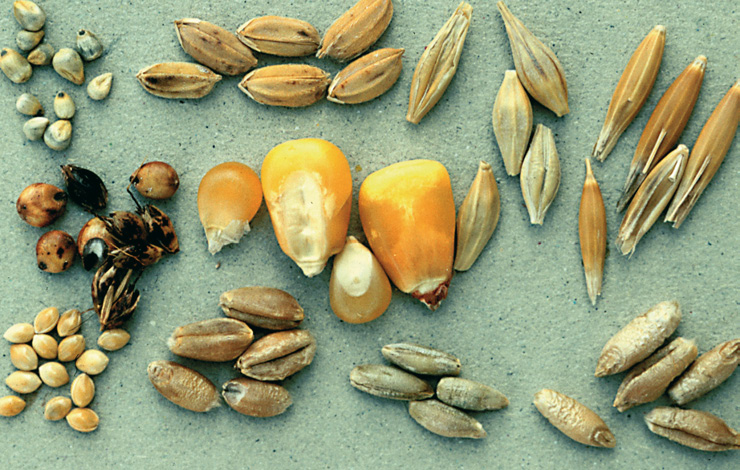
A cereal is a grass cultivated for its edible grain. Cereals are the world's largest crops, and are therefore staple foods. They include rice, wheat, rye, oats, barley, millet, and maize (corn). Edible grains from other plant families, such as amaranth, buckwheat and quinoa, are pseudocereals. Most cereals are annuals, producing one crop from each planting, though rice is sometimes grown as a perennial. Winter varieties are hardy enough to be planted in the autumn, becoming dormant in the winter, and harvested in spring or early summer; spring varieties are planted in spring and harvested in late summer. The term cereal is derived from the name of the Roman goddess of grain crops and fertility, Ceres.
Cereals were domesticated in the Neolithic around 8,000 years ago. Wheat and barley were domesticated in the Fertile Crescent. Rice and some millets were domesticated in East Asia, while sorghum and other millets were domesticated in West Africa. Maize was domesticated by Indigenous peoples of the Americas in southern Mexico about 9,000 years ago. In the 20th century, cereal productivity was greatly increased by the Green Revolution. This increase in production has accompanied a growing international trade, with some countries producing large portions of the cereal supply for other countries.
Cereals provide food eaten directly as whole grains, usually cooked, or they are ground to flour and made into bread, porridge, and other products. Cereals have a high starch content, enabling them to be fermented into alcoholic drinks such as beer. Cereal farming has a substantial environmental impact, and is often produced in high-intensity monocultures. The environmental harms can be mitigated by sustainable practices which reduce the impact on soil and improve biodiversity, such as no-till farming and intercropping.
Wheat, barley, rye, and oats were gathered and eaten in the Fertile Crescent during the early Neolithic. Cereal grains 19,000 years old have been found at the Ohalo II site in Israel, with charred remnants of wild wheat and barley.
During the same period, farmers in China began to farm rice and millet, using human-made floods and fires as part of their cultivation regimen. The use of soil conditioners, including manure, fish, compost and ashes, appears to have begun early, and developed independently in areas of the world including Mesopotamia, the Nile Valley, and Eastern Asia.
Cereals that became modern barley and wheat were domesticated some 8,000 years ago in the Fertile Crescent. Millets and rice were domesticated in East Asia, while sorghum and other millets were domesticated in sub-Saharan West Africa, primarily as feed for livestock. Maize arose from a single domestication in Mesoamerica about 9,000 years ago.
In these agricultural regions, religion was often shaped by the divinity associated with the grain and harvests. In the Mesopotamian creation myth, an era of civilization is inaugurated by the grain goddess Ashnan. The Roman goddess Ceres presided over agriculture, grain crops, fertility, and motherhood; the term cereal is derived from Latin cerealis, "of grain", originally meaning "of [the goddess] Ceres". Several gods of antiquity combined agriculture and war: the Hittite Sun goddess of Arinna, the Canaanite Lahmu and the Roman Janus.
Complex civilizations arose where cereal agriculture created a surplus, allowing for part of the harvest to be appropriated from farmers, allowing power to be concentrated in cities.
Hub AI
Cereal AI simulator
(@Cereal_simulator)
Cereal
A cereal is a grass cultivated for its edible grain. Cereals are the world's largest crops, and are therefore staple foods. They include rice, wheat, rye, oats, barley, millet, and maize (corn). Edible grains from other plant families, such as amaranth, buckwheat and quinoa, are pseudocereals. Most cereals are annuals, producing one crop from each planting, though rice is sometimes grown as a perennial. Winter varieties are hardy enough to be planted in the autumn, becoming dormant in the winter, and harvested in spring or early summer; spring varieties are planted in spring and harvested in late summer. The term cereal is derived from the name of the Roman goddess of grain crops and fertility, Ceres.
Cereals were domesticated in the Neolithic around 8,000 years ago. Wheat and barley were domesticated in the Fertile Crescent. Rice and some millets were domesticated in East Asia, while sorghum and other millets were domesticated in West Africa. Maize was domesticated by Indigenous peoples of the Americas in southern Mexico about 9,000 years ago. In the 20th century, cereal productivity was greatly increased by the Green Revolution. This increase in production has accompanied a growing international trade, with some countries producing large portions of the cereal supply for other countries.
Cereals provide food eaten directly as whole grains, usually cooked, or they are ground to flour and made into bread, porridge, and other products. Cereals have a high starch content, enabling them to be fermented into alcoholic drinks such as beer. Cereal farming has a substantial environmental impact, and is often produced in high-intensity monocultures. The environmental harms can be mitigated by sustainable practices which reduce the impact on soil and improve biodiversity, such as no-till farming and intercropping.
Wheat, barley, rye, and oats were gathered and eaten in the Fertile Crescent during the early Neolithic. Cereal grains 19,000 years old have been found at the Ohalo II site in Israel, with charred remnants of wild wheat and barley.
During the same period, farmers in China began to farm rice and millet, using human-made floods and fires as part of their cultivation regimen. The use of soil conditioners, including manure, fish, compost and ashes, appears to have begun early, and developed independently in areas of the world including Mesopotamia, the Nile Valley, and Eastern Asia.
Cereals that became modern barley and wheat were domesticated some 8,000 years ago in the Fertile Crescent. Millets and rice were domesticated in East Asia, while sorghum and other millets were domesticated in sub-Saharan West Africa, primarily as feed for livestock. Maize arose from a single domestication in Mesoamerica about 9,000 years ago.
In these agricultural regions, religion was often shaped by the divinity associated with the grain and harvests. In the Mesopotamian creation myth, an era of civilization is inaugurated by the grain goddess Ashnan. The Roman goddess Ceres presided over agriculture, grain crops, fertility, and motherhood; the term cereal is derived from Latin cerealis, "of grain", originally meaning "of [the goddess] Ceres". Several gods of antiquity combined agriculture and war: the Hittite Sun goddess of Arinna, the Canaanite Lahmu and the Roman Janus.
Complex civilizations arose where cereal agriculture created a surplus, allowing for part of the harvest to be appropriated from farmers, allowing power to be concentrated in cities.