


Community hub
Recent from talks
Contribute something to knowledge base
Content stats: 0 posts, 0 articles, 1 media, 0 notes
Members stats: 0 subscribers, 0 contributors, 0 moderators, 0 supporters
Subscribers
Supporters
Contributors
Moderators
Hub AI
Crosswind kite power AI simulator
(@Crosswind kite power_simulator)
Hub AI
Crosswind kite power AI simulator
(@Crosswind kite power_simulator)
Crosswind kite power
Crosswind kite power is power derived from airborne wind-energy conversion systems (AWECS, also AWES) or crosswind kite power systems (CWKPS). The kite system is characterized by energy-harvesting parts flying transversely to the direction of the ambient wind, i.e., to crosswind mode; sometimes the entire wing set and tether set are flown in crosswind mode. From toy to power-grid-feeding sizes, these systems may be used as high-altitude wind power (HAWP) devices or low-altitude wind power (LAWP) devices without having to use towers. Flexible wings or rigid wings may be used in the kite system. A tethered wing, flying in crosswind at many times wind speed, harvests wind power from an area that exceeds the wing's total area by many times.
Crosswind kite power systems have some advantages over conventional wind turbines, including access to more powerful and stable wind resources, a high capacity factor, capability for deployment on and offshore at comparable costs, and no need for a tower. Additionally, the wings of the CWKPS may vary in aerodynamic efficiency; the movement of crosswinding tethered wings is sometimes compared with the outer parts of conventional wind turbine blades. However, a conventional traverse-to-wind rotating blade set carried aloft in a kite-power system has the blade set cutting to crosswind and is a form of crosswind kite power.
Miles L. Loyd furthered studies on crosswind kite power systems in his 1980 work "Crosswind Kite Power". There are crosswind advocates who believe that crosswind kite power was introduced by P. Payne and C. McCutchen in their patent No. 3,987,987, filed in 1975; however, crosswind kite power was used far before such a patent, e.g., in target kites for war-target practice, where the cross winding power permitted high speeds to give practice to gunners.
How a system extracts energy from the wind and transfers energy to useful purposes helps to define types of crosswind kite power systems. One type of parameter regards the position of the generator or pump or tasking line or device. Another type of parameter regards how the tethers of the tether set of the kite system are utilized; the tethers holding the kiting wing elements aloft may be used in various ways to form types; tethers may simply hold working wings aloft, or they may be pulling loads on the ground, or multitasking by sending aloft-gained electricity to ground receivers or by pulling loads or by being the tasking device itself as when used for pulling people or things or cutting or grinding things. Some types are distinguished by fast motion transfer or slow motion transfer. Typing of crosswind kite power system also occurs by the nature of the wing set where count of wings and types of wings matter to designers and users; a wing set might be in a train arrangement, stack configuration, arch complex, dome mesh, coordinating family of wings, or just be a simple single-wing with single tether. Types of crosswind kite power devices are also distinguished by scale, purpose, intended life, and cost level. Typing by economic success occurs; is the system effective in the energy or task market or not? Some CWKPS are a type called lifters; they are purposed just for lifting loads, perhaps humans; the type is frequented by the use of auto rotating blades that appear then to look like helicopters. A single crosswind kite power system (CWKPS) may be a hybrid complex performing aloft energy generation while also performing ground-based work through tether pulling of loads. The crosswind kite power systems that involve fluttering elements are being explored in several research centres; flutter is mined for energy conversion in a few ways. Researchers are showing types of CWKPS that are difficult to classify or type.
In the systems of this type of CWKPS, the pulling tether set drives the resisting people and objects to various points on the surface of water bodies or land or points in the atmosphere. In this type of crosswind kite power operation, the design of the resistive objects (people, boards, hulls, boats, ships, water turbines, air turbines, other wings) makes for further types. Cross winding of the upper flying wings provide power to achieve certain final objectives. The objectives are found in such as kiteboarding, kite windsurfing, snow kiting, yacht kiting, freighter-ship sailing, kite boating, and free-flight soaring and jumping. A collection of researchers have explored the historic free-flight parakite realm to where crosswind flying of the systems' wings would enable free-flight in the atmosphere; fundamentally this is a kite-string set with a wing above and a wing as the resistive anchor set; control of the separate wing set, especially in cross winding efforts mine the power of winds in different layers of the atmosphere.
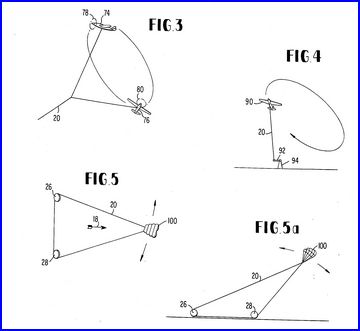
In the systems of this type, an electrical generator, pump, or tasking line is installed on the ground. There are two subtypes, with or without a secondary vehicle. In the subtype without a secondary vehicle, the "Yo-Yo" method, the tether slowly unwinds off a drum on the ground, due to the windward pull of the kite system's wing, while the wing travels crosswind, that is, left-right of the wind's ambient direction, along various paths, e.g., a figure-8 flight path, optimized lemniscate paths, or circular paths (small or large radius). The turning drum rotates the rotor of the generator or pump through, perhaps, a high-ratio gearbox. Periodically, the wing is powered, and the tether is reeled in, or, using the crosswind for a constant pull, the tether is re-connected to a different section of the drum while the wing is traveling in a "downwind" cycle. In some systems two tethers are used instead of one.
In another subtype, a secondary vehicle is used. Such a vehicle can be a carousel, a car, railed cart, wheeled land vehicle, or even a ship on the water. The electrical generator is installed on the vehicle. The rotor of the electrical generator is brought in motion by the carousel, the axle of the car, or the screw of the ship, correspondingly.
In the systems of this type, one or more flying blades and electrical generators are installed on the wing. The relative airflow rotates the blades by way of autorotation, an interaction with the wind, which transfer the power to the generators. Produced electrical energy is transmitted to the ground through an electrical cable laid along the tether or integrated with the tether. The same blades are sometimes used for double purpose where they are propellers positively driven by costed electricity for launching or special landing or calm-air flight-maintaining purpose.
Crosswind kite power
Crosswind kite power is power derived from airborne wind-energy conversion systems (AWECS, also AWES) or crosswind kite power systems (CWKPS). The kite system is characterized by energy-harvesting parts flying transversely to the direction of the ambient wind, i.e., to crosswind mode; sometimes the entire wing set and tether set are flown in crosswind mode. From toy to power-grid-feeding sizes, these systems may be used as high-altitude wind power (HAWP) devices or low-altitude wind power (LAWP) devices without having to use towers. Flexible wings or rigid wings may be used in the kite system. A tethered wing, flying in crosswind at many times wind speed, harvests wind power from an area that exceeds the wing's total area by many times.
Crosswind kite power systems have some advantages over conventional wind turbines, including access to more powerful and stable wind resources, a high capacity factor, capability for deployment on and offshore at comparable costs, and no need for a tower. Additionally, the wings of the CWKPS may vary in aerodynamic efficiency; the movement of crosswinding tethered wings is sometimes compared with the outer parts of conventional wind turbine blades. However, a conventional traverse-to-wind rotating blade set carried aloft in a kite-power system has the blade set cutting to crosswind and is a form of crosswind kite power.
Miles L. Loyd furthered studies on crosswind kite power systems in his 1980 work "Crosswind Kite Power". There are crosswind advocates who believe that crosswind kite power was introduced by P. Payne and C. McCutchen in their patent No. 3,987,987, filed in 1975; however, crosswind kite power was used far before such a patent, e.g., in target kites for war-target practice, where the cross winding power permitted high speeds to give practice to gunners.
How a system extracts energy from the wind and transfers energy to useful purposes helps to define types of crosswind kite power systems. One type of parameter regards the position of the generator or pump or tasking line or device. Another type of parameter regards how the tethers of the tether set of the kite system are utilized; the tethers holding the kiting wing elements aloft may be used in various ways to form types; tethers may simply hold working wings aloft, or they may be pulling loads on the ground, or multitasking by sending aloft-gained electricity to ground receivers or by pulling loads or by being the tasking device itself as when used for pulling people or things or cutting or grinding things. Some types are distinguished by fast motion transfer or slow motion transfer. Typing of crosswind kite power system also occurs by the nature of the wing set where count of wings and types of wings matter to designers and users; a wing set might be in a train arrangement, stack configuration, arch complex, dome mesh, coordinating family of wings, or just be a simple single-wing with single tether. Types of crosswind kite power devices are also distinguished by scale, purpose, intended life, and cost level. Typing by economic success occurs; is the system effective in the energy or task market or not? Some CWKPS are a type called lifters; they are purposed just for lifting loads, perhaps humans; the type is frequented by the use of auto rotating blades that appear then to look like helicopters. A single crosswind kite power system (CWKPS) may be a hybrid complex performing aloft energy generation while also performing ground-based work through tether pulling of loads. The crosswind kite power systems that involve fluttering elements are being explored in several research centres; flutter is mined for energy conversion in a few ways. Researchers are showing types of CWKPS that are difficult to classify or type.
In the systems of this type of CWKPS, the pulling tether set drives the resisting people and objects to various points on the surface of water bodies or land or points in the atmosphere. In this type of crosswind kite power operation, the design of the resistive objects (people, boards, hulls, boats, ships, water turbines, air turbines, other wings) makes for further types. Cross winding of the upper flying wings provide power to achieve certain final objectives. The objectives are found in such as kiteboarding, kite windsurfing, snow kiting, yacht kiting, freighter-ship sailing, kite boating, and free-flight soaring and jumping. A collection of researchers have explored the historic free-flight parakite realm to where crosswind flying of the systems' wings would enable free-flight in the atmosphere; fundamentally this is a kite-string set with a wing above and a wing as the resistive anchor set; control of the separate wing set, especially in cross winding efforts mine the power of winds in different layers of the atmosphere.
In the systems of this type, an electrical generator, pump, or tasking line is installed on the ground. There are two subtypes, with or without a secondary vehicle. In the subtype without a secondary vehicle, the "Yo-Yo" method, the tether slowly unwinds off a drum on the ground, due to the windward pull of the kite system's wing, while the wing travels crosswind, that is, left-right of the wind's ambient direction, along various paths, e.g., a figure-8 flight path, optimized lemniscate paths, or circular paths (small or large radius). The turning drum rotates the rotor of the generator or pump through, perhaps, a high-ratio gearbox. Periodically, the wing is powered, and the tether is reeled in, or, using the crosswind for a constant pull, the tether is re-connected to a different section of the drum while the wing is traveling in a "downwind" cycle. In some systems two tethers are used instead of one.
In another subtype, a secondary vehicle is used. Such a vehicle can be a carousel, a car, railed cart, wheeled land vehicle, or even a ship on the water. The electrical generator is installed on the vehicle. The rotor of the electrical generator is brought in motion by the carousel, the axle of the car, or the screw of the ship, correspondingly.
In the systems of this type, one or more flying blades and electrical generators are installed on the wing. The relative airflow rotates the blades by way of autorotation, an interaction with the wind, which transfer the power to the generators. Produced electrical energy is transmitted to the ground through an electrical cable laid along the tether or integrated with the tether. The same blades are sometimes used for double purpose where they are propellers positively driven by costed electricity for launching or special landing or calm-air flight-maintaining purpose.
Recent media
Recent media