


Community hub
Recent from talks
Contribute something to knowledge base
Content stats: 0 posts, 0 articles, 1 media, 0 notes
Members stats: 0 subscribers, 0 contributors, 0 moderators, 0 supporters
Subscribers
Supporters
Contributors
Moderators
Hub AI
CubeSat AI simulator
(@CubeSat_simulator)
Hub AI
CubeSat AI simulator
(@CubeSat_simulator)
CubeSat
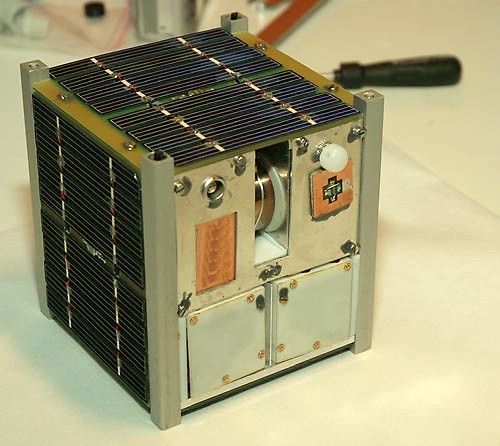
A CubeSat is a class of small satellite with a form factor of 10 cm (3.9 in) cubes. CubeSats have a mass of no more than 2 kg (4.4 lb) per unit, and often use commercial off-the-shelf (COTS) components for their electronics and structure. CubeSats are deployed into orbit from the International Space Station, or launched as secondary payloads on a launch vehicle. As of December 2023[update], more than 2,300 CubeSats have been launched.
In 1999, California Polytechnic State University (Cal Poly) professor Jordi Puig-Suari and Bob Twiggs, a professor at Stanford University Space Systems Development Laboratory, developed the CubeSat specifications to promote and develop the skills necessary for the design, manufacture, and testing of small satellites intended for low Earth orbit (LEO) that perform scientific research and explore new space technologies. Academia accounted for the majority of CubeSat launches until 2013, when more than half of launches were for non-academic purposes, and by 2014 most newly deployed CubeSats were for commercial or amateur projects.
Functions typically involve experiments that can be miniaturized or serve purposes such as Earth observation or amateur radio. CubeSats are employed to demonstrate spacecraft technologies intended for small satellites or that present questionable feasibility and are unlikely to justify the cost of a larger satellite. Scientific experiments with unproven underlying theory may also find themselves aboard CubeSats because their low cost can justify higher risks. Biological research payloads have been flown on several missions, with more planned. Several missions to the Moon and beyond are planning to use CubeSats. The first CubeSats in deep space were flown in the MarCO mission, where two CubeSats were launched towards Mars in May 2018 alongside the successful InSight mission.
Some CubeSats have become countries' first-ever satellites, launched either by universities, state-owned, or private companies. The searchable Nanosatellite and CubeSat Database lists over 4,000 CubeSats that have been or are planned to be launched since 1998.
Professors Jordi Puig-Suari of California Polytechnic State University and Bob Twiggs of Stanford University proposed the CubeSat reference design in 1999 with the aim of enabling graduate students to design, build, test and operate in space a spacecraft with capabilities similar to that of the first spacecraft, Sputnik. The CubeSat, as initially proposed, did not set out to become a standard; rather, it became a standard over time by a process of emergence. The first CubeSats launched in June 2003 on a Russian Eurockot, and approximately 75 CubeSats had entered orbit by 2012.
The need for such a small-factor satellite became apparent in 1998 as a result of work done at Stanford University's Space System Development Laboratory. At SSDL, students had been working on the OPAL (Orbiting Picosatellite Automatic Launcher) microsatellite since 1995. OPAL's mission to deploy daughter-ship "picosatellites" had resulted in the development of a launcher system that was "hopelessly complicated" and could only be made to work "most of the time". With the project's delays mounting, Twiggs sought DARPA funding that resulted in the redesign of the launching mechanism into a simple pusher-plate concept with the satellites held in place by a spring-loaded door.
Desiring to shorten the development cycle experienced on OPAL and inspired by the picosatellites OPAL carried, Twiggs set out to find "how much could you reduce the size and still have a practical satellite". The picosatellites on OPAL were 10.1 cm × 7.6 cm × 2.5 cm (4 in × 3 in × 1 in), a size that was not conducive to covering all sides of the spacecraft with solar cells. Inspired by a 4 in (10 cm) cubic plastic box used to display Beanie Babies in stores, Twiggs first settled on the larger ten-centimeter cube as a guideline for the new CubeSat concept. A model of a launcher was developed for the new satellite using the same pusher-plate concept that had been used in the modified OPAL launcher. Twiggs presented the idea to Puig-Suari in the summer of 1999 and then at the Japan–U.S. Science, Technology and Space Applications Program (JUSTSAP) conference in November 1999.
The term "CubeSat" was coined to denote nanosatellites that adhere to the standards described in the CubeSat design specification. Cal Poly published the standard in an effort led by aerospace engineering professor Jordi Puig-Suari. Bob Twiggs, of the Department of Aeronautics & Astronautics at Stanford University, and currently a member of the space science faculty at Morehead State University in Kentucky, has contributed to the CubeSat community. His efforts have focused on CubeSats from educational institutions. The specification does not apply to other cube-like nanosatellites such as the NASA "MEPSI" nanosatellite, which is slightly larger than a CubeSat. GeneSat-1 was NASA's first fully automated, self-contained biological spaceflight experiment on a satellite of its size. It was also the first U.S.-launched CubeSat. This work, led by John Hines at NASA Ames Research, became the catalyst for the entire NASA CubeSat program.
CubeSat
A CubeSat is a class of small satellite with a form factor of 10 cm (3.9 in) cubes. CubeSats have a mass of no more than 2 kg (4.4 lb) per unit, and often use commercial off-the-shelf (COTS) components for their electronics and structure. CubeSats are deployed into orbit from the International Space Station, or launched as secondary payloads on a launch vehicle. As of December 2023[update], more than 2,300 CubeSats have been launched.
In 1999, California Polytechnic State University (Cal Poly) professor Jordi Puig-Suari and Bob Twiggs, a professor at Stanford University Space Systems Development Laboratory, developed the CubeSat specifications to promote and develop the skills necessary for the design, manufacture, and testing of small satellites intended for low Earth orbit (LEO) that perform scientific research and explore new space technologies. Academia accounted for the majority of CubeSat launches until 2013, when more than half of launches were for non-academic purposes, and by 2014 most newly deployed CubeSats were for commercial or amateur projects.
Functions typically involve experiments that can be miniaturized or serve purposes such as Earth observation or amateur radio. CubeSats are employed to demonstrate spacecraft technologies intended for small satellites or that present questionable feasibility and are unlikely to justify the cost of a larger satellite. Scientific experiments with unproven underlying theory may also find themselves aboard CubeSats because their low cost can justify higher risks. Biological research payloads have been flown on several missions, with more planned. Several missions to the Moon and beyond are planning to use CubeSats. The first CubeSats in deep space were flown in the MarCO mission, where two CubeSats were launched towards Mars in May 2018 alongside the successful InSight mission.
Some CubeSats have become countries' first-ever satellites, launched either by universities, state-owned, or private companies. The searchable Nanosatellite and CubeSat Database lists over 4,000 CubeSats that have been or are planned to be launched since 1998.
Professors Jordi Puig-Suari of California Polytechnic State University and Bob Twiggs of Stanford University proposed the CubeSat reference design in 1999 with the aim of enabling graduate students to design, build, test and operate in space a spacecraft with capabilities similar to that of the first spacecraft, Sputnik. The CubeSat, as initially proposed, did not set out to become a standard; rather, it became a standard over time by a process of emergence. The first CubeSats launched in June 2003 on a Russian Eurockot, and approximately 75 CubeSats had entered orbit by 2012.
The need for such a small-factor satellite became apparent in 1998 as a result of work done at Stanford University's Space System Development Laboratory. At SSDL, students had been working on the OPAL (Orbiting Picosatellite Automatic Launcher) microsatellite since 1995. OPAL's mission to deploy daughter-ship "picosatellites" had resulted in the development of a launcher system that was "hopelessly complicated" and could only be made to work "most of the time". With the project's delays mounting, Twiggs sought DARPA funding that resulted in the redesign of the launching mechanism into a simple pusher-plate concept with the satellites held in place by a spring-loaded door.
Desiring to shorten the development cycle experienced on OPAL and inspired by the picosatellites OPAL carried, Twiggs set out to find "how much could you reduce the size and still have a practical satellite". The picosatellites on OPAL were 10.1 cm × 7.6 cm × 2.5 cm (4 in × 3 in × 1 in), a size that was not conducive to covering all sides of the spacecraft with solar cells. Inspired by a 4 in (10 cm) cubic plastic box used to display Beanie Babies in stores, Twiggs first settled on the larger ten-centimeter cube as a guideline for the new CubeSat concept. A model of a launcher was developed for the new satellite using the same pusher-plate concept that had been used in the modified OPAL launcher. Twiggs presented the idea to Puig-Suari in the summer of 1999 and then at the Japan–U.S. Science, Technology and Space Applications Program (JUSTSAP) conference in November 1999.
The term "CubeSat" was coined to denote nanosatellites that adhere to the standards described in the CubeSat design specification. Cal Poly published the standard in an effort led by aerospace engineering professor Jordi Puig-Suari. Bob Twiggs, of the Department of Aeronautics & Astronautics at Stanford University, and currently a member of the space science faculty at Morehead State University in Kentucky, has contributed to the CubeSat community. His efforts have focused on CubeSats from educational institutions. The specification does not apply to other cube-like nanosatellites such as the NASA "MEPSI" nanosatellite, which is slightly larger than a CubeSat. GeneSat-1 was NASA's first fully automated, self-contained biological spaceflight experiment on a satellite of its size. It was also the first U.S.-launched CubeSat. This work, led by John Hines at NASA Ames Research, became the catalyst for the entire NASA CubeSat program.
Recent media
Recent media