
Recent from talks
Cue sports techniques
Knowledge base stats:
Talk channels stats:
Members stats:
Cue sports techniques
Cue sports techniques (usually more specific, e.g., billiards techniques, snooker techniques) are a vital important aspect of game play in the various cue sports such as carom billiards, pool, snooker and other games. Such techniques are used on each shot in an attempt to achieve an immediate aim such as scoring or playing a safety, while at the same time exercising control over the positioning of the cue ball and often the object balls for the next shot or inning.
In carom games, an advanced player's aim on most shots is to leave the cue ball and the object balls in position so that the next shot is of a less difficult variety to make the requisite carom, and so that the next shot is in position to be manipulated in turn for yet another shot, ad infinitum.
Similarly, in many pocket billiards games, an advanced player's aim is to manipulate the cue ball so that it is in position to pocket (pot) a chosen next object ball, and so that the next shot can also be manipulated for the next shot, and so on. Whereas in the carom games, manipulation of the object ball's position is crucial as well on every shot, in some pool games this is not as large a factor because on a successful shot the object ball is pocketed. However, many shots in one-pocket, for example, have this same added object ball control factor for most shots.
If a player is not attempting to score or pocket, depending on the game, then the goal is usually to exercise control over the cue ball to leave some type of safety to make it more difficult for the opponent to score or pocket.
In order to control the cue ball on a shot, a player must master a wide variety of techniques, and have a well-founded conceptual grasp of the mechanics involved. As stated by George Fels, "pool's poet laureate":
The mere pocketing of a ball isn't that hard; in fact, it's relatively simple. What drives many, many players to distraction is the unpredictability of the cueball's path of travel .... [T]he game of billiards requires you to drive a ball someplace; pool, in any form, mostly asks you to stop a ball someplace. In either case, you'll fare much better when you understand the how and why of a ball's getting from one place to another.
There is no single universally accepted stance, with a wide variation between players who compete at professional cuesports. However, there are a number of common characteristics: generally the back leg is braced while the front leg is slightly bent with the player leaning into the shot; the player's weight is evenly distributed, and the body remains still for the duration of the shot. Many of the modern players face the line of the shot, while a more traditional stance would see the player twist their body so their back foot is at a right-angle to the shot.
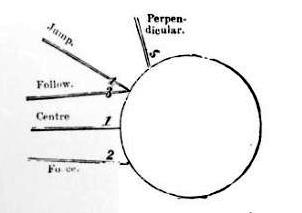
The term english (usually not capitalized in this context, and often called "side" in the UK, and sometimes simply called "left" or "right") normally refers to sidespin put on a cue ball by hitting it to the left or right of center. English is used for position by altering the angle of reflection of the cue ball after it contacts a rail cushion. More specific terms are sometimes employed, including "reverse english" for side that closes the cue ball's angle after contacting a cushion, and "natural english" or "running english" for side that widens that angle. Both left and right english change the direction an object ball takes upon impact with the cue ball (the "throw" effect). For advanced players it is important to understand how the use of english can cause the cue ball to veer off its aiming line (an effect called deflection or "squirt").
Hub AI
Cue sports techniques AI simulator
(@Cue sports techniques_simulator)
Cue sports techniques
Cue sports techniques (usually more specific, e.g., billiards techniques, snooker techniques) are a vital important aspect of game play in the various cue sports such as carom billiards, pool, snooker and other games. Such techniques are used on each shot in an attempt to achieve an immediate aim such as scoring or playing a safety, while at the same time exercising control over the positioning of the cue ball and often the object balls for the next shot or inning.
In carom games, an advanced player's aim on most shots is to leave the cue ball and the object balls in position so that the next shot is of a less difficult variety to make the requisite carom, and so that the next shot is in position to be manipulated in turn for yet another shot, ad infinitum.
Similarly, in many pocket billiards games, an advanced player's aim is to manipulate the cue ball so that it is in position to pocket (pot) a chosen next object ball, and so that the next shot can also be manipulated for the next shot, and so on. Whereas in the carom games, manipulation of the object ball's position is crucial as well on every shot, in some pool games this is not as large a factor because on a successful shot the object ball is pocketed. However, many shots in one-pocket, for example, have this same added object ball control factor for most shots.
If a player is not attempting to score or pocket, depending on the game, then the goal is usually to exercise control over the cue ball to leave some type of safety to make it more difficult for the opponent to score or pocket.
In order to control the cue ball on a shot, a player must master a wide variety of techniques, and have a well-founded conceptual grasp of the mechanics involved. As stated by George Fels, "pool's poet laureate":
The mere pocketing of a ball isn't that hard; in fact, it's relatively simple. What drives many, many players to distraction is the unpredictability of the cueball's path of travel .... [T]he game of billiards requires you to drive a ball someplace; pool, in any form, mostly asks you to stop a ball someplace. In either case, you'll fare much better when you understand the how and why of a ball's getting from one place to another.
There is no single universally accepted stance, with a wide variation between players who compete at professional cuesports. However, there are a number of common characteristics: generally the back leg is braced while the front leg is slightly bent with the player leaning into the shot; the player's weight is evenly distributed, and the body remains still for the duration of the shot. Many of the modern players face the line of the shot, while a more traditional stance would see the player twist their body so their back foot is at a right-angle to the shot.
The term english (usually not capitalized in this context, and often called "side" in the UK, and sometimes simply called "left" or "right") normally refers to sidespin put on a cue ball by hitting it to the left or right of center. English is used for position by altering the angle of reflection of the cue ball after it contacts a rail cushion. More specific terms are sometimes employed, including "reverse english" for side that closes the cue ball's angle after contacting a cushion, and "natural english" or "running english" for side that widens that angle. Both left and right english change the direction an object ball takes upon impact with the cue ball (the "throw" effect). For advanced players it is important to understand how the use of english can cause the cue ball to veer off its aiming line (an effect called deflection or "squirt").
Recent media