



Community hub
Recent from talks
Knowledge base stats:
Talk channels stats:
Members stats:
Culm Valley Light Railway
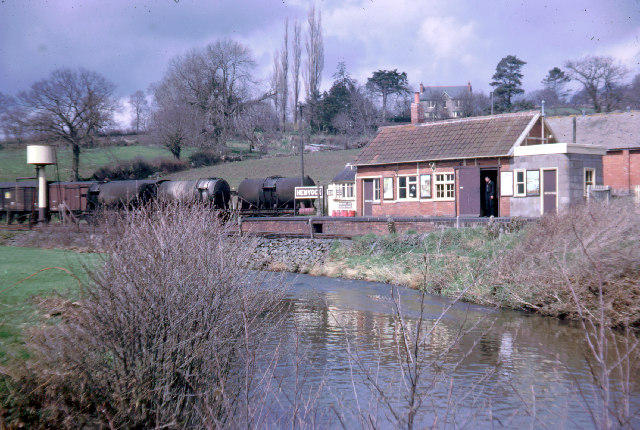
The Culm Valley Light Railway was a standard gauge branch railway that operated in the English county of Devon. It ran for just under 7+1⁄2 miles (12.1 km) from Tiverton Junction station on the Bristol to Exeter line, through the Culm valley to Hemyock.
It was intended as a very low-cost scheme, but by the time it opened in 1876 had cost more than twice the originally anticipated budget and taken five times the expected time to complete. It was operated from the start by the Great Western Railway, who purchased the line outright in 1880. It was loss-making and underused until United Dairies built a creamery and milk products factory at Hemyock; their output became the dominant traffic.
The line closed to passengers in 1963 but served the milk depot at Hemyock until 1975.
The valley of the River Culm was an attractive, but remote and declining area in the early nineteenth century, containing the villages of Uffculme, Culmstock and Hemyock. The Bristol and Exeter Railway (B&ER) opened its main line in 1844 with a station at Tiverton Road (later Tiverton Junction), and local people observed the improvements in the local economy of places effectively served by the railway, and the decline of places that were by-passed. The small communities in the Culm Valley fell into the latter category.
An engineer, Arthur Cadlick Pain, born 1844, had become interested in the concept of a low-cost railway on his return from working overseas, following the enactment of the Railway Construction Facilities Act 1864, which authorised railway construction without the necessity of an act of Parliament if no affected landowner objected. The Regulation of Railways Act 1868 (31 & 32 Vict. c. 119) authorised the construction of a light railway—the first use of the term—subject to conditions that might be imposed by the Board of Trade.
He discussed the idea of a light railway with Henry S. Ellis, a director of the B&ER; Pain suggested a low-cost line as a steam—or possibly horse operated—tramway running in or alongside the roadway, to serve the Culm Valley settlements. There were to be no stations, but the train would simply stop at road crossings. Such a line might be narrow gauge if the business was expected to be light; and by securing the enthusiasm of local people for the improvement of the district, land acquisition costs might be low. The line would be on the standard gauge.
A public meeting was held at Uffculme on 15 May 1872 and the idea was received with enthusiasm, and on 19 June at another meeting he reported that he had prepared plans and a prospectus. There was some discussion about the location of the Hemyock terminus, in case extension to the London and South Western Railway (LSWR) were later required: Honiton is about ten miles away, but over challenging terrain. There were two objections to the scheme among many positive opinions.
The Railway Construction Facilities Act 1864 authorised construction of a light railway provided that no affected landowner objected to the scheme, but here there were two; the provisional directors decided to apply for an act of Parliament for their line, although that would incur considerable expense, in order to get compulsory acquisition of land. (The objectors soon withdrew their objection, but notice of the fact was received too late to avoid the parliamentary process.) Pain calculated that the line could be built for £3,000 a mile. Enthusiasm was high and a meeting on 18 November 1872 set the process in motion. Pain was soon appointed engineer to the company for a fee of £1,125, to be taken in shares.
Hub AI
Culm Valley Light Railway AI simulator
(@Culm Valley Light Railway_simulator)
Culm Valley Light Railway
The Culm Valley Light Railway was a standard gauge branch railway that operated in the English county of Devon. It ran for just under 7+1⁄2 miles (12.1 km) from Tiverton Junction station on the Bristol to Exeter line, through the Culm valley to Hemyock.
It was intended as a very low-cost scheme, but by the time it opened in 1876 had cost more than twice the originally anticipated budget and taken five times the expected time to complete. It was operated from the start by the Great Western Railway, who purchased the line outright in 1880. It was loss-making and underused until United Dairies built a creamery and milk products factory at Hemyock; their output became the dominant traffic.
The line closed to passengers in 1963 but served the milk depot at Hemyock until 1975.
The valley of the River Culm was an attractive, but remote and declining area in the early nineteenth century, containing the villages of Uffculme, Culmstock and Hemyock. The Bristol and Exeter Railway (B&ER) opened its main line in 1844 with a station at Tiverton Road (later Tiverton Junction), and local people observed the improvements in the local economy of places effectively served by the railway, and the decline of places that were by-passed. The small communities in the Culm Valley fell into the latter category.
An engineer, Arthur Cadlick Pain, born 1844, had become interested in the concept of a low-cost railway on his return from working overseas, following the enactment of the Railway Construction Facilities Act 1864, which authorised railway construction without the necessity of an act of Parliament if no affected landowner objected. The Regulation of Railways Act 1868 (31 & 32 Vict. c. 119) authorised the construction of a light railway—the first use of the term—subject to conditions that might be imposed by the Board of Trade.
He discussed the idea of a light railway with Henry S. Ellis, a director of the B&ER; Pain suggested a low-cost line as a steam—or possibly horse operated—tramway running in or alongside the roadway, to serve the Culm Valley settlements. There were to be no stations, but the train would simply stop at road crossings. Such a line might be narrow gauge if the business was expected to be light; and by securing the enthusiasm of local people for the improvement of the district, land acquisition costs might be low. The line would be on the standard gauge.
A public meeting was held at Uffculme on 15 May 1872 and the idea was received with enthusiasm, and on 19 June at another meeting he reported that he had prepared plans and a prospectus. There was some discussion about the location of the Hemyock terminus, in case extension to the London and South Western Railway (LSWR) were later required: Honiton is about ten miles away, but over challenging terrain. There were two objections to the scheme among many positive opinions.
The Railway Construction Facilities Act 1864 authorised construction of a light railway provided that no affected landowner objected to the scheme, but here there were two; the provisional directors decided to apply for an act of Parliament for their line, although that would incur considerable expense, in order to get compulsory acquisition of land. (The objectors soon withdrew their objection, but notice of the fact was received too late to avoid the parliamentary process.) Pain calculated that the line could be built for £3,000 a mile. Enthusiasm was high and a meeting on 18 November 1872 set the process in motion. Pain was soon appointed engineer to the company for a fee of £1,125, to be taken in shares.