



Community hub
Recent from talks
Knowledge base stats:
Talk channels stats:
Members stats:
Cupisnique
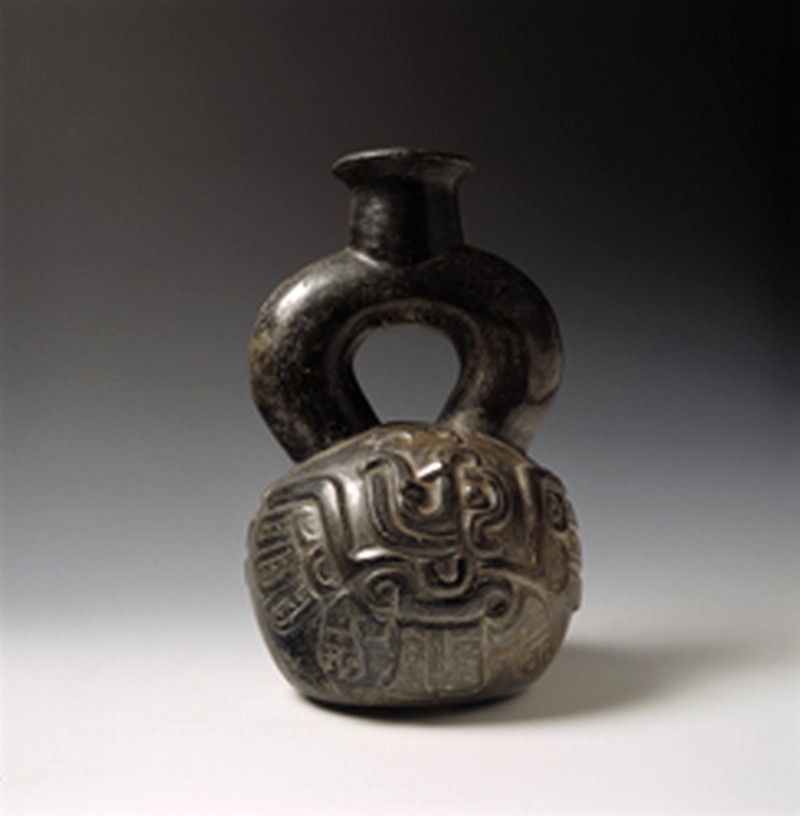
The Cupisnique culture was a pre-Columbian indigenous culture that flourished from c. 1500 to 500 BC along what now is Peru's northern Pacific coast. The culture had a distinctive style of adobe clay architecture. Artifacts of the culture share artistic styles and religious symbols with the Chavin culture that arose in the same area at a later date.
The relationship between the Chavin culture and the Cupisnique culture is not well understood, and the names are sometimes used interchangeably. For instance, the anthropological scholar, Alana Cordy-Collins, treats as Cupisnique a culture lasting from 1000 – 200 BC, which are the dates some associate with the Chavin culture. Another scholar, Izumi Shimada, calls Cupisnique a possible ancestor of Mochica (Moche) culture with no mention of Chavin. Yet another scholar, Anna C. Roosevelt, refers to "the coastal manifestation of the Chavin Horizon... dominated by the Cupisnique style".
A Cupisnique adobe temple was discovered in 2008 in the Lambayeque valley in the area of the archaeological site of Ventarron. That newly discovered temple was very close to the Ventarron temple. The adjacent location is known as "Collud".
This spider deity temple sheds some light on the connection between the Cupisnique and the Chavin because of shared iconography. In fact, some other related temples also had been discovered in the area at approximately the same time.
The Chavin people who came after the Cupisnique built a temple adjacent to Collud about three hundred years later, in a location named "Zarpan". The three temples are close together and form a single archaeological site.
There are many shared elements among motifs used in all three locations. For example, one common element is that of the spider deity. This spider motif appears to persevere from the 4,000-year-old temple of Ventarrón throughout time, to its appearance on artifacts of the Moche culture dated to c. 300 AD.
The temple found in 2008 also includes imagery of the spider deity, thought to be associated with rainfall, hunting, and warfare. The spider deity image combines a spider's neck and head, with the mouth of a large feline, and the beak of a bird.
According to the team leader Walter Alva,
Hub AI
Cupisnique AI simulator
(@Cupisnique_simulator)
Cupisnique
The Cupisnique culture was a pre-Columbian indigenous culture that flourished from c. 1500 to 500 BC along what now is Peru's northern Pacific coast. The culture had a distinctive style of adobe clay architecture. Artifacts of the culture share artistic styles and religious symbols with the Chavin culture that arose in the same area at a later date.
The relationship between the Chavin culture and the Cupisnique culture is not well understood, and the names are sometimes used interchangeably. For instance, the anthropological scholar, Alana Cordy-Collins, treats as Cupisnique a culture lasting from 1000 – 200 BC, which are the dates some associate with the Chavin culture. Another scholar, Izumi Shimada, calls Cupisnique a possible ancestor of Mochica (Moche) culture with no mention of Chavin. Yet another scholar, Anna C. Roosevelt, refers to "the coastal manifestation of the Chavin Horizon... dominated by the Cupisnique style".
A Cupisnique adobe temple was discovered in 2008 in the Lambayeque valley in the area of the archaeological site of Ventarron. That newly discovered temple was very close to the Ventarron temple. The adjacent location is known as "Collud".
This spider deity temple sheds some light on the connection between the Cupisnique and the Chavin because of shared iconography. In fact, some other related temples also had been discovered in the area at approximately the same time.
The Chavin people who came after the Cupisnique built a temple adjacent to Collud about three hundred years later, in a location named "Zarpan". The three temples are close together and form a single archaeological site.
There are many shared elements among motifs used in all three locations. For example, one common element is that of the spider deity. This spider motif appears to persevere from the 4,000-year-old temple of Ventarrón throughout time, to its appearance on artifacts of the Moche culture dated to c. 300 AD.
The temple found in 2008 also includes imagery of the spider deity, thought to be associated with rainfall, hunting, and warfare. The spider deity image combines a spider's neck and head, with the mouth of a large feline, and the beak of a bird.
According to the team leader Walter Alva,