
Recent from talks
Cusco school
Knowledge base stats:
Talk channels stats:
Members stats:
Cusco school
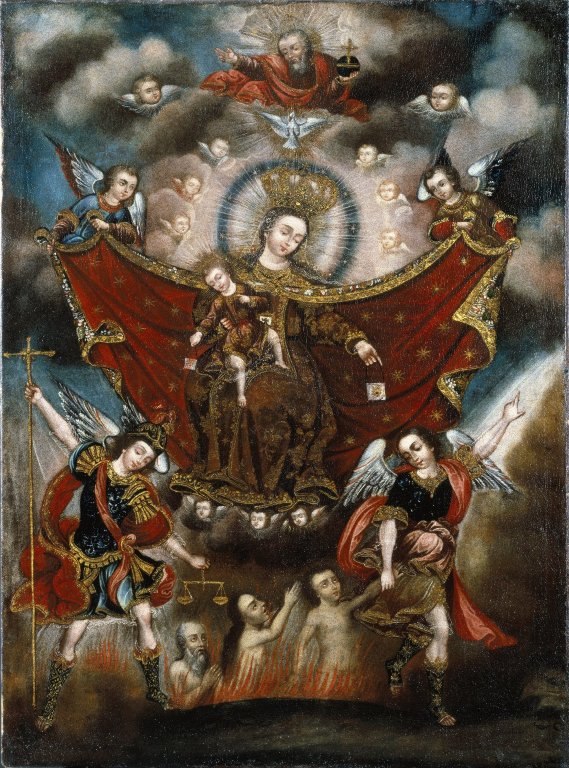
The Cusco school (escuela cuzqueña) or Cuzco school, was a Roman Catholic artistic tradition based in Cusco, Peru (the former capital of the Inca Empire) during the Colonial period, in the 16th, 17th and 18th centuries. It was not limited to Cusco only, but spread to other cities in the Andes, as well as to present day Ecuador and Bolivia.
Many colonial Cusco school paintings are preserved, most of them currently at Cusco, but also in other areas of Peru, the town of Calamarca (Bolivia) and in museums of Brazil, United States and England.
The tradition originated after the 1534 Spanish conquest of Peru, and it is considered the first artistic center that systematically taught European artistic techniques in the Americas. The Spanish contribution, and in general European, to the Cusco school of painting, is given from very early time, when the construction of the Cathedral of Cusco begins. However, it is the arrival of the Italian painter Bernardo Bitti in 1583, that marks a beginning of the development of Cuzqueño art. The Jesuit introduced in Cusco one of the fashionable currents in Europe of the time, Mannerism, whose main characteristics were the treatment of figures in a somewhat elongated way, with the light focused on them.
During his two stays in Cusco, Bitti was commissioned to make the main altarpiece of the church of his Order, replaced by another after the earthquake, and painted some masterpieces, such as The Coronation of the Virgin, currently in the museum of the church of La Merced, and the Virgen del pajarito, in the cathedral.
Another of the great exponents of Cusqueño mannerism is the painter Luis de Riaño, born in Lima and a disciple of Italian artist Angelino Medoro. In the words of the Bolivian historians José de Mesa and Teresa Gisbert, authors of the most complete history of Cuzqueño Art, Riaño lords in the local artistic environment between 1618 and 1640, leaving among other works, the murals of the church of Andahuaylillas. Another standout in these first decades of the 17th century is the muralist Diego Cusihuamán, with works in the churches of Chinchero and Urcos.
The presence of Baroque style in Cuzqueña painting is mainly the result of the influence of tenebrism through the work of Francisco de Zurbarán and through inspiration from engravings of Flemish art from Antwerp. Marcos Ribera, born in Cusco in 1830, is the major exponent of this tendency. Five pieces of apostles by him can be seen in the church of San Pedro, two in the altarpiece and another in a side reredos. The monastery of Santa Catalina of Arequipa keeps La Piedad, and that of St. Francis, some of the canvases that illustrate the life of the founder of the Order, belonging to various authors.
The increasing activity of Amerindian-Quechua and Mestizo painters towards the end of the 17th century, makes the term Cusco school conform more strictly to this artistic movement. This painting is "Cuzqueña", not only because it comes from the hands of local artists, but mainly because it moves away from the influence of the predominant trends in European art and follows its own path.
This new Cuzqueño art is characterized thematically by the interest in Costumbrista subjects such as the procession of Corpus Christi, and by the presence for the first time of Andean flora and fauna. A series of portraits of Amerindian caciques and genealogical and heraldic paintings also appear. As for the technical treatment, there is a misunderstanding of the perspective added to a fragmentation of the space in several concurrent spaces or compartmentalized scenes. New chromatic solutions, with a predilection for intense colors, are another typical feature of the nascent pictorial style.
Hub AI
Cusco school AI simulator
(@Cusco school_simulator)
Cusco school
The Cusco school (escuela cuzqueña) or Cuzco school, was a Roman Catholic artistic tradition based in Cusco, Peru (the former capital of the Inca Empire) during the Colonial period, in the 16th, 17th and 18th centuries. It was not limited to Cusco only, but spread to other cities in the Andes, as well as to present day Ecuador and Bolivia.
Many colonial Cusco school paintings are preserved, most of them currently at Cusco, but also in other areas of Peru, the town of Calamarca (Bolivia) and in museums of Brazil, United States and England.
The tradition originated after the 1534 Spanish conquest of Peru, and it is considered the first artistic center that systematically taught European artistic techniques in the Americas. The Spanish contribution, and in general European, to the Cusco school of painting, is given from very early time, when the construction of the Cathedral of Cusco begins. However, it is the arrival of the Italian painter Bernardo Bitti in 1583, that marks a beginning of the development of Cuzqueño art. The Jesuit introduced in Cusco one of the fashionable currents in Europe of the time, Mannerism, whose main characteristics were the treatment of figures in a somewhat elongated way, with the light focused on them.
During his two stays in Cusco, Bitti was commissioned to make the main altarpiece of the church of his Order, replaced by another after the earthquake, and painted some masterpieces, such as The Coronation of the Virgin, currently in the museum of the church of La Merced, and the Virgen del pajarito, in the cathedral.
Another of the great exponents of Cusqueño mannerism is the painter Luis de Riaño, born in Lima and a disciple of Italian artist Angelino Medoro. In the words of the Bolivian historians José de Mesa and Teresa Gisbert, authors of the most complete history of Cuzqueño Art, Riaño lords in the local artistic environment between 1618 and 1640, leaving among other works, the murals of the church of Andahuaylillas. Another standout in these first decades of the 17th century is the muralist Diego Cusihuamán, with works in the churches of Chinchero and Urcos.
The presence of Baroque style in Cuzqueña painting is mainly the result of the influence of tenebrism through the work of Francisco de Zurbarán and through inspiration from engravings of Flemish art from Antwerp. Marcos Ribera, born in Cusco in 1830, is the major exponent of this tendency. Five pieces of apostles by him can be seen in the church of San Pedro, two in the altarpiece and another in a side reredos. The monastery of Santa Catalina of Arequipa keeps La Piedad, and that of St. Francis, some of the canvases that illustrate the life of the founder of the Order, belonging to various authors.
The increasing activity of Amerindian-Quechua and Mestizo painters towards the end of the 17th century, makes the term Cusco school conform more strictly to this artistic movement. This painting is "Cuzqueña", not only because it comes from the hands of local artists, but mainly because it moves away from the influence of the predominant trends in European art and follows its own path.
This new Cuzqueño art is characterized thematically by the interest in Costumbrista subjects such as the procession of Corpus Christi, and by the presence for the first time of Andean flora and fauna. A series of portraits of Amerindian caciques and genealogical and heraldic paintings also appear. As for the technical treatment, there is a misunderstanding of the perspective added to a fragmentation of the space in several concurrent spaces or compartmentalized scenes. New chromatic solutions, with a predilection for intense colors, are another typical feature of the nascent pictorial style.
Recent media