
Recent from talks
Custer Channel Wing
Knowledge base stats:
Talk channels stats:
Members stats:
Custer Channel Wing
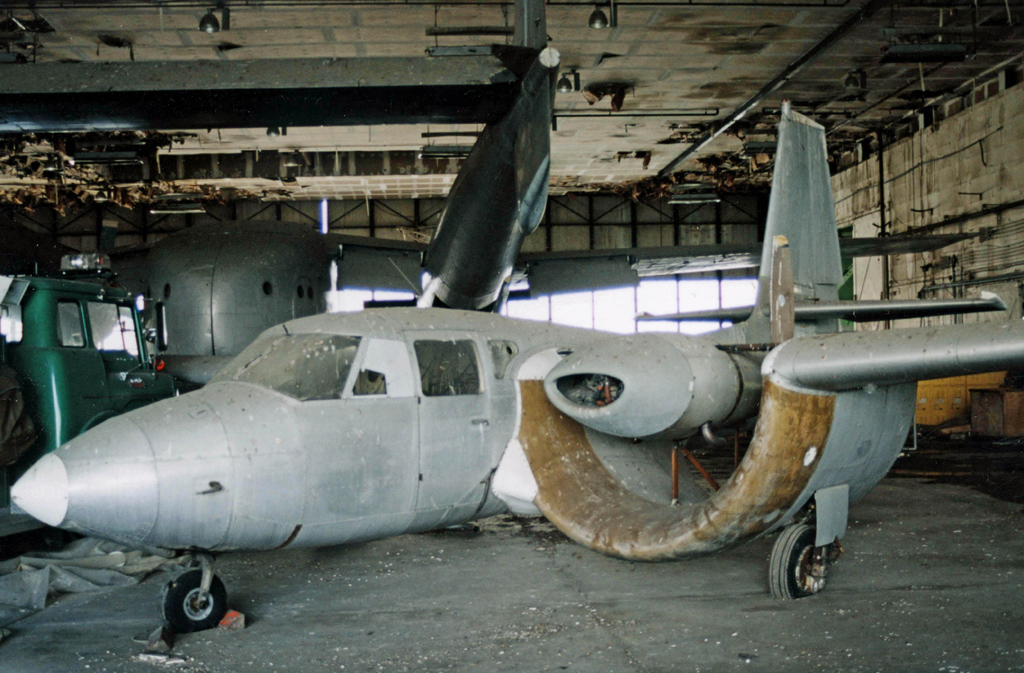
The Custer Channel Wing is a series of American-built experimental aircraft designs of the 1940s and 1950s incorporating a half-barrel shaped section to each wing.
In 1925, Willard Custer noticed how very strong winds had managed to lift the roof of a barn. He realized that the high velocity of the wind created a lower pressure above the roof while the pressure remained high inside, literally lifting the roof off. This low pressure above/high pressure below is the same phenomenon that allows an airplane wing to provide lift.
Custer developed a wing design incorporating a semi-circular channel or "half barrel" shape in which an engine was to be fitted, in order to draw air over the wing and, in 1929, he received a United States patent.
The arrangement is intended to draw enough air over the wing, even when moving slowly, to create sufficient lift to fly. Custer claimed that this layout, the channel wing, gave STOL operating capabilities and resulted in a design "which is an aircraft not an airplane. It does not plane the air to fly, rather it brings the air to the lift surfaces and reduces pressure to fly at 8 to 11 mph."
The first aircraft to incorporate Custer's concept was the CCW-1 which was fitted with a single-seat and was powered by two 75 horsepower (56 kW) Lycoming O-145 pusher engines. Registered NX30090 in the FAAs experimental category, the sole example first flew on 12 November 1942 during a solo flight that was quite unintentional. Custer, who was a non-pilot, taxied the aircraft in a demonstration for financial backers and it suddenly became airborne. A hard landing followed, and one landing gear collapsed, but this did not dampen his backers' enthusiasm.
The prototype was test flown by Frank D. Kelley, who would become a partner in the National Aircraft Corporation with Custer. The Channelwing concept was demonstrated with scale wind tunnel tests for the United States Army Air Forces in Dayton in June 1944, and again, in 1946, with 53 different configurations.
NX30090 was donated to the National Air and Space Museum and displayed at Silver Hill, Maryland.
This was an evolution of the CCW-1 as a single-seat test bed and used an adapted uncovered fuselage of a Taylorcraft BC-12 light aircraft, replacing the single engine with two pusher engines fitted each side of the fuselage and placed within the wing channels. The sole example N1375V first flew on July 3, 1948. It was flown for about 100 hours of testing with take-off and landing being made within 45–65 feet (14–20 m). Despite the claim of "flying better than a conventional aircraft," it was calculated that a stock Piper Cub was more efficient, lifting 18 lb/hp (11 kg/kW) versus the CCW-2's 11 lb/hp (6.7 kg/kW). The CCW-3 and CCW-4 designations were not used.
Hub AI
Custer Channel Wing AI simulator
(@Custer Channel Wing_simulator)
Custer Channel Wing
The Custer Channel Wing is a series of American-built experimental aircraft designs of the 1940s and 1950s incorporating a half-barrel shaped section to each wing.
In 1925, Willard Custer noticed how very strong winds had managed to lift the roof of a barn. He realized that the high velocity of the wind created a lower pressure above the roof while the pressure remained high inside, literally lifting the roof off. This low pressure above/high pressure below is the same phenomenon that allows an airplane wing to provide lift.
Custer developed a wing design incorporating a semi-circular channel or "half barrel" shape in which an engine was to be fitted, in order to draw air over the wing and, in 1929, he received a United States patent.
The arrangement is intended to draw enough air over the wing, even when moving slowly, to create sufficient lift to fly. Custer claimed that this layout, the channel wing, gave STOL operating capabilities and resulted in a design "which is an aircraft not an airplane. It does not plane the air to fly, rather it brings the air to the lift surfaces and reduces pressure to fly at 8 to 11 mph."
The first aircraft to incorporate Custer's concept was the CCW-1 which was fitted with a single-seat and was powered by two 75 horsepower (56 kW) Lycoming O-145 pusher engines. Registered NX30090 in the FAAs experimental category, the sole example first flew on 12 November 1942 during a solo flight that was quite unintentional. Custer, who was a non-pilot, taxied the aircraft in a demonstration for financial backers and it suddenly became airborne. A hard landing followed, and one landing gear collapsed, but this did not dampen his backers' enthusiasm.
The prototype was test flown by Frank D. Kelley, who would become a partner in the National Aircraft Corporation with Custer. The Channelwing concept was demonstrated with scale wind tunnel tests for the United States Army Air Forces in Dayton in June 1944, and again, in 1946, with 53 different configurations.
NX30090 was donated to the National Air and Space Museum and displayed at Silver Hill, Maryland.
This was an evolution of the CCW-1 as a single-seat test bed and used an adapted uncovered fuselage of a Taylorcraft BC-12 light aircraft, replacing the single engine with two pusher engines fitted each side of the fuselage and placed within the wing channels. The sole example N1375V first flew on July 3, 1948. It was flown for about 100 hours of testing with take-off and landing being made within 45–65 feet (14–20 m). Despite the claim of "flying better than a conventional aircraft," it was calculated that a stock Piper Cub was more efficient, lifting 18 lb/hp (11 kg/kW) versus the CCW-2's 11 lb/hp (6.7 kg/kW). The CCW-3 and CCW-4 designations were not used.
Recent media