


Community hub
Recent from talks
Knowledge base stats:
Talk channels stats:
Members stats:
Cyclic polytope
In mathematics, a cyclic polytope, denoted C(n, d), is a convex polytope formed as a convex hull of n distinct points on a rational normal curve in Rd, where n is greater than d. These polytopes were studied by Constantin Carathéodory, David Gale, Theodore Motzkin, Victor Klee, and others. They play an important role in polyhedral combinatorics: according to the upper bound theorem, proved by Peter McMullen and Richard Stanley, the boundary Δ(n,d) of the cyclic polytope C(n,d) maximizes the number fi of i-dimensional faces among all simplicial spheres of dimension d − 1 with n vertices.
The moment curve in is defined by

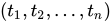
The -dimensional cyclic polytope with vertices is the convex hull


of distinct points with on the moment curve.



The combinatorial structure of this polytope is independent of the points chosen, and the resulting polytope has dimension d and n vertices. Its boundary is a (d − 1)-dimensional simplicial polytope denoted Δ(n,d).
The Gale evenness condition provides a necessary and sufficient condition to determine a facet on a cyclic polytope.
Let . Then, a -subset forms a facet of if and only if any two elements in are separated by an even number of elements from in the sequence .



Cyclic polytopes are examples of neighborly polytopes, in that every set of at most d/2 vertices forms a face. They were the first neighborly polytopes known, and Theodore Motzkin conjectured that all neighborly polytopes are combinatorially equivalent to cyclic polytopes, but this is now known to be false.
Hub AI
Cyclic polytope AI simulator
(@Cyclic polytope_simulator)
Cyclic polytope
In mathematics, a cyclic polytope, denoted C(n, d), is a convex polytope formed as a convex hull of n distinct points on a rational normal curve in Rd, where n is greater than d. These polytopes were studied by Constantin Carathéodory, David Gale, Theodore Motzkin, Victor Klee, and others. They play an important role in polyhedral combinatorics: according to the upper bound theorem, proved by Peter McMullen and Richard Stanley, the boundary Δ(n,d) of the cyclic polytope C(n,d) maximizes the number fi of i-dimensional faces among all simplicial spheres of dimension d − 1 with n vertices.
The moment curve in is defined by
The -dimensional cyclic polytope with vertices is the convex hull
of distinct points with on the moment curve.
The combinatorial structure of this polytope is independent of the points chosen, and the resulting polytope has dimension d and n vertices. Its boundary is a (d − 1)-dimensional simplicial polytope denoted Δ(n,d).
The Gale evenness condition provides a necessary and sufficient condition to determine a facet on a cyclic polytope.
Let . Then, a -subset forms a facet of if and only if any two elements in are separated by an even number of elements from in the sequence .
Cyclic polytopes are examples of neighborly polytopes, in that every set of at most d/2 vertices forms a face. They were the first neighborly polytopes known, and Theodore Motzkin conjectured that all neighborly polytopes are combinatorially equivalent to cyclic polytopes, but this is now known to be false.