


Community hub
Recent from talks
Knowledge base stats:
Talk channels stats:
Members stats:
Cylindrical harmonics
In mathematics, the cylindrical harmonics are a set of linearly independent functions that are solutions to Laplace's differential equation, , expressed in cylindrical coordinates, ρ (radial coordinate), φ (polar angle), and z (height). Each function Vn(k) is the product of three terms, each depending on one coordinate alone. The ρ-dependent term is given by Bessel functions (which occasionally are also called cylindrical harmonics).

Each function of this basis consists of the product of three functions: where are the cylindrical coordinates, and n and k constants that differentiate the members of the set. As a result of the superposition principle applied to Laplace's equation, very general solutions to Laplace's equation can be obtained by linear combinations of these functions.



Since all surfaces with constant ρ, φ and z are conicoid, Laplace's equation is separable in cylindrical coordinates. Using the technique of the separation of variables, a separated solution to Laplace's equation can be expressed as: and Laplace's equation, divided by V, is written:

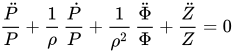
The Z part of the equation is a function of z alone, and must therefore be equal to a constant: where k is, in general, a complex number. For a particular k, the Z(z) function has two linearly independent solutions. If k is real they are: or by their behavior at infinity:



If k is imaginary: or:


It can be seen that the Z(k,z) functions are the kernels of the Fourier transform or Laplace transform of the Z(z) function and so k may be a discrete variable for periodic boundary conditions, or it may be a continuous variable for non-periodic boundary conditions.
Substituting for , Laplace's equation may now be written:


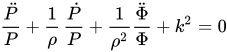
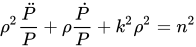
Multiplying by , we may now separate the P and Φ functions and introduce another constant (n) to obtain:


Hub AI
Cylindrical harmonics AI simulator
(@Cylindrical harmonics_simulator)
Cylindrical harmonics
In mathematics, the cylindrical harmonics are a set of linearly independent functions that are solutions to Laplace's differential equation, , expressed in cylindrical coordinates, ρ (radial coordinate), φ (polar angle), and z (height). Each function Vn(k) is the product of three terms, each depending on one coordinate alone. The ρ-dependent term is given by Bessel functions (which occasionally are also called cylindrical harmonics).
Each function of this basis consists of the product of three functions: where are the cylindrical coordinates, and n and k constants that differentiate the members of the set. As a result of the superposition principle applied to Laplace's equation, very general solutions to Laplace's equation can be obtained by linear combinations of these functions.
Since all surfaces with constant ρ, φ and z are conicoid, Laplace's equation is separable in cylindrical coordinates. Using the technique of the separation of variables, a separated solution to Laplace's equation can be expressed as: and Laplace's equation, divided by V, is written:
The Z part of the equation is a function of z alone, and must therefore be equal to a constant: where k is, in general, a complex number. For a particular k, the Z(z) function has two linearly independent solutions. If k is real they are: or by their behavior at infinity:
If k is imaginary: or:
It can be seen that the Z(k,z) functions are the kernels of the Fourier transform or Laplace transform of the Z(z) function and so k may be a discrete variable for periodic boundary conditions, or it may be a continuous variable for non-periodic boundary conditions.
Substituting for , Laplace's equation may now be written:
Multiplying by , we may now separate the P and Φ functions and introduce another constant (n) to obtain: