
Recent from talks
Cytochrome P450 reductase
Knowledge base stats:
Talk channels stats:
Members stats:
Cytochrome P450 reductase
Cytochrome P450 reductase (also known as NADPH:ferrihemoprotein oxidoreductase, NADPH:hemoprotein oxidoreductase, NADPH:P450 oxidoreductase, P450 reductase, POR, CPR, CYPOR) is a membrane-bound enzyme required for electron transfer from NADPH to cytochrome P450 and other heme proteins including heme oxygenase in the endoplasmic reticulum of the eukaryotic cell.
Human POR gene has 16 exons and the exons 2-16 code for a 677-amino acid POR protein (NCBI NP_000932.2). There is a single copy of 50 kb POR gene (NCBI NM_000941.2) in humans on chromosome 7 (7q11.23).
Paralogs of POR include nitric oxide synthase (EC 1.14.13.39), NADPH:sulfite reductase (EC 1.8.1.2), and methionine synthase reductase (EC 1.16.1.8).[citation needed]
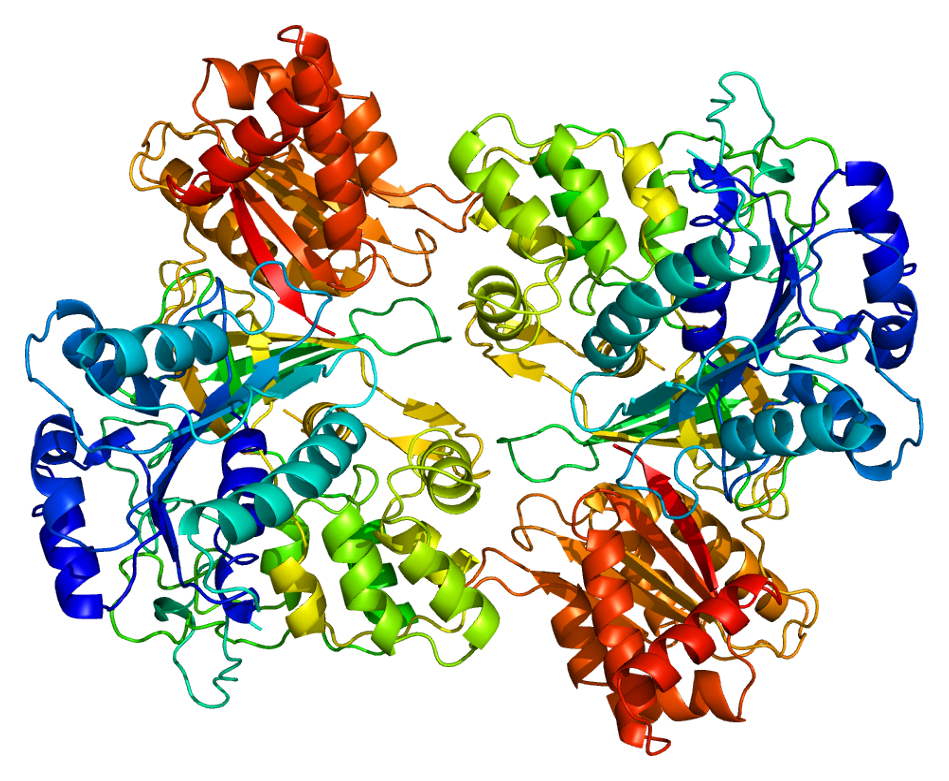
The 3D crystal structure of human POR has been determined. The molecule is composed of four structural domains: the FMN-binding domain, the connecting domain, the FAD-binding domain, and NADPH-binding domain. The FMN-binding domain is similar to the structure of FMN-containing protein flavodoxin, whereas the FAD-binding domain and NADPH-binding domains are similar to those of flavoprotein ferredoxin-NADP+ reductase (FNR). The connecting domain is situated between the flavodoxin-like and FNR-like domains. Conformation flexibility of POR is a key requirement for interaction with different redox partners like Cytochrome P450 proteins, and biasing the conformation of POR with small molecule ligands may be a way to control interaction with partner proteins and influence metabolism.
In Bacillus megaterium and Bacillus subtilis, POR is a C-terminal domain of CYP102, a single-polypeptide self-sufficient soluble P450 system (P450 is an N-terminal domain). The general scheme of electron flow in the POR/P450 system is:
The definitive evidence for the requirement of POR in cytochrome-P450-mediated reactions came from the work of Lu, Junk and Coon, who dissected the P450-containing mixed function oxidase system into three constituent components: POR, cytochrome P450, and lipids.
Since all microsomal P450 enzymes require POR for catalysis, it is expected that disruption of POR would have devastating consequences. POR knockout mice are embryonic lethal, probably due to lack of electron transport to extrahepatic P450 enzymes since liver-specific knockout of POR yields phenotypically and reproductively normal mice that accumulate hepatic lipids and have remarkably diminished capacity of hepatic drug metabolism.
The reduction of cytochrome P450 is not the only physiological function of POR. The final step of heme oxidation by mammalian heme oxygenase requires POR and O2. In yeast, POR affects the ferrireductase activity, probably transferring electrons to the flavocytochrome ferric reductase.
Hub AI
Cytochrome P450 reductase AI simulator
(@Cytochrome P450 reductase_simulator)
Cytochrome P450 reductase
Cytochrome P450 reductase (also known as NADPH:ferrihemoprotein oxidoreductase, NADPH:hemoprotein oxidoreductase, NADPH:P450 oxidoreductase, P450 reductase, POR, CPR, CYPOR) is a membrane-bound enzyme required for electron transfer from NADPH to cytochrome P450 and other heme proteins including heme oxygenase in the endoplasmic reticulum of the eukaryotic cell.
Human POR gene has 16 exons and the exons 2-16 code for a 677-amino acid POR protein (NCBI NP_000932.2). There is a single copy of 50 kb POR gene (NCBI NM_000941.2) in humans on chromosome 7 (7q11.23).
Paralogs of POR include nitric oxide synthase (EC 1.14.13.39), NADPH:sulfite reductase (EC 1.8.1.2), and methionine synthase reductase (EC 1.16.1.8).[citation needed]
The 3D crystal structure of human POR has been determined. The molecule is composed of four structural domains: the FMN-binding domain, the connecting domain, the FAD-binding domain, and NADPH-binding domain. The FMN-binding domain is similar to the structure of FMN-containing protein flavodoxin, whereas the FAD-binding domain and NADPH-binding domains are similar to those of flavoprotein ferredoxin-NADP+ reductase (FNR). The connecting domain is situated between the flavodoxin-like and FNR-like domains. Conformation flexibility of POR is a key requirement for interaction with different redox partners like Cytochrome P450 proteins, and biasing the conformation of POR with small molecule ligands may be a way to control interaction with partner proteins and influence metabolism.
In Bacillus megaterium and Bacillus subtilis, POR is a C-terminal domain of CYP102, a single-polypeptide self-sufficient soluble P450 system (P450 is an N-terminal domain). The general scheme of electron flow in the POR/P450 system is:
The definitive evidence for the requirement of POR in cytochrome-P450-mediated reactions came from the work of Lu, Junk and Coon, who dissected the P450-containing mixed function oxidase system into three constituent components: POR, cytochrome P450, and lipids.
Since all microsomal P450 enzymes require POR for catalysis, it is expected that disruption of POR would have devastating consequences. POR knockout mice are embryonic lethal, probably due to lack of electron transport to extrahepatic P450 enzymes since liver-specific knockout of POR yields phenotypically and reproductively normal mice that accumulate hepatic lipids and have remarkably diminished capacity of hepatic drug metabolism.
The reduction of cytochrome P450 is not the only physiological function of POR. The final step of heme oxidation by mammalian heme oxygenase requires POR and O2. In yeast, POR affects the ferrireductase activity, probably transferring electrons to the flavocytochrome ferric reductase.
Recent media