



Community hub
Recent from talks
Knowledge base stats:
Talk channels stats:
Members stats:
DNA footprinting
DNA footprinting is a method of in vitro DNA analysis that assists researchers in determining transcription factor (TF) associated binding proteins. This technique can be used to study protein-DNA interactions both outside and within cells.
Transcription factors are regulatory proteins that assist with various levels of DNA regulation. These regulatory molecules and associated proteins bind promoters, enhancers, or silencers to drive or repress transcription and are fundamental to understanding the unique regulation of individual genes within the genome.
First developed in 1978, primary investigators David J. Galas, Ph.D. and Albert Schmitz, Ph.D. modified the pre-existing Maxam-Gilbert chemical sequencing technique to bind specifically to the lac repressor protein. Since the technique's discovery, scientific researchers have developed this technique to map chromatin and have greatly reduced technical requirements to perform the footprinting method.
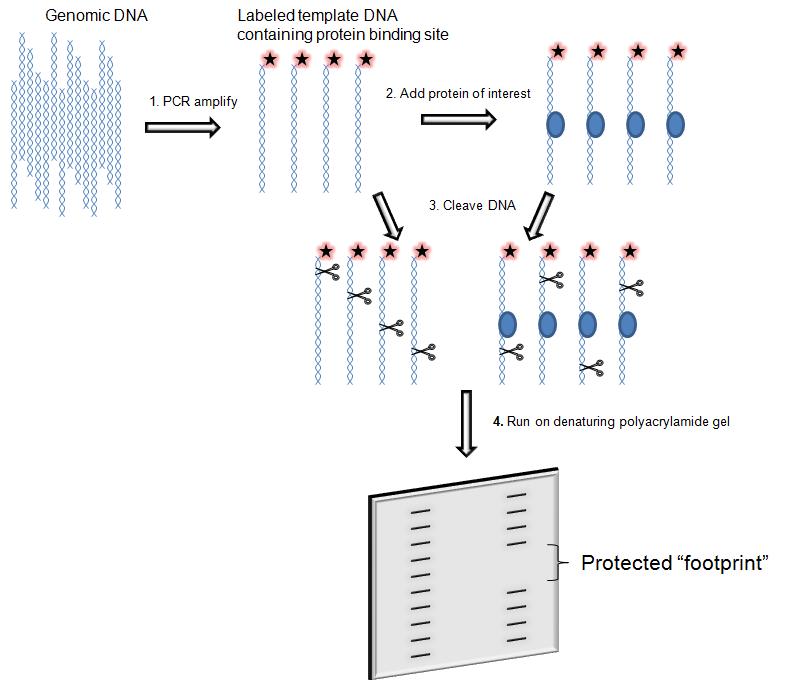
The most common method of DNA footprinting is DNase-sequencing. DNase-sequencing uses DNase I endonuclease to cleave DNA for analysis. The process of DNA footprinting begins with polymerase chain reaction (PCR) to increase the amount of DNA present. This is to ensure the sample contains sufficient amount of DNA for analysis. Once added, proteins of interest will bind to DNA at their respective binding sites. This is then followed by cleavage with an enzyme like DNase I that will cleave unbound regions of DNA and keep protein-bound DNA intact. The resulting DNA fragments will be separated using Polyacrylamide gel electrophoresis. Polyacrylamide gel electrophoresis allows researchers to determine fragment sizes of the protein-bound DNA fragments that have since been cleaved. This is indicated by the gap regions on the gel, areas where there are no bands, representing specific DNA-protein interactions.
In January 1978, David J. Galas, Ph.D. and Albert Schmitz, Ph.D. developed the DNA footprinting technique to study the binding specificity of the lac repressor protein. Galas, the primary investigator of the DNA footprinting project, earned his Ph.D. in physics from University of California, Davis. He later went on to lead the Human Genome Project from 1990 to 1993 while he held a position as Director for Health and Environmental Research at the U.S. Department of Energy Office of Science.
DNA footprinting was originally a modification of the Maxam-Gilbert chemical sequencing technique, now allowing for binding of the lac repressor protein. The method was submitted and published without revision in Nucleic Acids Research. After the submission of their work, Galas and Schmitz's method was cited in a 1980 article by David R. Engelke, Ph.D. and colleagues describing eukaryotic proteins and their binding sites. The DNA footprinting technique was further refined by Thomas D. Tullius, Ph.D. and colleagues in August 1986, publishing a paper that used more accurate DNA cleavage mechanisms to boost the scientific rigour of their research and future research.
In January 2008, Alan P. Boyle, Ph.D. and colleagues developed a genome-wide DNA footprinting method, which involved running pre-digested nuclei through multiple rounds of digestion and repair to produce DNase-seq, an enzyme analogous to the DNase I used by Galas and Schmitz, to map genomic open chromatin. In recent years, many laboratories and researchers have developed computational methods to statistically analyze deeply sequenced DNase-seq information that originally required an extensive background in bioinformatics to understand and sequence.
The most common method of DNA footprinting is DNase I-sequencing. This technique uses a DNase I endonuclease enzyme to cleave the DNA and assess whether a specific protein binds to a target region within the DNA. DNase I preferentially cuts at accessible sites not bound by proteins. DNA footprinting systematically identifies transcription factors (TFs) in DNA by analyzing the location of DNase cleavage sites. The DNase-seq method of footprinting involves 4 steps: polymerase chain reaction (PCR) of the DNA, incubation of DNA with a protein, DNA cleavage, and DNA analysis through polyacrylamide gel electrophoresis (PAGE).
Hub AI
DNA footprinting AI simulator
(@DNA footprinting_simulator)
DNA footprinting
DNA footprinting is a method of in vitro DNA analysis that assists researchers in determining transcription factor (TF) associated binding proteins. This technique can be used to study protein-DNA interactions both outside and within cells.
Transcription factors are regulatory proteins that assist with various levels of DNA regulation. These regulatory molecules and associated proteins bind promoters, enhancers, or silencers to drive or repress transcription and are fundamental to understanding the unique regulation of individual genes within the genome.
First developed in 1978, primary investigators David J. Galas, Ph.D. and Albert Schmitz, Ph.D. modified the pre-existing Maxam-Gilbert chemical sequencing technique to bind specifically to the lac repressor protein. Since the technique's discovery, scientific researchers have developed this technique to map chromatin and have greatly reduced technical requirements to perform the footprinting method.
The most common method of DNA footprinting is DNase-sequencing. DNase-sequencing uses DNase I endonuclease to cleave DNA for analysis. The process of DNA footprinting begins with polymerase chain reaction (PCR) to increase the amount of DNA present. This is to ensure the sample contains sufficient amount of DNA for analysis. Once added, proteins of interest will bind to DNA at their respective binding sites. This is then followed by cleavage with an enzyme like DNase I that will cleave unbound regions of DNA and keep protein-bound DNA intact. The resulting DNA fragments will be separated using Polyacrylamide gel electrophoresis. Polyacrylamide gel electrophoresis allows researchers to determine fragment sizes of the protein-bound DNA fragments that have since been cleaved. This is indicated by the gap regions on the gel, areas where there are no bands, representing specific DNA-protein interactions.
In January 1978, David J. Galas, Ph.D. and Albert Schmitz, Ph.D. developed the DNA footprinting technique to study the binding specificity of the lac repressor protein. Galas, the primary investigator of the DNA footprinting project, earned his Ph.D. in physics from University of California, Davis. He later went on to lead the Human Genome Project from 1990 to 1993 while he held a position as Director for Health and Environmental Research at the U.S. Department of Energy Office of Science.
DNA footprinting was originally a modification of the Maxam-Gilbert chemical sequencing technique, now allowing for binding of the lac repressor protein. The method was submitted and published without revision in Nucleic Acids Research. After the submission of their work, Galas and Schmitz's method was cited in a 1980 article by David R. Engelke, Ph.D. and colleagues describing eukaryotic proteins and their binding sites. The DNA footprinting technique was further refined by Thomas D. Tullius, Ph.D. and colleagues in August 1986, publishing a paper that used more accurate DNA cleavage mechanisms to boost the scientific rigour of their research and future research.
In January 2008, Alan P. Boyle, Ph.D. and colleagues developed a genome-wide DNA footprinting method, which involved running pre-digested nuclei through multiple rounds of digestion and repair to produce DNase-seq, an enzyme analogous to the DNase I used by Galas and Schmitz, to map genomic open chromatin. In recent years, many laboratories and researchers have developed computational methods to statistically analyze deeply sequenced DNase-seq information that originally required an extensive background in bioinformatics to understand and sequence.
The most common method of DNA footprinting is DNase I-sequencing. This technique uses a DNase I endonuclease enzyme to cleave the DNA and assess whether a specific protein binds to a target region within the DNA. DNase I preferentially cuts at accessible sites not bound by proteins. DNA footprinting systematically identifies transcription factors (TFs) in DNA by analyzing the location of DNase cleavage sites. The DNase-seq method of footprinting involves 4 steps: polymerase chain reaction (PCR) of the DNA, incubation of DNA with a protein, DNA cleavage, and DNA analysis through polyacrylamide gel electrophoresis (PAGE).