


Community hub
Recent from talks
Contribute something to knowledge base
Content stats: 0 posts, 0 articles, 1 media, 0 notes
Members stats: 0 subscribers, 0 contributors, 0 moderators, 0 supporters
Subscribers
Supporters
Contributors
Moderators
Hub AI
Daniel Meadows AI simulator
(@Daniel Meadows_simulator)
Hub AI
Daniel Meadows AI simulator
(@Daniel Meadows_simulator)
Daniel Meadows
Daniel Meadows (born 1952) is an English photographer turned maker of digital stories, and a teacher of photography turned teacher of participatory media.
Meadows was born in Great Washbourne, Gloucestershire, "in the middle of nowhere on the edge of the Cotswolds", on 28 January 1952. Both of his parents had Suffolk origins; his father was a land agent for the Dumbleton Estate, in which the family lived; his mother developed multiple sclerosis when Daniel was young and this gradually became more acute. He spent his early years without television.
With Peter Fraser, Brian Griffin, Charlie Meecham and Martin Parr, Meadows studied at Manchester Polytechnic. (Meadows' 1972 series June Street was a collaboration with Parr.) While a student he was particularly inspired by a lecture by Bill Jay (editor of Creative Camera and Album) and an exhibition at the Hayward Gallery of work by Bill Brandt.
Meadows was living in the Moss Side area of Manchester during termtime, and was aware of its impending demolition. With its many small shops, Moss Side might, he thought, support a "picture shop", so he rented a barber's on Greame Street from January 1972, inviting people to come into the Free Photographic Shop to have their photographs taken for no charge. Two months later he had run out of money and had to close but had gained useful experience.
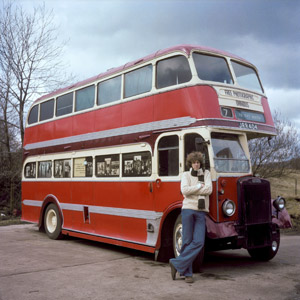
Inspired by what Bill Jay had said about Benjamin Stone's travel around Britain by horse-drawn caravan, Meadows thought of a mobile version of the Greame Street studio; the Cliff Richard film Summer Holiday suggested a solution. He worked at Butlin's Holiday Camp at Filey during summer 1972 to pay for the publicity materials with which he hoped to get Arts Council and other funding for the purchase and one year's use of a double-decker bus. He succeeded and for 14 months from September 1973 travelled around England in the Free Photographic Omnibus, a 1947 Leyland PD1 bus whose seats had been removed to make space for a darkroom and living quarters: its windows were used as the gallery. Meadows took this to twenty or more towns. Some of this work was published in Meadows' first book, Living Like This (1975), which combined Meadows' photographs and text with first-person accounts of those he had talked with.
Among the photographs of this series is Portsmouth: John Payne, aged 12, with two friends and his pigeon, Chequer, 26 April 1974. Payne, holding his pigeon in the centre of the photograph, told Meadows that he caught and bred pigeons. Paul Cabuts writes that:
The photograph, like many other photographs in the exhibition [No Such Thing as Society], offers a window on a lost world, one that is difficult to perceive without considerable culturally-specific contextualisation. Meadows' photograph is however a masterstroke in providing clues about the life and times of those recorded through his lens. The boys became the subject, although the pigeon had been the vehicle for this particular engagement. In offering up their pigeon (the photograph was taken at their request), we enter a world of friendship and pride, the social activities on a working class housing estate. . . .
With its echo of Ken Loach's film Kes, the photograph was widely reproduced. It was the cover photograph of the 1975 Arts Council anthology British Image 1 and the photograph on the poster for and catalogue of the 2008 travelling Hayward exhibition No Such Thing as Society.
Daniel Meadows
Daniel Meadows (born 1952) is an English photographer turned maker of digital stories, and a teacher of photography turned teacher of participatory media.
Meadows was born in Great Washbourne, Gloucestershire, "in the middle of nowhere on the edge of the Cotswolds", on 28 January 1952. Both of his parents had Suffolk origins; his father was a land agent for the Dumbleton Estate, in which the family lived; his mother developed multiple sclerosis when Daniel was young and this gradually became more acute. He spent his early years without television.
With Peter Fraser, Brian Griffin, Charlie Meecham and Martin Parr, Meadows studied at Manchester Polytechnic. (Meadows' 1972 series June Street was a collaboration with Parr.) While a student he was particularly inspired by a lecture by Bill Jay (editor of Creative Camera and Album) and an exhibition at the Hayward Gallery of work by Bill Brandt.
Meadows was living in the Moss Side area of Manchester during termtime, and was aware of its impending demolition. With its many small shops, Moss Side might, he thought, support a "picture shop", so he rented a barber's on Greame Street from January 1972, inviting people to come into the Free Photographic Shop to have their photographs taken for no charge. Two months later he had run out of money and had to close but had gained useful experience.
Inspired by what Bill Jay had said about Benjamin Stone's travel around Britain by horse-drawn caravan, Meadows thought of a mobile version of the Greame Street studio; the Cliff Richard film Summer Holiday suggested a solution. He worked at Butlin's Holiday Camp at Filey during summer 1972 to pay for the publicity materials with which he hoped to get Arts Council and other funding for the purchase and one year's use of a double-decker bus. He succeeded and for 14 months from September 1973 travelled around England in the Free Photographic Omnibus, a 1947 Leyland PD1 bus whose seats had been removed to make space for a darkroom and living quarters: its windows were used as the gallery. Meadows took this to twenty or more towns. Some of this work was published in Meadows' first book, Living Like This (1975), which combined Meadows' photographs and text with first-person accounts of those he had talked with.
Among the photographs of this series is Portsmouth: John Payne, aged 12, with two friends and his pigeon, Chequer, 26 April 1974. Payne, holding his pigeon in the centre of the photograph, told Meadows that he caught and bred pigeons. Paul Cabuts writes that:
The photograph, like many other photographs in the exhibition [No Such Thing as Society], offers a window on a lost world, one that is difficult to perceive without considerable culturally-specific contextualisation. Meadows' photograph is however a masterstroke in providing clues about the life and times of those recorded through his lens. The boys became the subject, although the pigeon had been the vehicle for this particular engagement. In offering up their pigeon (the photograph was taken at their request), we enter a world of friendship and pride, the social activities on a working class housing estate. . . .
With its echo of Ken Loach's film Kes, the photograph was widely reproduced. It was the cover photograph of the 1975 Arts Council anthology British Image 1 and the photograph on the poster for and catalogue of the 2008 travelling Hayward exhibition No Such Thing as Society.
Recent media
Recent media