


Community hub
Recent from talks
Contribute something to knowledge base
Content stats: 0 posts, 0 articles, 1 media, 0 notes
Members stats: 0 subscribers, 0 contributors, 0 moderators, 0 supporters
Subscribers
Supporters
Contributors
Moderators
Hub AI
Danish nobility AI simulator
(@Danish nobility_simulator)
Hub AI
Danish nobility AI simulator
(@Danish nobility_simulator)
Danish nobility
Danish nobility is a social class and a former estate in the Kingdom of Denmark. The nobility has official recognition in Denmark, a monarchy. Its legal privileges were abolished with the constitution of 1849. Some of the families still own and reside in castles or country houses. A minority of nobles still belong to the elite, and they are as such present at royal events where they hold court posts, are guests, or are objects of media coverage, for example Kanal 4's TV-hostess Caroline Fleming née Baroness Iuel-Brockdorff.[citation needed] Some of them own and manage companies or have leading positions within business, banking, diplomacy and NGOs.
Historians divide the Danish nobility into two categories: ancient nobility (Danish: uradel) and letter nobility (Danish: brevadel) based on the way they achieved nobility. Another status-based categorization distinguishes between higher and lower nobility (Danish: højadel, lavadel). "Ancient nobility" refers to those noble families that are known from the era before the Danish reformation where we have no exact knowledge of how they attained noble status, whereas letter nobility are those families that received their rank by a patent at the time of their elevation to the nobility. Families of the Lord High Councillors of Denmark before the introduction of absolutism in Denmark in 1660 and houses endowed with a title from 1671 onwards are regarded as higher nobility of Denmark.[citation needed] Whereas all other noble families are considered lower nobility.
In 1671 a new titled higher nobility was introduced with the ranks of count and baron available for families that owned estates with a minimum of 2,500 and 1,000 barrels of land hartkorn respectively and were willing to allocate them as feudal counties and baronies to be inherited by primogeniture with the possessor receiving the title of lensgreve (lit. 'fief count') or lensbaron (lit. 'fief baron'). Despite their patents – which in reality were subjugations to a nascent absolutist state, most nobles who were elevated to the titled nobility by the post-1671 patents came from families that had belonged to the higher nobility before the introduction of absolutism, such as Brahe or Rantzau. The title of duke being restricted to the royal family and their relatives is in contrast to German and French usage. In Germany, most dukes had executive power within the Reichstag.
A striking feature has been the close ties medieval Danish magnate families had with German (Thuringian, Lower-Saxon, etc.) counts: for example in the 13th century, there were several marriages between Danish magnate families and German counts in each generation.
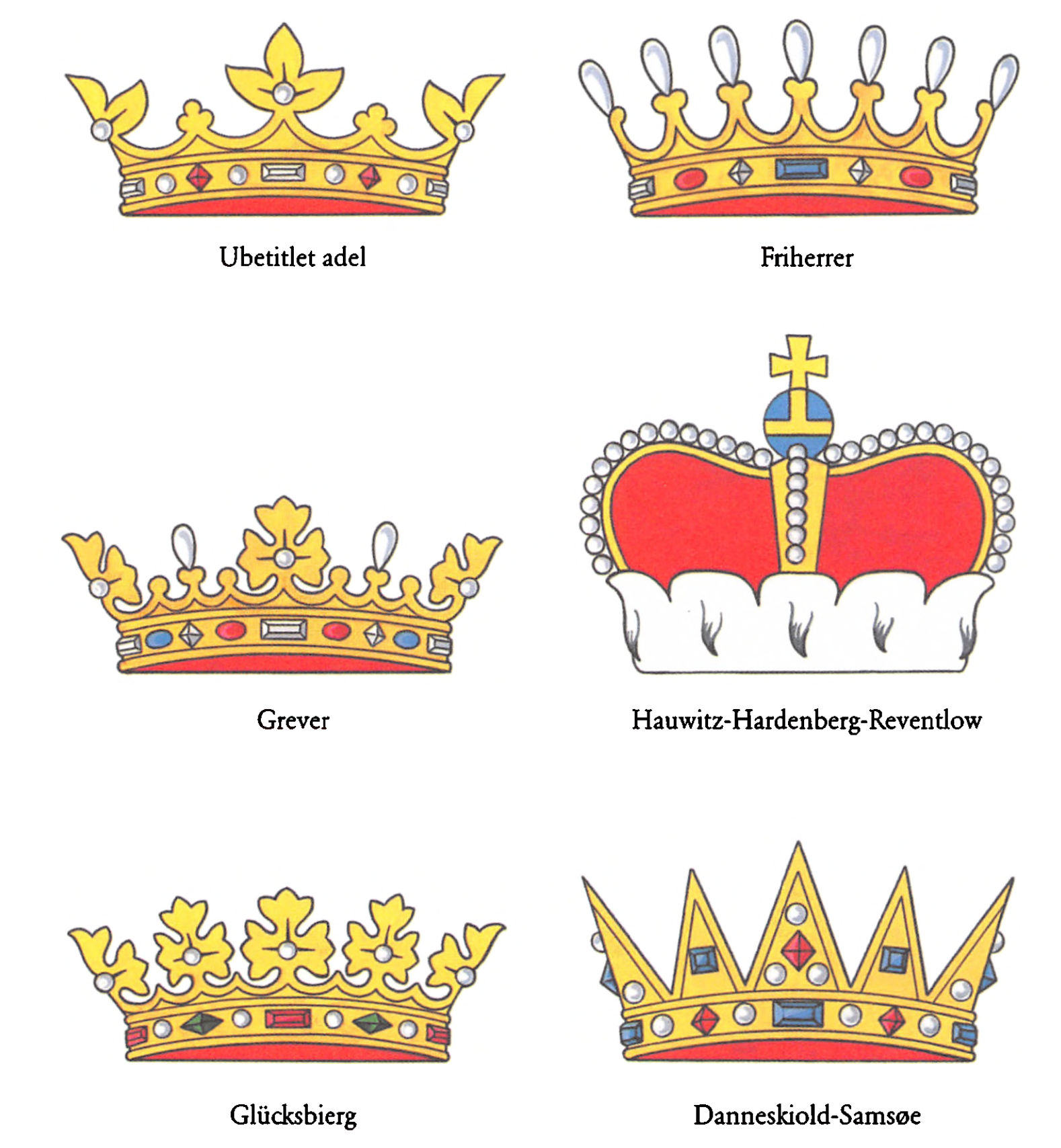
The following system, which was introduced in 1671 with the titles of feudal count (lensgreve) and feudal baron (lensbaron), is currently in force:
Note: Gentlemen with foreign titles (German counts or Freiherren for example) ranked below Danish lensgreve and Danish lensfriherre. Thus from a Danish point of view, Friedrich von Ahlefeldt (see above), who had been distinguished in 1665 with a comital title by the emperor, was actually "elevated" when he became a Danish lensgreve after 1671. Of course his German title – which left him in the Lower Nobility in Germany – should not be termed "rigsgreve" as explained above, but perhaps "tyske greve".
Two families bear the Danish title of duke, not being counted as "nobility":
Dukes had earlier the German-inspired style of Durchlauchtighed (German: Durchlaucht; English: Serene Highness), but Danish ducal titles are at present virtually non-existent. In historical contexts, for example, older predicates as (your) grace or højvelbårenhed are applied.
Danish nobility
Danish nobility is a social class and a former estate in the Kingdom of Denmark. The nobility has official recognition in Denmark, a monarchy. Its legal privileges were abolished with the constitution of 1849. Some of the families still own and reside in castles or country houses. A minority of nobles still belong to the elite, and they are as such present at royal events where they hold court posts, are guests, or are objects of media coverage, for example Kanal 4's TV-hostess Caroline Fleming née Baroness Iuel-Brockdorff.[citation needed] Some of them own and manage companies or have leading positions within business, banking, diplomacy and NGOs.
Historians divide the Danish nobility into two categories: ancient nobility (Danish: uradel) and letter nobility (Danish: brevadel) based on the way they achieved nobility. Another status-based categorization distinguishes between higher and lower nobility (Danish: højadel, lavadel). "Ancient nobility" refers to those noble families that are known from the era before the Danish reformation where we have no exact knowledge of how they attained noble status, whereas letter nobility are those families that received their rank by a patent at the time of their elevation to the nobility. Families of the Lord High Councillors of Denmark before the introduction of absolutism in Denmark in 1660 and houses endowed with a title from 1671 onwards are regarded as higher nobility of Denmark.[citation needed] Whereas all other noble families are considered lower nobility.
In 1671 a new titled higher nobility was introduced with the ranks of count and baron available for families that owned estates with a minimum of 2,500 and 1,000 barrels of land hartkorn respectively and were willing to allocate them as feudal counties and baronies to be inherited by primogeniture with the possessor receiving the title of lensgreve (lit. 'fief count') or lensbaron (lit. 'fief baron'). Despite their patents – which in reality were subjugations to a nascent absolutist state, most nobles who were elevated to the titled nobility by the post-1671 patents came from families that had belonged to the higher nobility before the introduction of absolutism, such as Brahe or Rantzau. The title of duke being restricted to the royal family and their relatives is in contrast to German and French usage. In Germany, most dukes had executive power within the Reichstag.
A striking feature has been the close ties medieval Danish magnate families had with German (Thuringian, Lower-Saxon, etc.) counts: for example in the 13th century, there were several marriages between Danish magnate families and German counts in each generation.
The following system, which was introduced in 1671 with the titles of feudal count (lensgreve) and feudal baron (lensbaron), is currently in force:
Note: Gentlemen with foreign titles (German counts or Freiherren for example) ranked below Danish lensgreve and Danish lensfriherre. Thus from a Danish point of view, Friedrich von Ahlefeldt (see above), who had been distinguished in 1665 with a comital title by the emperor, was actually "elevated" when he became a Danish lensgreve after 1671. Of course his German title – which left him in the Lower Nobility in Germany – should not be termed "rigsgreve" as explained above, but perhaps "tyske greve".
Two families bear the Danish title of duke, not being counted as "nobility":
Dukes had earlier the German-inspired style of Durchlauchtighed (German: Durchlaucht; English: Serene Highness), but Danish ducal titles are at present virtually non-existent. In historical contexts, for example, older predicates as (your) grace or højvelbårenhed are applied.
Recent media
Recent media