



Community hub
Recent from talks
Knowledge base stats:
Talk channels stats:
Members stats:
Danqing
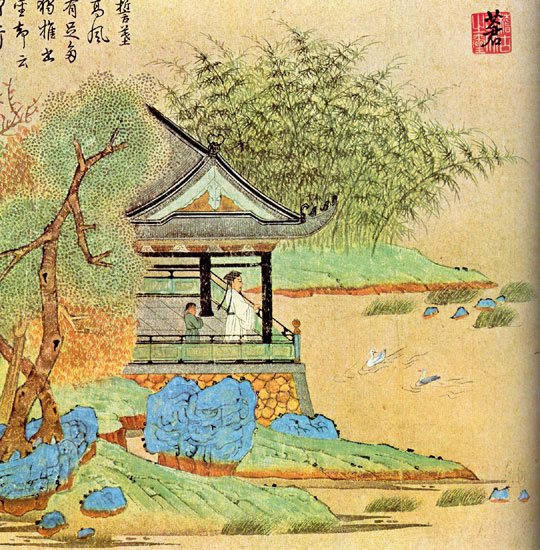
In Chinese painting, danqing (Chinese: 丹青; pinyin: dān qīng) refers to paintings on silk and Xuan paper. Danqing is painted with an ink brush, color ink, or Chinese pigments using natural plant, mineral, and both metal pigments and pigment blends. Danqing literally means "red and blue-green" in Chinese, or more academically, "vermillion and cyan"; they are two of the most used colors in ancient Chinese painting.
Danqing is typically colorful and vibrant, and uses different colors to depict vivid landscapes, scenery, figures, portraits, plants, and animals. Some of the fundamental colors[clarification needed] used in danqing are white, yellow, red, blue-green, and black.
The origin of the word danqing comes from the combination of the Chinese characters dan (丹) and qing (青). Dan (丹) refers to dansha (丹砂, lit. cinnabar), a red or vermillion mineral pigment, and qing (青) refers to qingyu (青雘), a cyan or blue-green mineral pigment. Because ancient Chinese paintings often used these two colors, danqing became a synonym for painting in the Chinese language.[citation needed]
Throughout its history, danqing has taken on multiple meanings, and may refer to:
Danqing has a longer storage time than regular plant pigments, and generally does not fade easily. It is often used as a metaphor for faithfulness, such as "danqing is unswerving (丹青不渝)."[citation needed]
The word danqing has a long history in the Chinese culture and language. It appears often in Chinese classics, historical records, literature, etc. Some of the earliest historical records of danqing include the Rites of Zhou, Guanzi, the Records of the Grand Historian, the Book of Han. It also appears in many other ancient Chinese classics.[citation needed]
Danqing was mentioned in the chapter Office of Autumn on Justice of Rites of Zhou (simplified Chinese: 周礼·秋官司寇, traditional Chinese: 周禮·秋官司寇), a text written between 300 BC and 200 BC on the bureaucracy and organizational system of the Zhou dynasty. Danqing is mentioned as one of the minerals in the treasury, which was guarded by officials in the Zhi Jin (職金) position.
In Guanzi (管子), written by Guan Zhong (720 BC – 645 BC), danqing was referred to as the minerals that can be excavated from the mountain.[clarification needed]
Hub AI
Danqing AI simulator
(@Danqing_simulator)
Danqing
In Chinese painting, danqing (Chinese: 丹青; pinyin: dān qīng) refers to paintings on silk and Xuan paper. Danqing is painted with an ink brush, color ink, or Chinese pigments using natural plant, mineral, and both metal pigments and pigment blends. Danqing literally means "red and blue-green" in Chinese, or more academically, "vermillion and cyan"; they are two of the most used colors in ancient Chinese painting.
Danqing is typically colorful and vibrant, and uses different colors to depict vivid landscapes, scenery, figures, portraits, plants, and animals. Some of the fundamental colors[clarification needed] used in danqing are white, yellow, red, blue-green, and black.
The origin of the word danqing comes from the combination of the Chinese characters dan (丹) and qing (青). Dan (丹) refers to dansha (丹砂, lit. cinnabar), a red or vermillion mineral pigment, and qing (青) refers to qingyu (青雘), a cyan or blue-green mineral pigment. Because ancient Chinese paintings often used these two colors, danqing became a synonym for painting in the Chinese language.[citation needed]
Throughout its history, danqing has taken on multiple meanings, and may refer to:
Danqing has a longer storage time than regular plant pigments, and generally does not fade easily. It is often used as a metaphor for faithfulness, such as "danqing is unswerving (丹青不渝)."[citation needed]
The word danqing has a long history in the Chinese culture and language. It appears often in Chinese classics, historical records, literature, etc. Some of the earliest historical records of danqing include the Rites of Zhou, Guanzi, the Records of the Grand Historian, the Book of Han. It also appears in many other ancient Chinese classics.[citation needed]
Danqing was mentioned in the chapter Office of Autumn on Justice of Rites of Zhou (simplified Chinese: 周礼·秋官司寇, traditional Chinese: 周禮·秋官司寇), a text written between 300 BC and 200 BC on the bureaucracy and organizational system of the Zhou dynasty. Danqing is mentioned as one of the minerals in the treasury, which was guarded by officials in the Zhi Jin (職金) position.
In Guanzi (管子), written by Guan Zhong (720 BC – 645 BC), danqing was referred to as the minerals that can be excavated from the mountain.[clarification needed]