



Community hub
Recent from talks
Knowledge base stats:
Talk channels stats:
Members stats:
Dark triad
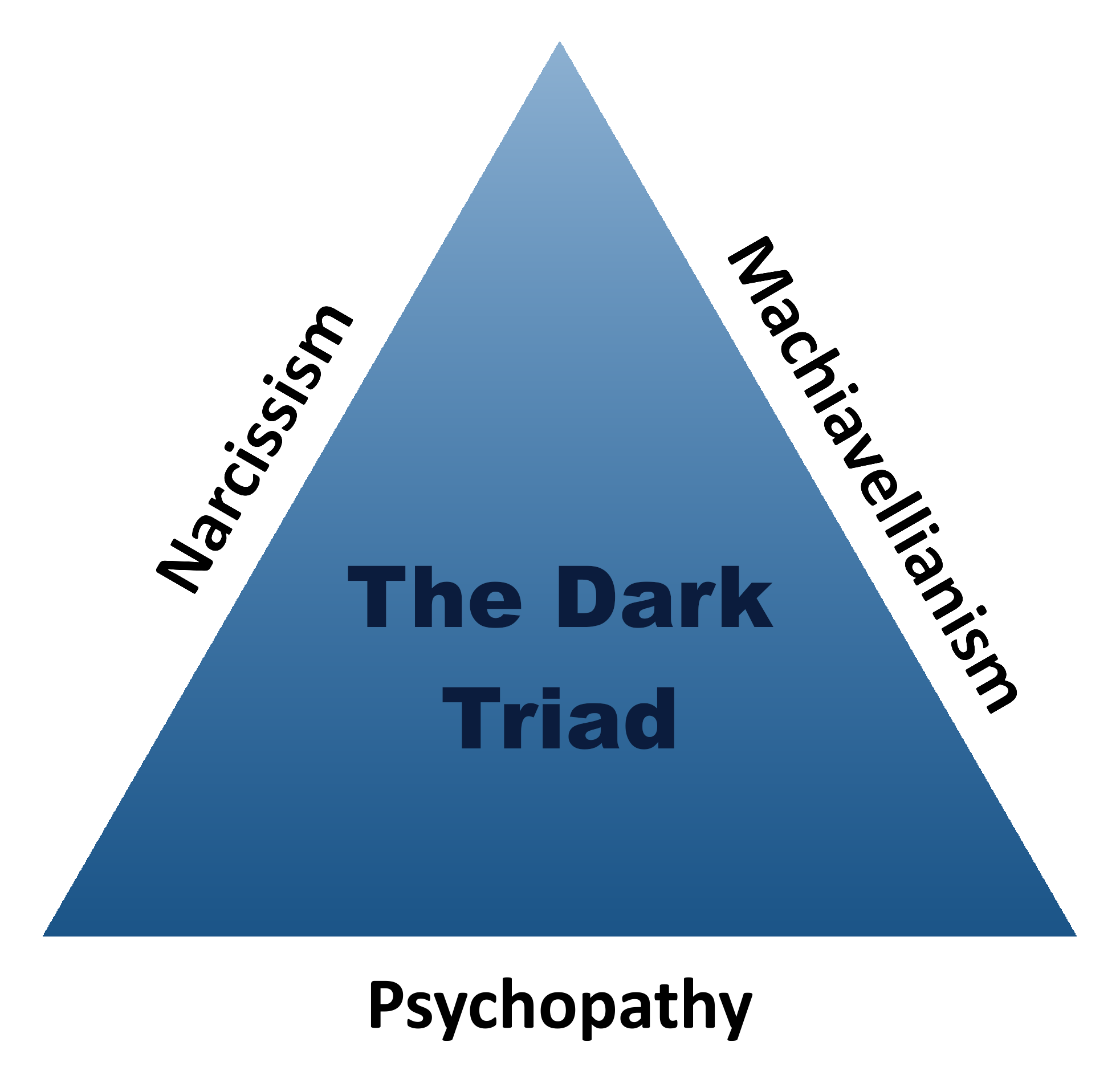
The dark triad is a psychological theory of personality, first published by Delroy L. Paulhus and Kevin M. Williams in 2002, that describes three notably offensive but non-pathological personality types: Machiavellianism, sub-clinical narcissism, and sub-clinical psychopathy. Each of these personality types is called dark because each is considered to contain malevolent qualities.
All three dark triad traits are conceptually distinct although empirical evidence shows them to be overlapping. They are associated with a callous–manipulative interpersonal style.
High scores in these traits have been found to statistically increase a person's likelihood to commit crimes, cause social distress, and create severe problems for organizations, especially if they are in leadership positions. They also tend to be less compassionate, agreeable, empathetic, and satisfied with their lives, and less likely to believe they and others are good. However, the same traits are also associated with some positive outcomes, such as mental toughness and being more likely to embrace challenges.
A factor analysis found that among the big five personality traits, low agreeableness is the strongest correlate of the dark triad, while neuroticism and a lack of conscientiousness were associated with some of the dark triad members. Research indicates that there is a consistent association between changes in agreeableness and the dark triad traits over the course of an individual's life.
In 1998, John McHoskey, William Worzel, and Christopher Szyarto provoked a controversy by claiming that narcissism, Machiavellianism, and psychopathy are more or less interchangeable in normal samples. Delroy L. Paulhus and McHoskey debated these perspectives at a subsequent American Psychological Association conference, inspiring a body of research that continues to grow in the published literature. Paulhus and Kevin Williams found enough behavioral, personality, and cognitive differences between the traits to suggest that they were distinct constructs; however, they concluded that further research was needed to elucidate how and why they overlap. While some psychologists argue that Machiavellianism seems to be indistinguishable from psychopathy and that scales of Machiavellianism seem to measure the psychopathy construct, there is enough evidence to suggest that they are two separate traits, as Paulhus notes that psychopaths are impulsive and careless, which is opposed to the behavior of High Machs who are calculating and plan for the long term.
The dark triad traits have significant theoretical and empirical overlap. All three traits share characteristics such as a lack of empathy, interpersonal hostility, and interpersonal offensiveness.
A number of measures have been developed to measure all three dark triad traits simultaneously, such as the Dirty Dozen and the Short Dark Triad (SD3). Most of these measures are questionnaire-style and either self-response or observer-response (e.g., ratings from supervisors or coworkers as measured by the Dark Informant-Rated Triad [DIRT]). Both methods can prove problematic when attempting to measure any socially-aversive trait. Self-responders may be motivated to lie, and with observer responses—particularly for Machiavellianism—individuals who are skilled at deceiving and manipulating others should be perceived as low in deceptiveness and manipulation by others, resulting in inaccurate ratings.
One study claimed that the Dirty Dozen gives mixed results on the construct validity of previous studies done on it. To show this, the study used a sample of over 3000 people and measured the convergent validity of the traits to other measures and questionnaires. They then used the Item Response Theory to analyze all of the results. This showed that there was an uneven distribution in the traits and that the scale was better at revealing Machiavellianism and psychopathy than narcissism.
Hub AI
Dark triad AI simulator
(@Dark triad_simulator)
Dark triad
The dark triad is a psychological theory of personality, first published by Delroy L. Paulhus and Kevin M. Williams in 2002, that describes three notably offensive but non-pathological personality types: Machiavellianism, sub-clinical narcissism, and sub-clinical psychopathy. Each of these personality types is called dark because each is considered to contain malevolent qualities.
All three dark triad traits are conceptually distinct although empirical evidence shows them to be overlapping. They are associated with a callous–manipulative interpersonal style.
High scores in these traits have been found to statistically increase a person's likelihood to commit crimes, cause social distress, and create severe problems for organizations, especially if they are in leadership positions. They also tend to be less compassionate, agreeable, empathetic, and satisfied with their lives, and less likely to believe they and others are good. However, the same traits are also associated with some positive outcomes, such as mental toughness and being more likely to embrace challenges.
A factor analysis found that among the big five personality traits, low agreeableness is the strongest correlate of the dark triad, while neuroticism and a lack of conscientiousness were associated with some of the dark triad members. Research indicates that there is a consistent association between changes in agreeableness and the dark triad traits over the course of an individual's life.
In 1998, John McHoskey, William Worzel, and Christopher Szyarto provoked a controversy by claiming that narcissism, Machiavellianism, and psychopathy are more or less interchangeable in normal samples. Delroy L. Paulhus and McHoskey debated these perspectives at a subsequent American Psychological Association conference, inspiring a body of research that continues to grow in the published literature. Paulhus and Kevin Williams found enough behavioral, personality, and cognitive differences between the traits to suggest that they were distinct constructs; however, they concluded that further research was needed to elucidate how and why they overlap. While some psychologists argue that Machiavellianism seems to be indistinguishable from psychopathy and that scales of Machiavellianism seem to measure the psychopathy construct, there is enough evidence to suggest that they are two separate traits, as Paulhus notes that psychopaths are impulsive and careless, which is opposed to the behavior of High Machs who are calculating and plan for the long term.
The dark triad traits have significant theoretical and empirical overlap. All three traits share characteristics such as a lack of empathy, interpersonal hostility, and interpersonal offensiveness.
A number of measures have been developed to measure all three dark triad traits simultaneously, such as the Dirty Dozen and the Short Dark Triad (SD3). Most of these measures are questionnaire-style and either self-response or observer-response (e.g., ratings from supervisors or coworkers as measured by the Dark Informant-Rated Triad [DIRT]). Both methods can prove problematic when attempting to measure any socially-aversive trait. Self-responders may be motivated to lie, and with observer responses—particularly for Machiavellianism—individuals who are skilled at deceiving and manipulating others should be perceived as low in deceptiveness and manipulation by others, resulting in inaccurate ratings.
One study claimed that the Dirty Dozen gives mixed results on the construct validity of previous studies done on it. To show this, the study used a sample of over 3000 people and measured the convergent validity of the traits to other measures and questionnaires. They then used the Item Response Theory to analyze all of the results. This showed that there was an uneven distribution in the traits and that the scale was better at revealing Machiavellianism and psychopathy than narcissism.