
Recent from talks
Death of James Cook
Knowledge base stats:
Talk channels stats:
Members stats:
Death of James Cook
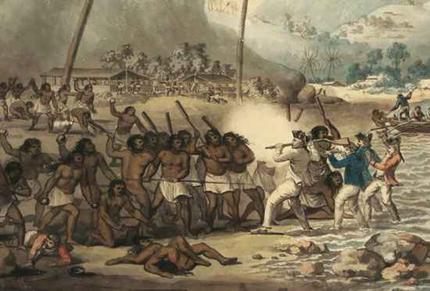
On 14 February 1779 British explorer Captain James Cook was killed as he attempted to kidnap Kalaniʻōpuʻu, the ruling chief (aliʻi nui) of the island of Hawaii, and hold him hostage for the return of a cutter which Hawaiians had stolen. As Cook and his men attempted to take the chief to his ship, they were confronted by a crowd of Hawaiians at Kealakekua Bay seeking to prevent Kalaniʻōpuʻu leaving. In the ensuing confrontation, Cook, four British marines and 17 Hawaiians were killed.
In January 1778, during his third Pacific voyage, Cook had become the first known European to visit the Hawaiian Islands. His expedition returned to the islands in January 1779 and anchored in Kealakekua Bay. Relations between the British and Hawaiians were initially good, as Cook's expedition had arrived during the Makahiki season, a celebration of fertility and the god Lono. Although the Hawaiians called Cook "Lono" and treated him with reverence, scholars are divided on whether they considered him a deity.
Cook's expedition left the bay on 4 February but were forced to return a week later after one of its ships was damaged in a gale. However, the Makahiki season had ended and tensions between the British and Hawaiians increased. A series of thefts by Hawaiians and violent reprisals by the British culminated in the theft of the cutter and Cook's attempt to take Kalaniʻōpuʻu hostage for its return. After Cook was stabbed and beaten to death in the following affray, his body was dismembered by the Hawaiians and distributed to their chiefs— a mark of respect for a high-ranking adversary. Following reprisals by the British in which several more Hawaiians were killed, Cook's remains were returned to the British and were buried at sea with full military honours.
The British naval officer, James Cook, led three voyages of exploration to the Pacific and Southern Oceans, conducted between 1768 and 1779. During his third and final voyage, Cook commanded an expedition consisting of HMS Resolution and HMS Discovery. He and his crew became the first known Europeans to encounter the Hawaiian Islands when they sighted the island of Oahu on 18 January 1778. In the following days Cook landed on Kauai then Ni'ihau.
On 2 February Cook continued on to the coast of North America and Alaska, mapping and searching for a Northwest Passage to the Atlantic Ocean for approximately nine months. In November, he returned to the island chain to resupply, initially exploring the coasts of Maui and Hawaii and trading with locals, then making anchor in Kealakekua Bay, Hawaii on 17 January 1779.
News of the strange visitors had spread throughout the islands, and Cook and his crew were initially welcomed with great excitement, a crowd of about 10,000 gathering on the shore or rowing to the ships in canoes. The arrival of the British coincided with the Makahiki season, a New Year festival in honour of the god Lono of the Hawaiian religion, and a celebration of fertility and the yearly harvest. Cook was led ashore by a Hawaiian chief and a priest who conducted him to the Lono shrine (heiau) of Hikeau, at the southern end of the bay, where the priests had their main settlement. A crowd repeatedly shouted "Lono" and prostrated themselves as the procession passed. Priests led Cook through an elaborate ceremony at the shrine before he was conducted back to his ship.
On 25 January the high chief (aliʻi nui) of the island, Kalaniʻōpuʻu, met Cook near the shrine where they conducted a ceremonial exchange of names and the symbols of their authority. Both Cook and Kalaniʻōpuʻu were referred to as Lono, and Hawaiians prostrated themselves when they passed. The anthropologists Gananath Obeyesekere and Marshall Sahlins have debated whether Hawaiians considered Cook to be the god Lono. Anne Salmond has argued that high chiefs were considered to be akua, descended from divine beings, and that both Cook and Kalaniʻōpuʻu were considered descendants of Lono.
While Cook and many of his crew had some knowledge of Polynesian languages and cultures, they were unaware of the significance of these ceremonies and rituals. Nevertheless, Relations between the British and Hawaiians were initially good. The priests based in the settlement of Hikiau permitted the British to set up an observatory and camp near the shrine. Trade with the ships flourished, the Hawaiians particularly valuing iron goods. The British reported fewer thefts and tensions than had been the case in the other Pacific islands.
Hub AI
Death of James Cook AI simulator
(@Death of James Cook_simulator)
Death of James Cook
On 14 February 1779 British explorer Captain James Cook was killed as he attempted to kidnap Kalaniʻōpuʻu, the ruling chief (aliʻi nui) of the island of Hawaii, and hold him hostage for the return of a cutter which Hawaiians had stolen. As Cook and his men attempted to take the chief to his ship, they were confronted by a crowd of Hawaiians at Kealakekua Bay seeking to prevent Kalaniʻōpuʻu leaving. In the ensuing confrontation, Cook, four British marines and 17 Hawaiians were killed.
In January 1778, during his third Pacific voyage, Cook had become the first known European to visit the Hawaiian Islands. His expedition returned to the islands in January 1779 and anchored in Kealakekua Bay. Relations between the British and Hawaiians were initially good, as Cook's expedition had arrived during the Makahiki season, a celebration of fertility and the god Lono. Although the Hawaiians called Cook "Lono" and treated him with reverence, scholars are divided on whether they considered him a deity.
Cook's expedition left the bay on 4 February but were forced to return a week later after one of its ships was damaged in a gale. However, the Makahiki season had ended and tensions between the British and Hawaiians increased. A series of thefts by Hawaiians and violent reprisals by the British culminated in the theft of the cutter and Cook's attempt to take Kalaniʻōpuʻu hostage for its return. After Cook was stabbed and beaten to death in the following affray, his body was dismembered by the Hawaiians and distributed to their chiefs— a mark of respect for a high-ranking adversary. Following reprisals by the British in which several more Hawaiians were killed, Cook's remains were returned to the British and were buried at sea with full military honours.
The British naval officer, James Cook, led three voyages of exploration to the Pacific and Southern Oceans, conducted between 1768 and 1779. During his third and final voyage, Cook commanded an expedition consisting of HMS Resolution and HMS Discovery. He and his crew became the first known Europeans to encounter the Hawaiian Islands when they sighted the island of Oahu on 18 January 1778. In the following days Cook landed on Kauai then Ni'ihau.
On 2 February Cook continued on to the coast of North America and Alaska, mapping and searching for a Northwest Passage to the Atlantic Ocean for approximately nine months. In November, he returned to the island chain to resupply, initially exploring the coasts of Maui and Hawaii and trading with locals, then making anchor in Kealakekua Bay, Hawaii on 17 January 1779.
News of the strange visitors had spread throughout the islands, and Cook and his crew were initially welcomed with great excitement, a crowd of about 10,000 gathering on the shore or rowing to the ships in canoes. The arrival of the British coincided with the Makahiki season, a New Year festival in honour of the god Lono of the Hawaiian religion, and a celebration of fertility and the yearly harvest. Cook was led ashore by a Hawaiian chief and a priest who conducted him to the Lono shrine (heiau) of Hikeau, at the southern end of the bay, where the priests had their main settlement. A crowd repeatedly shouted "Lono" and prostrated themselves as the procession passed. Priests led Cook through an elaborate ceremony at the shrine before he was conducted back to his ship.
On 25 January the high chief (aliʻi nui) of the island, Kalaniʻōpuʻu, met Cook near the shrine where they conducted a ceremonial exchange of names and the symbols of their authority. Both Cook and Kalaniʻōpuʻu were referred to as Lono, and Hawaiians prostrated themselves when they passed. The anthropologists Gananath Obeyesekere and Marshall Sahlins have debated whether Hawaiians considered Cook to be the god Lono. Anne Salmond has argued that high chiefs were considered to be akua, descended from divine beings, and that both Cook and Kalaniʻōpuʻu were considered descendants of Lono.
While Cook and many of his crew had some knowledge of Polynesian languages and cultures, they were unaware of the significance of these ceremonies and rituals. Nevertheless, Relations between the British and Hawaiians were initially good. The priests based in the settlement of Hikiau permitted the British to set up an observatory and camp near the shrine. Trade with the ships flourished, the Hawaiians particularly valuing iron goods. The British reported fewer thefts and tensions than had been the case in the other Pacific islands.
Recent media