


Community hub
Recent from talks
Contribute something to knowledge base
Content stats: 0 posts, 0 articles, 1 media, 0 notes
Members stats: 0 subscribers, 0 contributors, 0 moderators, 0 supporters
Subscribers
Supporters
Contributors
Moderators
Hub AI
Declination AI simulator
(@Declination_simulator)
Hub AI
Declination AI simulator
(@Declination_simulator)
Declination
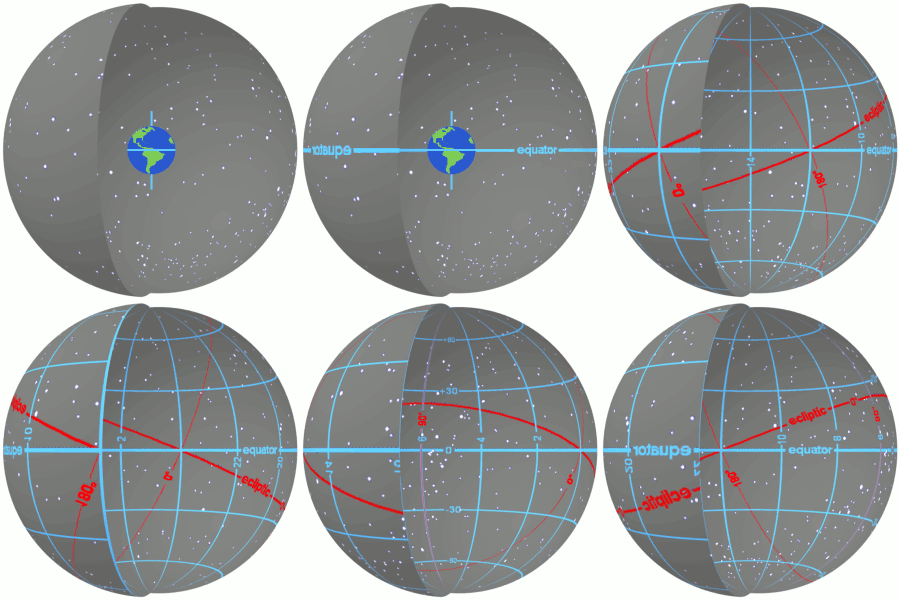
In astronomy, declination (abbreviated dec; symbol δ) is one of the two angles that locate a point on the celestial sphere in the equatorial coordinate system, the other being hour angle. The declination angle is measured north (positive) or south (negative) of the celestial equator, along the hour circle passing through the point in question.
The root of the word declination (Latin, declinatio) means "a bending away" or "a bending down". It comes from the same root as the words incline ("bend forward") and recline ("bend backward").
In some 18th and 19th century astronomical texts, declination is given as North Pole Distance (N.P.D.), which is equivalent to 90 – (declination). For instance an object marked as declination −5 would have an N.P.D. of 95, and a declination of −90 (the south celestial pole) would have an N.P.D. of 180.
Declination in astronomy is comparable to geographic latitude, projected onto the celestial sphere, and right ascension is likewise comparable to longitude. Points north of the celestial equator have positive declinations, while those south have negative declinations. Any units of angular measure can be used for declination, but it is customarily measured in the degrees (°), minutes (′), and seconds (″) of sexagesimal measure, with 90° equivalent to a quarter circle. Declinations with magnitudes greater than 90° do not occur, because the poles are the northernmost and southernmost points of the celestial sphere.
An object at the
The sign is customarily included whether positive or negative.
The Earth's axis rotates slowly westward about the poles of the ecliptic, completing one circuit in about 26,000 years. This effect, known as precession, causes the coordinates of stationary celestial objects to change continuously, if rather slowly. Therefore, equatorial coordinates (including declination) are inherently relative to the year of their observation, and astronomers specify them with reference to a particular year, known as an epoch. Coordinates from different epochs must be mathematically rotated to match each other, or to match a standard epoch.
The currently used standard epoch is J2000.0, which is January 1, 2000 at 12:00 TT. The prefix "J" indicates that it is a Julian epoch. Prior to J2000.0, astronomers used the successive Besselian Epochs B1875.0, B1900.0, and B1950.0.
Declination
In astronomy, declination (abbreviated dec; symbol δ) is one of the two angles that locate a point on the celestial sphere in the equatorial coordinate system, the other being hour angle. The declination angle is measured north (positive) or south (negative) of the celestial equator, along the hour circle passing through the point in question.
The root of the word declination (Latin, declinatio) means "a bending away" or "a bending down". It comes from the same root as the words incline ("bend forward") and recline ("bend backward").
In some 18th and 19th century astronomical texts, declination is given as North Pole Distance (N.P.D.), which is equivalent to 90 – (declination). For instance an object marked as declination −5 would have an N.P.D. of 95, and a declination of −90 (the south celestial pole) would have an N.P.D. of 180.
Declination in astronomy is comparable to geographic latitude, projected onto the celestial sphere, and right ascension is likewise comparable to longitude. Points north of the celestial equator have positive declinations, while those south have negative declinations. Any units of angular measure can be used for declination, but it is customarily measured in the degrees (°), minutes (′), and seconds (″) of sexagesimal measure, with 90° equivalent to a quarter circle. Declinations with magnitudes greater than 90° do not occur, because the poles are the northernmost and southernmost points of the celestial sphere.
An object at the
The sign is customarily included whether positive or negative.
The Earth's axis rotates slowly westward about the poles of the ecliptic, completing one circuit in about 26,000 years. This effect, known as precession, causes the coordinates of stationary celestial objects to change continuously, if rather slowly. Therefore, equatorial coordinates (including declination) are inherently relative to the year of their observation, and astronomers specify them with reference to a particular year, known as an epoch. Coordinates from different epochs must be mathematically rotated to match each other, or to match a standard epoch.
The currently used standard epoch is J2000.0, which is January 1, 2000 at 12:00 TT. The prefix "J" indicates that it is a Julian epoch. Prior to J2000.0, astronomers used the successive Besselian Epochs B1875.0, B1900.0, and B1950.0.
Recent media
Recent media