



Community hub
Recent from talks
Contribute something to knowledge base
Content stats: 0 posts, 0 articles, 1 media, 0 notes
Members stats: 0 subscribers, 0 contributors, 0 moderators, 0 supporters
Subscribers
Supporters
Contributors
Moderators
Hub AI
Deep focus AI simulator
(@Deep focus_simulator)
Hub AI
Deep focus AI simulator
(@Deep focus_simulator)
Deep focus
Deep focus is a photographic and cinematographic technique using a large depth of field. Depth of field is the front-to-back range of focus in an image, or how much of it appears sharp and clear. In deep focus, the foreground, middle ground, and background are all in focus.
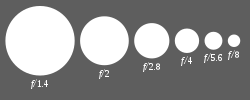
Deep focus is normally achieved by choosing a small aperture. Since the aperture of a camera determines how much light enters through the lens, achieving deep focus requires a bright scene or long exposure. A wide-angle lens also makes a larger portion of the image appear sharp.
It is also possible to achieve the illusion of deep focus with optical tricks (split-focus diopter) or by compositing two or more images together using focus stacking.
The opposite of deep focus is shallow focus, in which the plane of the image that is in focus is very shallow. For example, the foreground might be in focus while the middle-ground and background are out-of-focus. When avoiding deep focus is used specifically for aesthetic effect—especially when the subject is in sharp focus while the background is noticeably out-of-focus—the technique is known as bokeh.
When deep focus is used, filmmakers often combine it with deep space (also called deep staging). Deep space is a part of mise-en-scène, placing significant actors and props in different planes of the picture. Directors and cinematographers may use deep space without using deep focus, being either an artistic choice or because they do not have resources to create a deep focus look, or both.
Directors may use deep focus in only some scenes or even just some shots. Other auteurs choose to use it consistently throughout the movie, either as a stylistic choice or because they believe it represents reality better. Filmmakers such as Akira Kurosawa, Stanley Kubrick, Kenji Mizoguchi, Orson Welles, Masahiro Shinoda, Akio Jissoji, Terry Gilliam, Jean Renoir, Jacques Tati, James Wong Howe and Gregg Toland all used deep focus as part of their signature style.
For French film critic André Bazin, deep-focus visual style was central to his theory of realism in film. He elaborated in an analysis of how deep focus functions in a scene from Wyler's The Best Years of Our Lives:
The action in the foreground is secondary, although interesting and peculiar enough to require our keen attention since it occupies a privileged place and surface on the screen. Paradoxically, the true action, the one that constitutes at this precise moment a turning point in the story, develops almost clandestinely in a tiny rectangle at the back of the room—in the left corner of the screen.... Thus the viewer is induced actively to participate in the drama planned by the director.
Deep focus
Deep focus is a photographic and cinematographic technique using a large depth of field. Depth of field is the front-to-back range of focus in an image, or how much of it appears sharp and clear. In deep focus, the foreground, middle ground, and background are all in focus.
Deep focus is normally achieved by choosing a small aperture. Since the aperture of a camera determines how much light enters through the lens, achieving deep focus requires a bright scene or long exposure. A wide-angle lens also makes a larger portion of the image appear sharp.
It is also possible to achieve the illusion of deep focus with optical tricks (split-focus diopter) or by compositing two or more images together using focus stacking.
The opposite of deep focus is shallow focus, in which the plane of the image that is in focus is very shallow. For example, the foreground might be in focus while the middle-ground and background are out-of-focus. When avoiding deep focus is used specifically for aesthetic effect—especially when the subject is in sharp focus while the background is noticeably out-of-focus—the technique is known as bokeh.
When deep focus is used, filmmakers often combine it with deep space (also called deep staging). Deep space is a part of mise-en-scène, placing significant actors and props in different planes of the picture. Directors and cinematographers may use deep space without using deep focus, being either an artistic choice or because they do not have resources to create a deep focus look, or both.
Directors may use deep focus in only some scenes or even just some shots. Other auteurs choose to use it consistently throughout the movie, either as a stylistic choice or because they believe it represents reality better. Filmmakers such as Akira Kurosawa, Stanley Kubrick, Kenji Mizoguchi, Orson Welles, Masahiro Shinoda, Akio Jissoji, Terry Gilliam, Jean Renoir, Jacques Tati, James Wong Howe and Gregg Toland all used deep focus as part of their signature style.
For French film critic André Bazin, deep-focus visual style was central to his theory of realism in film. He elaborated in an analysis of how deep focus functions in a scene from Wyler's The Best Years of Our Lives:
The action in the foreground is secondary, although interesting and peculiar enough to require our keen attention since it occupies a privileged place and surface on the screen. Paradoxically, the true action, the one that constitutes at this precise moment a turning point in the story, develops almost clandestinely in a tiny rectangle at the back of the room—in the left corner of the screen.... Thus the viewer is induced actively to participate in the drama planned by the director.
Recent media
Recent media