
Recent from talks
Inguinal canal
Knowledge base stats:
Talk channels stats:
Members stats:
Inguinal canal
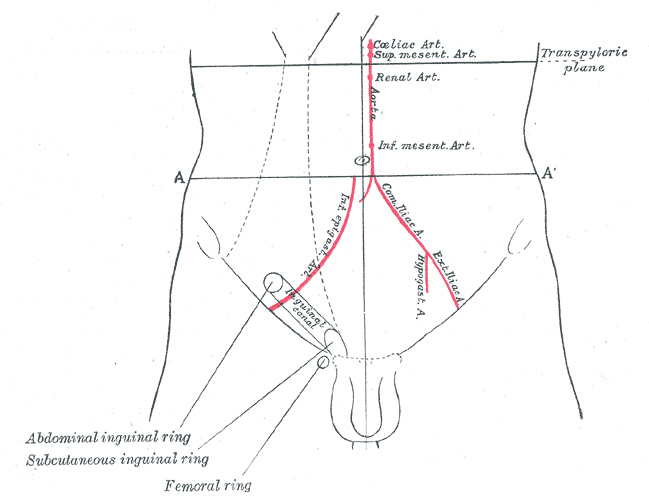
The inguinal canal is a passage in the anterior abdominal wall on each side of the body (one on each side of the midline), which in males, convey the spermatic cords and in females, the round ligament of the uterus. The inguinal canals are larger and more prominent in males.
The inguinal canals are situated just above the medial half of the inguinal ligament. The canals are approximately 4 to 6 cm long, angled anteroinferiorly and medially. In males, its diameter is normally 2 cm (±1 cm in standard deviation) at the deep inguinal ring.
A first-order approximation is to visualize each canal as a cylinder.
To help define the boundaries, these canals are often further approximated as boxes with six sides. Not including the two rings, the remaining four sides are usually called the "anterior wall", "inferior wall ("floor")", "superior wall ("roof")", and "posterior wall". These consist of the following:
The deep inguinal ring (internal or deep abdominal ring, abdominal inguinal ring, internal inguinal ring, annulus abdominalis) is the entrance to the inguinal canal.
The surface marking of the deep inguinal ring is classically described as half an inch above the midpoint of the inguinal ligament.
However, the surface anatomy of the point is disputed. In a recent study, it was found to be in a region between the mid-inguinal point (situated midway between the anterior superior iliac spine and the pubic symphysis) and the midpoint of the inguinal ligament (i.e. midway between the anterior superior iliac spine and the pubic tubercle). Traditionally, either one of these two sites was claimed as its location. However, this claim is based upon the study's dissection of 52 cadavers, and may not reflect the live in vivo anatomy.
Some sources state that it is at the layer of the transversalis fascia.
Hub AI
Inguinal canal AI simulator
(@Inguinal canal_simulator)
Inguinal canal
The inguinal canal is a passage in the anterior abdominal wall on each side of the body (one on each side of the midline), which in males, convey the spermatic cords and in females, the round ligament of the uterus. The inguinal canals are larger and more prominent in males.
The inguinal canals are situated just above the medial half of the inguinal ligament. The canals are approximately 4 to 6 cm long, angled anteroinferiorly and medially. In males, its diameter is normally 2 cm (±1 cm in standard deviation) at the deep inguinal ring.
A first-order approximation is to visualize each canal as a cylinder.
To help define the boundaries, these canals are often further approximated as boxes with six sides. Not including the two rings, the remaining four sides are usually called the "anterior wall", "inferior wall ("floor")", "superior wall ("roof")", and "posterior wall". These consist of the following:
The deep inguinal ring (internal or deep abdominal ring, abdominal inguinal ring, internal inguinal ring, annulus abdominalis) is the entrance to the inguinal canal.
The surface marking of the deep inguinal ring is classically described as half an inch above the midpoint of the inguinal ligament.
However, the surface anatomy of the point is disputed. In a recent study, it was found to be in a region between the mid-inguinal point (situated midway between the anterior superior iliac spine and the pubic symphysis) and the midpoint of the inguinal ligament (i.e. midway between the anterior superior iliac spine and the pubic tubercle). Traditionally, either one of these two sites was claimed as its location. However, this claim is based upon the study's dissection of 52 cadavers, and may not reflect the live in vivo anatomy.
Some sources state that it is at the layer of the transversalis fascia.
Recent media