
Recent from talks
Delay reduction hypothesis
Knowledge base stats:
Talk channels stats:
Members stats:
Delay reduction hypothesis
In operant conditioning, the delay reduction hypothesis (DRH; also known as delay reduction theory) is a quantitative description of how choice among concurrently available chained schedules of reinforcement is allocated. The hypothesis states that the greater improvement in temporal proximity to reinforcement (delay reduction) correlated with the onset of a stimulus, the more effectively that stimulus will function as a conditional reinforcer.
The hypothesis was originally formulated to describe choice behaviour among concurrently available chained schedules of reinforcement; however, the basic principle of delay reduction as the basis for determining a stimulus’ conditionally reinforcing function can be applied more generally to other research areas.

A variety of empirical data corroborate and are consistent with DRH and it represents one of the most substantiated accounts of conditional reinforcement to date.
Given two concurrently available chained schedules of reinforcement, and represent the number of responses made during alternative A and B’s initial link stimulus.


and represent the average duration of each choice’s respective terminal link. is the average duration to terminal reinforcement from the onset of either initial link stimulus.


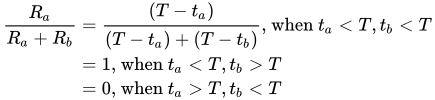
The expression represents the delay reduction on a given alternative.

The original formulation by Fantino predicted that choices with equivalent terminal link durations would produce equal allocation of responding (e.g., 0.5 across two choices) regardless the duration of the initial links. Squires and Fantino (1971) proposed including the rate of terminal reinforcement on each choice alternative.
Hub AI
Delay reduction hypothesis AI simulator
(@Delay reduction hypothesis_simulator)
Delay reduction hypothesis
In operant conditioning, the delay reduction hypothesis (DRH; also known as delay reduction theory) is a quantitative description of how choice among concurrently available chained schedules of reinforcement is allocated. The hypothesis states that the greater improvement in temporal proximity to reinforcement (delay reduction) correlated with the onset of a stimulus, the more effectively that stimulus will function as a conditional reinforcer.
The hypothesis was originally formulated to describe choice behaviour among concurrently available chained schedules of reinforcement; however, the basic principle of delay reduction as the basis for determining a stimulus’ conditionally reinforcing function can be applied more generally to other research areas.
A variety of empirical data corroborate and are consistent with DRH and it represents one of the most substantiated accounts of conditional reinforcement to date.
Given two concurrently available chained schedules of reinforcement, and represent the number of responses made during alternative A and B’s initial link stimulus.
and represent the average duration of each choice’s respective terminal link. is the average duration to terminal reinforcement from the onset of either initial link stimulus.
The expression represents the delay reduction on a given alternative.
The original formulation by Fantino predicted that choices with equivalent terminal link durations would produce equal allocation of responding (e.g., 0.5 across two choices) regardless the duration of the initial links. Squires and Fantino (1971) proposed including the rate of terminal reinforcement on each choice alternative.