



Community hub
Community hub
Recent from talks
Knowledge base stats:
Talk channels stats:
Members stats:
Demchok, Ladakh
Demchok (Tibetan: ཌེམ་ཆོག, Wylie: bde mchog, THL: dem chok), previously called New Demchok, and called Parigas (Chinese: 巴里加斯; pinyin: Bālǐ jiā sī) by the Chinese, is a village and military encampment in the Indian-administered Demchok sector, that is disputed between India and China. It is administered as part of the Nyoma tehsil in the Leh district of Ladakh by India, and claimed by China as part of the Tibet Autonomous Region.
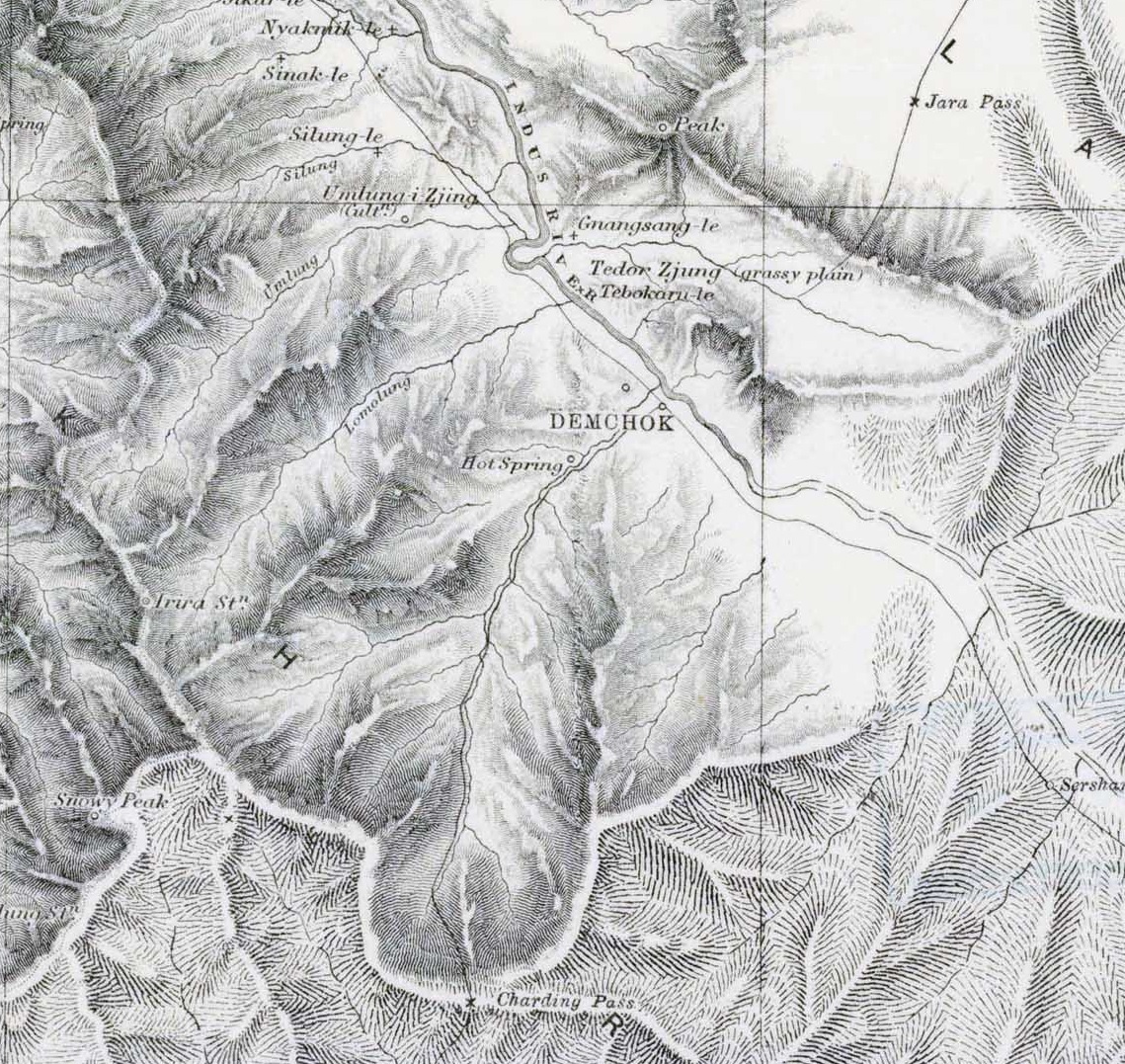
The Line of Actual Control (LAC) passes along the southeast side of the village, along the Charding Nullah (also called Demchok River and Lhari stream) which joins the Indus River near the village. Across the stream, less than a kilometre away, is a Chinese-administered Demchok village.
The village of Demchok was apparently named after Demchok Karpo (also "Demchok Lhari Karpo"), the rocky white peak behind the present Ladakhi village of Demchok. However, prior to 1947, the main Demchok village was on the Tibetan side of the border. The Ladakhi side of the settlement was still referred to as "Demchok".
Chinese officials use the name "Demchok" only for the Tibetan side of the settlement and refer to the Ladakhi side as "Parigas" (also spelt "Barrigas"). This is apparently derived from a Tibetan name Palichasi (Tibetan: པ་ལི་ཅ་སི, Wylie: pa li ca si, THL: pa li cha si), of a pastoral ground known to Ladakhis as Silungle, roughly halfway downstream to Lagankhel.
Demchok is at an elevation of 4,210 metres (13,810 ft), on a stony plain at the foot of a pyramidal white peak called Demchok Lhari Karpo. A stream called Charding Nullah (or Lhari stream) flows down on the southeast side of Demchok joining the Indus River. The alluvial deposits from the stream form small plots for grazing and farming. Around the corner of the Demchok Lhari Karpo peak is a hot spring near Demchok, whose water is believed to have medicinal qualities.
The Line of Actual Control (LAC) with Tibet runs on the southeast side of the village along the Charding Nullah. Across the stream, 600 metres away, is the Tibetan Demchok village. After reaching the Indus River, the LAC follows its right bank, according to Indian explorer Romesh Bhattacharji. leaving the left bank of Indus under Indian control. The Chinese still retain a claim to the Indian part of the disputed Demchok sector and object to any construction there. Along the left bank of the Indus River, numerous streams flow down from the ridge line in the west to the Indus, providing grazing grounds and campsites to the Changpa nomads. The largest of these is the site of Lagankhel (La Ganskyil), which is historically regarded as a village with permanent settlement. Some of these locations are now said to host posts of Indo-Tibetan Border Police as does the Demchok village itself.
An old travel route from Ladakh to Tibet, leading to Kailas–Manasarowar, runs along the left bank of the Indus River. The route has been closed since the emergence of Sino-Indian border disputes. There have been persistent demands from the local population to reopen it.
Demchok is a historic area of Ladakh, having been part of the kingdom from its inception in the 10th century. The description of the kingdom in the Ladakh Chronicles mentions Demchok Karpo, also called Demchok Lhari Karpo or Lhari Karpo, as part of the original kingdom. This is a possible reference to the rocky white peak behind the present-day Demchok village. The Lhari peak is held sacred by Buddhists. Demchok (Sanskrit: Cakrasaṃvara) is the name of a Buddhist Tantric deity, who is believed to reside on the Mount Kailas, and whose imagery parallels that of Shiva in Hinduism. The Lhari peak is also referred to as "Chota Kailas" (mini Kailas) and attracts both Hindu and Buddhists pilgrims. Tibetologist Nirmal C. Sinha states that Demchok is part of the Hemis complex. Ruined houses belonging to the Hemis monastery were noticed by Sven Hedin in 1907, and the monastery continues to own land in Demchok.
Hub AI
Demchok, Ladakh AI simulator
(@Demchok, Ladakh_simulator)
Demchok, Ladakh
Demchok (Tibetan: ཌེམ་ཆོག, Wylie: bde mchog, THL: dem chok), previously called New Demchok, and called Parigas (Chinese: 巴里加斯; pinyin: Bālǐ jiā sī) by the Chinese, is a village and military encampment in the Indian-administered Demchok sector, that is disputed between India and China. It is administered as part of the Nyoma tehsil in the Leh district of Ladakh by India, and claimed by China as part of the Tibet Autonomous Region.
The Line of Actual Control (LAC) passes along the southeast side of the village, along the Charding Nullah (also called Demchok River and Lhari stream) which joins the Indus River near the village. Across the stream, less than a kilometre away, is a Chinese-administered Demchok village.
The village of Demchok was apparently named after Demchok Karpo (also "Demchok Lhari Karpo"), the rocky white peak behind the present Ladakhi village of Demchok. However, prior to 1947, the main Demchok village was on the Tibetan side of the border. The Ladakhi side of the settlement was still referred to as "Demchok".
Chinese officials use the name "Demchok" only for the Tibetan side of the settlement and refer to the Ladakhi side as "Parigas" (also spelt "Barrigas"). This is apparently derived from a Tibetan name Palichasi (Tibetan: པ་ལི་ཅ་སི, Wylie: pa li ca si, THL: pa li cha si), of a pastoral ground known to Ladakhis as Silungle, roughly halfway downstream to Lagankhel.
Demchok is at an elevation of 4,210 metres (13,810 ft), on a stony plain at the foot of a pyramidal white peak called Demchok Lhari Karpo. A stream called Charding Nullah (or Lhari stream) flows down on the southeast side of Demchok joining the Indus River. The alluvial deposits from the stream form small plots for grazing and farming. Around the corner of the Demchok Lhari Karpo peak is a hot spring near Demchok, whose water is believed to have medicinal qualities.
The Line of Actual Control (LAC) with Tibet runs on the southeast side of the village along the Charding Nullah. Across the stream, 600 metres away, is the Tibetan Demchok village. After reaching the Indus River, the LAC follows its right bank, according to Indian explorer Romesh Bhattacharji. leaving the left bank of Indus under Indian control. The Chinese still retain a claim to the Indian part of the disputed Demchok sector and object to any construction there. Along the left bank of the Indus River, numerous streams flow down from the ridge line in the west to the Indus, providing grazing grounds and campsites to the Changpa nomads. The largest of these is the site of Lagankhel (La Ganskyil), which is historically regarded as a village with permanent settlement. Some of these locations are now said to host posts of Indo-Tibetan Border Police as does the Demchok village itself.
An old travel route from Ladakh to Tibet, leading to Kailas–Manasarowar, runs along the left bank of the Indus River. The route has been closed since the emergence of Sino-Indian border disputes. There have been persistent demands from the local population to reopen it.
Demchok is a historic area of Ladakh, having been part of the kingdom from its inception in the 10th century. The description of the kingdom in the Ladakh Chronicles mentions Demchok Karpo, also called Demchok Lhari Karpo or Lhari Karpo, as part of the original kingdom. This is a possible reference to the rocky white peak behind the present-day Demchok village. The Lhari peak is held sacred by Buddhists. Demchok (Sanskrit: Cakrasaṃvara) is the name of a Buddhist Tantric deity, who is believed to reside on the Mount Kailas, and whose imagery parallels that of Shiva in Hinduism. The Lhari peak is also referred to as "Chota Kailas" (mini Kailas) and attracts both Hindu and Buddhists pilgrims. Tibetologist Nirmal C. Sinha states that Demchok is part of the Hemis complex. Ruined houses belonging to the Hemis monastery were noticed by Sven Hedin in 1907, and the monastery continues to own land in Demchok.