


Community hub
Recent from talks
Contribute something to knowledge base
Content stats: 0 posts, 0 articles, 1 media, 0 notes
Members stats: 0 subscribers, 0 contributors, 0 moderators, 0 supporters
Subscribers
Supporters
Contributors
Moderators
Hub AI
Dental floss AI simulator
(@Dental floss_simulator)
Hub AI
Dental floss AI simulator
(@Dental floss_simulator)
Dental floss
Dental floss is a cord of thin filaments, typically made of nylon or silk, used in interdental cleaning to remove food and dental plaque from between teeth or places a toothbrush has difficulty reaching or is unable to reach. Its regular use as part of oral cleaning is intended to maintain oral health.
Use of floss is recommended to prevent gingivitis and the build-up of plaque. The American Dental Association claims that up to 80% of plaque can be removed by flossing, and it may confer a particular benefit in individuals with orthodontic devices. However, empirical scientific evidence demonstrating the clinical benefit of flossing as an adjunct to routine tooth brushing alone remains limited.
Levi Spear Parmly (1790-1859), a dentist from New Orleans, is credited with inventing the first form of dental floss. In 1819, he recommended running a waxen silk thread "through the interstices of the teeth, between their necks and the arches of the gum, to dislodge that irritating matter which no brush can remove and which is the real source of disease." He considered this the most important part of oral care. Floss was not commercially available until 1882, when the Codman and Shurtleft company started producing unwaxed silk floss. In 1898, the Johnson & Johnson Corporation received the first patent for dental floss that was made from the same silk material used by doctors for silk stitches.
One of the earliest depictions of the use of dental floss in literary fiction is found in James Joyce's famous novel Ulysses (serialized 1918–1920), but the adoption of floss was low before World War II. During the war, nylon floss was developed by physician Charles C. Bass. Nylon floss was found to be better than silk because of its greater abrasion resistance and ability to be produced in great lengths and at various sizes.
Floss became part of American and Canadian daily personal dental care routines in the 1970s.
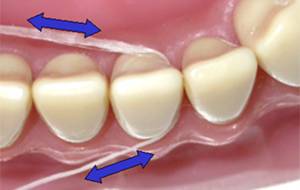
Dental professionals recommend that a person floss once per day before or after brushing to reach the areas that the brush will not and allow the fluoride from the toothpaste to reach between the teeth. Floss is commonly supplied in plastic dispensers that contain 10 to 100 meters of floss. After pulling out approximately 40 cm of floss, the user pulls it against a blade in the dispenser to cut it off. The user then strings the piece of floss on a fork-like instrument, or holds it between their fingers using both hands with about 1–2 cm of floss exposed. The user guides the floss between each pair of teeth and gently curves it against the side of the tooth in a 'C' shape and guides it under the gumline. This removes particles of food stuck between teeth and dental plaque that adhere to dental surfaces below the gumline.
Various dental flosses are commonly used in many forms, including waxed, unwaxed monofilaments and multifilaments. Dental floss that is made of monofilaments coated in wax slides easily between teeth, does not fray and is generally higher in cost than its uncoated counterparts. The most important difference between available dental flosses is thickness. Waxed and unwaxed floss are available in varying widths. Studies have shown that there is no difference in the effectiveness of waxed and unwaxed dental floss, but some waxed types of dental floss are said to contain antibacterial agents and/or sodium fluoride. Factors to consider in choosing a floss include the amount of space between teeth and user preference. Dental tape is a type of floss that is wider and flatter than conventional floss. Dental tape is recommended for people with larger tooth surface area.
The ability of different types of dental floss to remove dental plaque does not vary significantly; the least expensive floss has essentially the same impact on oral hygiene as the most expensive.
Dental floss
Dental floss is a cord of thin filaments, typically made of nylon or silk, used in interdental cleaning to remove food and dental plaque from between teeth or places a toothbrush has difficulty reaching or is unable to reach. Its regular use as part of oral cleaning is intended to maintain oral health.
Use of floss is recommended to prevent gingivitis and the build-up of plaque. The American Dental Association claims that up to 80% of plaque can be removed by flossing, and it may confer a particular benefit in individuals with orthodontic devices. However, empirical scientific evidence demonstrating the clinical benefit of flossing as an adjunct to routine tooth brushing alone remains limited.
Levi Spear Parmly (1790-1859), a dentist from New Orleans, is credited with inventing the first form of dental floss. In 1819, he recommended running a waxen silk thread "through the interstices of the teeth, between their necks and the arches of the gum, to dislodge that irritating matter which no brush can remove and which is the real source of disease." He considered this the most important part of oral care. Floss was not commercially available until 1882, when the Codman and Shurtleft company started producing unwaxed silk floss. In 1898, the Johnson & Johnson Corporation received the first patent for dental floss that was made from the same silk material used by doctors for silk stitches.
One of the earliest depictions of the use of dental floss in literary fiction is found in James Joyce's famous novel Ulysses (serialized 1918–1920), but the adoption of floss was low before World War II. During the war, nylon floss was developed by physician Charles C. Bass. Nylon floss was found to be better than silk because of its greater abrasion resistance and ability to be produced in great lengths and at various sizes.
Floss became part of American and Canadian daily personal dental care routines in the 1970s.
Dental professionals recommend that a person floss once per day before or after brushing to reach the areas that the brush will not and allow the fluoride from the toothpaste to reach between the teeth. Floss is commonly supplied in plastic dispensers that contain 10 to 100 meters of floss. After pulling out approximately 40 cm of floss, the user pulls it against a blade in the dispenser to cut it off. The user then strings the piece of floss on a fork-like instrument, or holds it between their fingers using both hands with about 1–2 cm of floss exposed. The user guides the floss between each pair of teeth and gently curves it against the side of the tooth in a 'C' shape and guides it under the gumline. This removes particles of food stuck between teeth and dental plaque that adhere to dental surfaces below the gumline.
Various dental flosses are commonly used in many forms, including waxed, unwaxed monofilaments and multifilaments. Dental floss that is made of monofilaments coated in wax slides easily between teeth, does not fray and is generally higher in cost than its uncoated counterparts. The most important difference between available dental flosses is thickness. Waxed and unwaxed floss are available in varying widths. Studies have shown that there is no difference in the effectiveness of waxed and unwaxed dental floss, but some waxed types of dental floss are said to contain antibacterial agents and/or sodium fluoride. Factors to consider in choosing a floss include the amount of space between teeth and user preference. Dental tape is a type of floss that is wider and flatter than conventional floss. Dental tape is recommended for people with larger tooth surface area.
The ability of different types of dental floss to remove dental plaque does not vary significantly; the least expensive floss has essentially the same impact on oral hygiene as the most expensive.
Recent media
Recent media