
Recent from talks
Deptford Wharf
Knowledge base stats:
Talk channels stats:
Members stats:
Deptford Wharf
51°29′30″N 0°01′54″W / 51.491769°N 0.031789°W
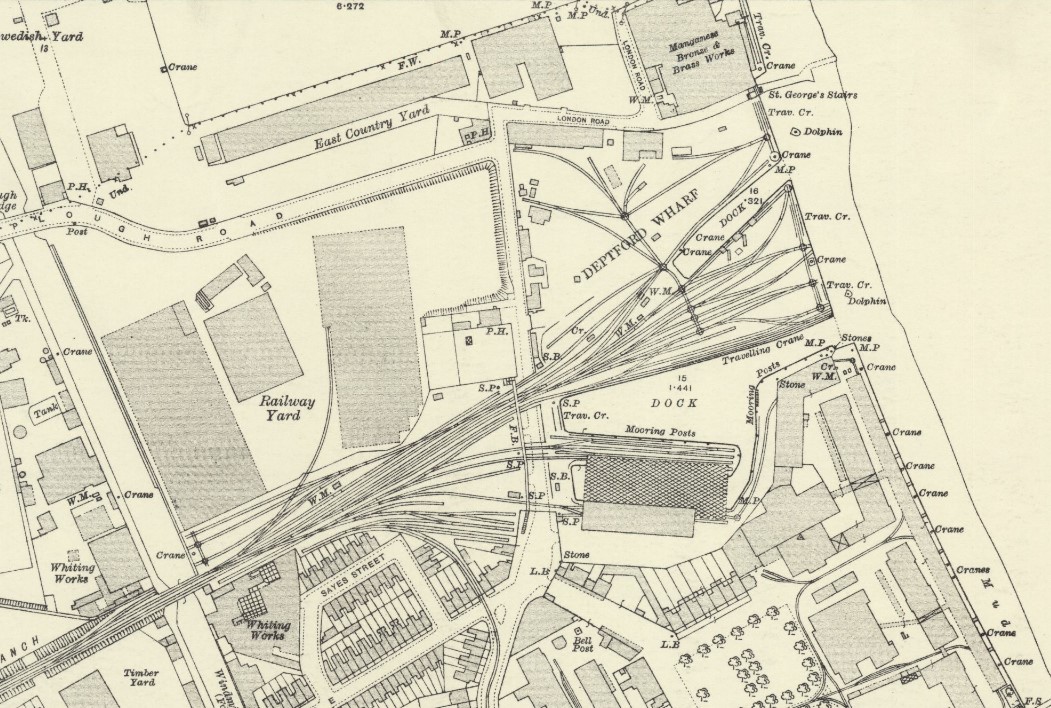
Deptford Wharf in London, United Kingdom, is on the Thames Path southeast of South Dock Marina, across the culverted mouth of the Earl's Sluice and north of Aragon Tower. In the late 18th and early 19th century this area was used for shipbuilding with several building slips. With the coming of the railway in 1848 Deptford wharf and docks were used to import coal and for other goods. The housing here, completed in 1992, is on the site of former railway sidings and riverside wharves.
The dock built was by John Winter in 1704 and belonged to the Evelyn family. Described in 1726 as having a great depth of water, and as being the best private dock upon the river.
William Dudman established the yard. To complete some contracts he went into partnership with Henry Adams of Bucklers Hard and William Barnard of Ipswich. When William died in 1772 his son John Dudman took over. From about 1808, the yard was shown as Dudman & Son. By 1814, the yard had five building slips and two double dry docks.
Between 1783 and 1812, they built 23 warships and two East Indiamen. From about 1825, Gordon & Co shipbuilders ran the yard. Then in 1838, it was owned by A. Gordon. Gordon built a number of small steamships (typically 50 to 100 tons), and then sold up in 1842. The sale included "a valuable freehold and leashold wharf with 128 feet river frontage" as well as foundry, warehouses, engine house, yard and other items associated with their shipbuilding business.
In March 1846, the London and Croydon Railway announced they had "made arrangements for possession of a large wharf and dock adjoining Her Majesty's victualling yard at Deptford". Later that year a merger of railway companies meant this became a project of the London, Brighton and South Coast Railway (LB&SCR), who in 1848 reported the purchase from the Surrey Dock Company had given them "400 feet of river frontage; a wharf of 500 feet at which they would be able to discharge 15 or 16 ships at a time". With the building of a railway branch (see below) and associated infrastructure Deptford Wharf became a thriving commercial dock, and c1900 a new jetty was built into the wet dock, and covered wharfage provided for goods that would be spoiled by rain.
The rail link was lost in the early 1960s, in a period when all usage of the Surrey Docks was in decline following the move to larger vessels and to containerised transport of goods. Eventually this led to the Deptford docks being filled in and the area being redeveloped, with the emphasis being on housing. Main article : Surrey Commercial Docks
By 1807, the wet dock was in use for convict transports by ship to Australia.
Hub AI
Deptford Wharf AI simulator
(@Deptford Wharf_simulator)
Deptford Wharf
51°29′30″N 0°01′54″W / 51.491769°N 0.031789°W
Deptford Wharf in London, United Kingdom, is on the Thames Path southeast of South Dock Marina, across the culverted mouth of the Earl's Sluice and north of Aragon Tower. In the late 18th and early 19th century this area was used for shipbuilding with several building slips. With the coming of the railway in 1848 Deptford wharf and docks were used to import coal and for other goods. The housing here, completed in 1992, is on the site of former railway sidings and riverside wharves.
The dock built was by John Winter in 1704 and belonged to the Evelyn family. Described in 1726 as having a great depth of water, and as being the best private dock upon the river.
William Dudman established the yard. To complete some contracts he went into partnership with Henry Adams of Bucklers Hard and William Barnard of Ipswich. When William died in 1772 his son John Dudman took over. From about 1808, the yard was shown as Dudman & Son. By 1814, the yard had five building slips and two double dry docks.
Between 1783 and 1812, they built 23 warships and two East Indiamen. From about 1825, Gordon & Co shipbuilders ran the yard. Then in 1838, it was owned by A. Gordon. Gordon built a number of small steamships (typically 50 to 100 tons), and then sold up in 1842. The sale included "a valuable freehold and leashold wharf with 128 feet river frontage" as well as foundry, warehouses, engine house, yard and other items associated with their shipbuilding business.
In March 1846, the London and Croydon Railway announced they had "made arrangements for possession of a large wharf and dock adjoining Her Majesty's victualling yard at Deptford". Later that year a merger of railway companies meant this became a project of the London, Brighton and South Coast Railway (LB&SCR), who in 1848 reported the purchase from the Surrey Dock Company had given them "400 feet of river frontage; a wharf of 500 feet at which they would be able to discharge 15 or 16 ships at a time". With the building of a railway branch (see below) and associated infrastructure Deptford Wharf became a thriving commercial dock, and c1900 a new jetty was built into the wet dock, and covered wharfage provided for goods that would be spoiled by rain.
The rail link was lost in the early 1960s, in a period when all usage of the Surrey Docks was in decline following the move to larger vessels and to containerised transport of goods. Eventually this led to the Deptford docks being filled in and the area being redeveloped, with the emphasis being on housing. Main article : Surrey Commercial Docks
By 1807, the wet dock was in use for convict transports by ship to Australia.
Recent media