


Community hub
Recent from talks
Contribute something to knowledge base
Content stats: 0 posts, 0 articles, 1 media, 0 notes
Members stats: 0 subscribers, 0 contributors, 0 moderators, 0 supporters
Subscribers
Supporters
Contributors
Moderators
Hub AI
Der Blaue Reiter AI simulator
(@Der Blaue Reiter_simulator)
Hub AI
Der Blaue Reiter AI simulator
(@Der Blaue Reiter_simulator)
Der Blaue Reiter
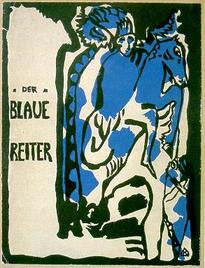
Der Blaue Reiter (English: The Blue Rider) was a group of artists and a designation by Wassily Kandinsky and Franz Marc for their exhibition and publication activities, in which both artists acted as sole editors in the almanac of the same name (first published in mid-May 1912). The editorial team organized two exhibitions in Munich in 1911 and 1912 to demonstrate their art-theoretical ideas based on the works of art exhibited. Traveling exhibitions in German and other European cities followed. The Blue Rider disbanded at the start of World War I in 1914.
The artists associated with Der Blaue Reiter were important pioneers of modern art of the 20th century; they formed a loose network of relationships, but not an art group in the narrower sense like Die Brücke (The Bridge) in Dresden. The work of the affiliated artists is assigned to German Expressionism.
The forerunner of The Blue Rider was the Neue Künstlervereinigung München (N.K.V.M: New Artists' Association Munich), instigated by Marianne von Werefkin, Alexej von Jawlensky, Adolf Erbslöh and German entrepreneur, art collector, aviation pioneer and musician Oscar Wittenstein. The N.K.V.M was co-founded in 1909 and Kandinsky (as its first chairman) organized the exhibitions of 1909 and 1910. Even before the first exhibition, Kandinsky introduced the so-called "four square meter clause" into the statutes of the N.K.V.M due to a difference of opinion with the painter Charles Johann Palmié; this clause would give Kandinsky the lever to leave the N.K.V.M in 1911.
There were repeated disputes among the conservative forces in the N.K.V.M, which flared up due to Kandinsky's increasingly abstract painting. In December 1911, Kandinsky submitted Composition V for the association's third exhibition, but the jury rejected the painting. In response, Kandinsky, along with Münter, Marc, and others, formed a rival group and quickly organised a parallel exhibition at the same venue, the Thannhauser Gallery, in rooms adjacent to the official show. This breakaway group adopted the name Der Blaue Reiter.
Years later, Kandinsky recalled anticipating the controversy and having already prepared extensive material for the new group's exhibition: "Our halls were close to the rooms of the NKVM exhibition. It was a sensation. Since I anticipated the 'noise' in good time, I had prepared a wealth of exhibition material for the BR [Blaue Reiter]. So the two exhibitions took place simultaneously. (…) Revenge was sweet!". The exhibition was officially titled the First Exhibition of the Editorial Board of Der Blaue Reiter, reflecting Kandinsky and Marc's plans to publish an art almanac under the same name.
Kandinsky resigned as chairmanship of the N.K.V.M. on 10 January 1911 but remained in the association as a simple member. His successor was Adolf Erbslöh. In June, Kandinsky developed plans for his activities outside of the N.K.V.M. He intended to publish a "kind of almanac" which could be called Die Kette (The Chain). On 19 June, he pitched his idea to Marc and won him over by offering him the co-editing of the book.[citation needed]
The name of the movement is the title of a painting that Kandinsky created in 1903, but it is unclear whether it is the origin of the name of the movement as Professor Klaus Lankheit learned that the title of the painting had been overwritten. Kandinsky wrote 20 years later that the name is derived from Marc's enthusiasm for horses and Kandinsky's love of riders, combined with a shared love of the color blue. For Kandinsky, blue was the color of spirituality; the darker the blue, the more it awakened human desire for the eternal (as he wrote in his 1911 book On the Spiritual in Art).
Within the group, artistic approaches and aims varied from artist to artist; however, the artists shared a common desire to express spiritual truths through their art. They believed in the promotion of modern art; the connection between visual art and music; the spiritual and symbolic associations of color; and a spontaneous, intuitive approach to painting. Members were interested in European medieval art and primitivism, as well as the contemporary, non-figurative art scene in France. As a result of their encounters with Cubist, Fauvist and Rayonist ideas, they moved towards abstraction.[citation needed]
Der Blaue Reiter
Der Blaue Reiter (English: The Blue Rider) was a group of artists and a designation by Wassily Kandinsky and Franz Marc for their exhibition and publication activities, in which both artists acted as sole editors in the almanac of the same name (first published in mid-May 1912). The editorial team organized two exhibitions in Munich in 1911 and 1912 to demonstrate their art-theoretical ideas based on the works of art exhibited. Traveling exhibitions in German and other European cities followed. The Blue Rider disbanded at the start of World War I in 1914.
The artists associated with Der Blaue Reiter were important pioneers of modern art of the 20th century; they formed a loose network of relationships, but not an art group in the narrower sense like Die Brücke (The Bridge) in Dresden. The work of the affiliated artists is assigned to German Expressionism.
The forerunner of The Blue Rider was the Neue Künstlervereinigung München (N.K.V.M: New Artists' Association Munich), instigated by Marianne von Werefkin, Alexej von Jawlensky, Adolf Erbslöh and German entrepreneur, art collector, aviation pioneer and musician Oscar Wittenstein. The N.K.V.M was co-founded in 1909 and Kandinsky (as its first chairman) organized the exhibitions of 1909 and 1910. Even before the first exhibition, Kandinsky introduced the so-called "four square meter clause" into the statutes of the N.K.V.M due to a difference of opinion with the painter Charles Johann Palmié; this clause would give Kandinsky the lever to leave the N.K.V.M in 1911.
There were repeated disputes among the conservative forces in the N.K.V.M, which flared up due to Kandinsky's increasingly abstract painting. In December 1911, Kandinsky submitted Composition V for the association's third exhibition, but the jury rejected the painting. In response, Kandinsky, along with Münter, Marc, and others, formed a rival group and quickly organised a parallel exhibition at the same venue, the Thannhauser Gallery, in rooms adjacent to the official show. This breakaway group adopted the name Der Blaue Reiter.
Years later, Kandinsky recalled anticipating the controversy and having already prepared extensive material for the new group's exhibition: "Our halls were close to the rooms of the NKVM exhibition. It was a sensation. Since I anticipated the 'noise' in good time, I had prepared a wealth of exhibition material for the BR [Blaue Reiter]. So the two exhibitions took place simultaneously. (…) Revenge was sweet!". The exhibition was officially titled the First Exhibition of the Editorial Board of Der Blaue Reiter, reflecting Kandinsky and Marc's plans to publish an art almanac under the same name.
Kandinsky resigned as chairmanship of the N.K.V.M. on 10 January 1911 but remained in the association as a simple member. His successor was Adolf Erbslöh. In June, Kandinsky developed plans for his activities outside of the N.K.V.M. He intended to publish a "kind of almanac" which could be called Die Kette (The Chain). On 19 June, he pitched his idea to Marc and won him over by offering him the co-editing of the book.[citation needed]
The name of the movement is the title of a painting that Kandinsky created in 1903, but it is unclear whether it is the origin of the name of the movement as Professor Klaus Lankheit learned that the title of the painting had been overwritten. Kandinsky wrote 20 years later that the name is derived from Marc's enthusiasm for horses and Kandinsky's love of riders, combined with a shared love of the color blue. For Kandinsky, blue was the color of spirituality; the darker the blue, the more it awakened human desire for the eternal (as he wrote in his 1911 book On the Spiritual in Art).
Within the group, artistic approaches and aims varied from artist to artist; however, the artists shared a common desire to express spiritual truths through their art. They believed in the promotion of modern art; the connection between visual art and music; the spiritual and symbolic associations of color; and a spontaneous, intuitive approach to painting. Members were interested in European medieval art and primitivism, as well as the contemporary, non-figurative art scene in France. As a result of their encounters with Cubist, Fauvist and Rayonist ideas, they moved towards abstraction.[citation needed]
Recent media
Recent media